

Quick facts by PokerStrategy
- Middle position (MP) sits between early and late positions at a poker table.
- MP gives more strategic flexibility than early position, but less than late position.
- Seat allocation will vary depending on table size (6-max or 9-max, for instance).
- Middle position knowledge will likely have maximum hand selection and wagering possibilities.
What Is Middle Position in Poker?
Middle position in poker includes those seats between early position and late position at the table. Table size dictates that there are fewer or more seats classified as middle position.
In a standard 9-handed online poker game or live table, middle position are seats 4-6, which are seats to the right of the small blind when moving in a clockwise direction. These seats are typically MP1, MP2, and sometimes Hijack (which sits on the borderline of middle position and late position).
In a 9-max table (nine players), the positions break down as follows:
- Early Position (EP): UTG (Under the Gun), UTG+1
- Middle Position (MP): MP1, MP2, Hijack
- Late Position (LP): Cutoff, Button
- Blinds: Small Blind, Big Blind
In a 6-max table (six players), the middle position is less distinct. Typically, the Hijack is considered MP, with the Cutoff and Button serving as late positions.
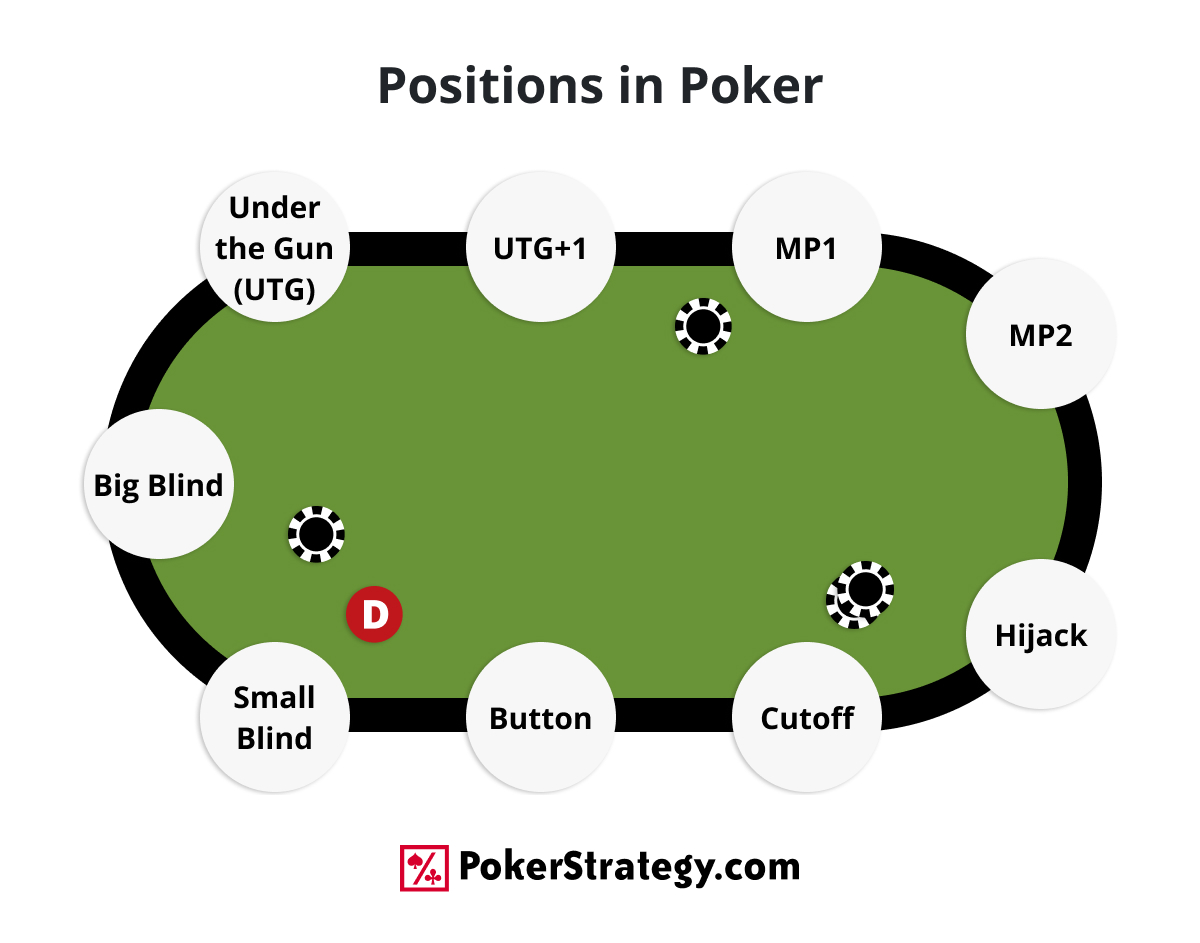
Thus, the middle position in poker definition is all about relative seating and its effect on the betting order. Players in MP act after early position players, providing a mix of informational advantage and risk that will invariably influence betting strategies.
Understanding Poker Positions
Position plays a crucial role in poker strategy. When you act later in the betting round, you gain a valuable advantage – you get to see what your opponents do before making your own decisions. This information makes it easier to choose when to bet, fold, or bluff.
Poker positions are usually grouped into four categories:
- Early Position (EP): Players who act first after the blinds. These players have the least information and need tighter hand ranges.
- Middle Position (MP): Players seated after EP but before LP. This group can widen ranges compared to EP.
- Late Position (LP): Includes the Cutoff and Button. These are the most advantageous positions due to the maximum amount of information.
- Blinds: Small Blind and Big Blind act last pre-flop but first post-flop, placing them at a post-flop disadvantage.
How Middle Position Affects Poker Strategy
The significance of middle position lies in its dual nature – it’s stronger than early position but not as advantageous as late position. Players in MP can take advantage of weak actions from early players while avoiding over-aggressive late position steal attempts. The middle position serves as a bridge between tight and loose play.
Advantages:
- Opportunity to observe multiple early players’ actions.
- Ability to open a broader range of hands than from EP.
- Possibility to isolate limpers or weak raises.
Disadvantages:
- Risk of strong raises from later positions.
- Vulnerability to 3-bets when opening too wide.
- Uncertainty in multiway pots when out of position post-flop.
Middle Position Example
In a 9-handed game, if you are seated in seat 5, you are likely MP2. A player in UTG+1 folds, and you are next to act. You see Ace-Jack offsuit. This hand may be too risky in early position but is solid in middle position, allowing you to open the betting or raise over a limper.
Recommended Hands to Play from Middle Position
The range of hands you can profitably play from middle position is wider than early position, but still requires caution.
A recommended MP opening range may include:
- Premium hands: AA–TT, AK, AQ.
- Broadway hands: AJs–ATs, KQs–KTs, QJs–QTs.
- Suited connectors: 98s, 87s, 76s.
- Pocket pairs: 99–55.
- Selective steals: You can begin with lesser suited Aces (such as A9s) or one-gappers suited.
In tournaments or softer cash games, these ranges can expand or tighten, depending on the table dynamics.
How to Play Middle Position in Online Poker
In online Hold’em games on top-rated poker apps, which run more frequently at faster speeds and with more player action, mid-position strategy will also need to bend. Players online will bluff and 3-bet more regularly, and staying solid will hold up.
To play middle position effectively in online poker, consider the following adjustments:
- Open with tighter ranges at aggressive tables to avoid 3-bet traps.
- Exploit limpers from early position with value raises or isolation.
- Pay attention to HUD stats or the betting patterns of players behind you.
- Avoid flat-calling marginal hands that perform poorly out of position post-flop.
The key difference online is volume: you can gather statistics and tendencies quickly, helping refine your middle position strategy with data.
Middle Position vs Early and Late Position
Middle position in poker explained through a clear chart can help you quickly understand how position affects your hand selection and overall strategy at the table:
| Feature | Early Position | Middle Position | Late Position |
|---|---|---|---|
| Number of Players After | 6–8 (9-max) | 4–6 (9-max) | 2–3 (9-max) |
| Hand Selection | Very tight | Moderately tight | Loose, especially on Button |
| Strategic Risk | High | Moderate | Low |
| Bluff Potential | Low | Moderate | High |
The middle position in poker shifts as table sizes change, but it consistently offers moderate flexibility. Compared to early position, you can enter more pots and apply more pressure. Compared to late position, you still face positional disadvantages post-flop.
Common Mistakes to Avoid from Middle Position
- Overplaying Marginal Hands: Hands like A9 offsuit or KJo should often be folded in middle position, especially if aggressive players remain behind.
- Ignoring Player Tendencies: If late position players 3-bet frequently, adjust your opening ranges accordingly.
- Limping or Flat Calling Too Often: These plays from MP can lead to bloated pots with poor position and hand strength.
- Failing to Re-Evaluate Post-Flop: Being out of position against late players post-flop requires careful hand reading and often tighter play.
- Assuming MP is Always Neutral: Some MP seats are closer to EP (MP1) and should be treated more cautiously than borderline LP seats like the Hijack.
By understanding middle position thoroughly and adapting range selection, bet size, and aggression, the neutral seat also turns out to be a money seat. It lacks full privilege of late position, but more power and mobility compared to early seats held; thus, a middle position poker strategy forms a cornerstone of a winner.
Frequently Asked Questions
What hands should you fold from MP?
Hands like offsuit Aces below A10, weak suited connectors (e.g., 65s), and small offsuit Broadway hands (like QJo) are usually folds in middle position, especially at full tables.
How does MP differ between live and online poker?
Live cards are usually slower and looser, so relatively wider MP tables are acceptable. Online games are faster and more aggressive, and tighter and better-balanced MP styles are needed.
How does the middle position affect poker odds?
The middle position does not affect raw probabilities, but affects EV. This is because there are strategic drawbacks compared to a late position, but strategic strengths compared to an early position.
Should you play more hands from middle position?
Yes, more in earlier positions, but less often when out of position. You will, selectively, depending on opponents and stack sizes, want to increase your range.
Does middle position apply to all variants of poker?
Yes, but its impact varies. In Texas Hold’em and Omaha, position plays a major role. In games like Stud or Razz, betting order may change by street, affecting the concept of middle position.