

Preflop
In This Guide
Quick Facts by PokerStrategy
- Preflop in poker is the stage of a hand before the community cards are revealed.
- Players are dealt hole cards, and the first betting round takes place.
- Hand selection is one of the most important aspects of preflop poker strategy.
- Preflop ranges should be adjusted according to position, stack sizes, and opponents.
What is Preflop in Poker?
Preflop in poker is the stage of a hand that occurs before the first three community cards are dealt.
The blinds are posted, and all players are dealt two private hole cards. This is followed by the preflop betting round, when players have their first opportunity to act by raising, calling, or folding.
In this stage of the hand, the action starts with the player to the left of the big blind and moves clockwise around the table. After the betting round is complete, the preflop stage ends, and the flop is dealt.
Preflop Strategy Basics
During the preflop round, players are betting based on the relative strength of their hole cards. If your cards are weak, it’s best to fold and wait for a better hand, especially if you are out of position. With this said, when you have a playable hand, you’ll usually be entering the pot with a raise.
This approach is especially important when playing on online poker sites, where faster gameplay and tougher opponents punish loose or passive preflop decisions.
An aggressive preflop poker strategy with solid preflop ranges will set you up for the rest of the hand. In the next section, we’ll break down the core betting moves, positional ranges, and stack-size considerations.
Preflop Betting Moves
Here are the betting moves you will most commonly make preflop in poker, along with a short explanation of each:
- Open raising: If the action folds to you, it’s recommended that you open-raise the hands you choose to play preflop. The standard preflop raise size is 2-3 big blinds.
- Stealing: As the blinds rise in tournament poker, it’s profitable to steal pots preflop by raising light from late position.
- Limping: Involves betting the minimum, one big blind. It’s generally considered a weak move and can be easily exploited by competent opponents.
- Iso raising: When someone limps into the pot, you can raise to isolate the player, who will potentially be out of position with a weak hand.
- Flat calling: Calling a raise can be effective when you are in position or defending your big blind, even with speculative hands.
- Three-betting: Three-betting is a powerful move that you can execute for value with strong hands or as a bluff against opponents who are raising a lot of hands.
- Fold: Folding is the best move to make preflop if you have a weak or unplayable hand.
Knowing when to use each of these preflop actions is essential, as small mistakes at this stage can quickly snowball into costly decisions later in the hand.
Preflop Hand Selection
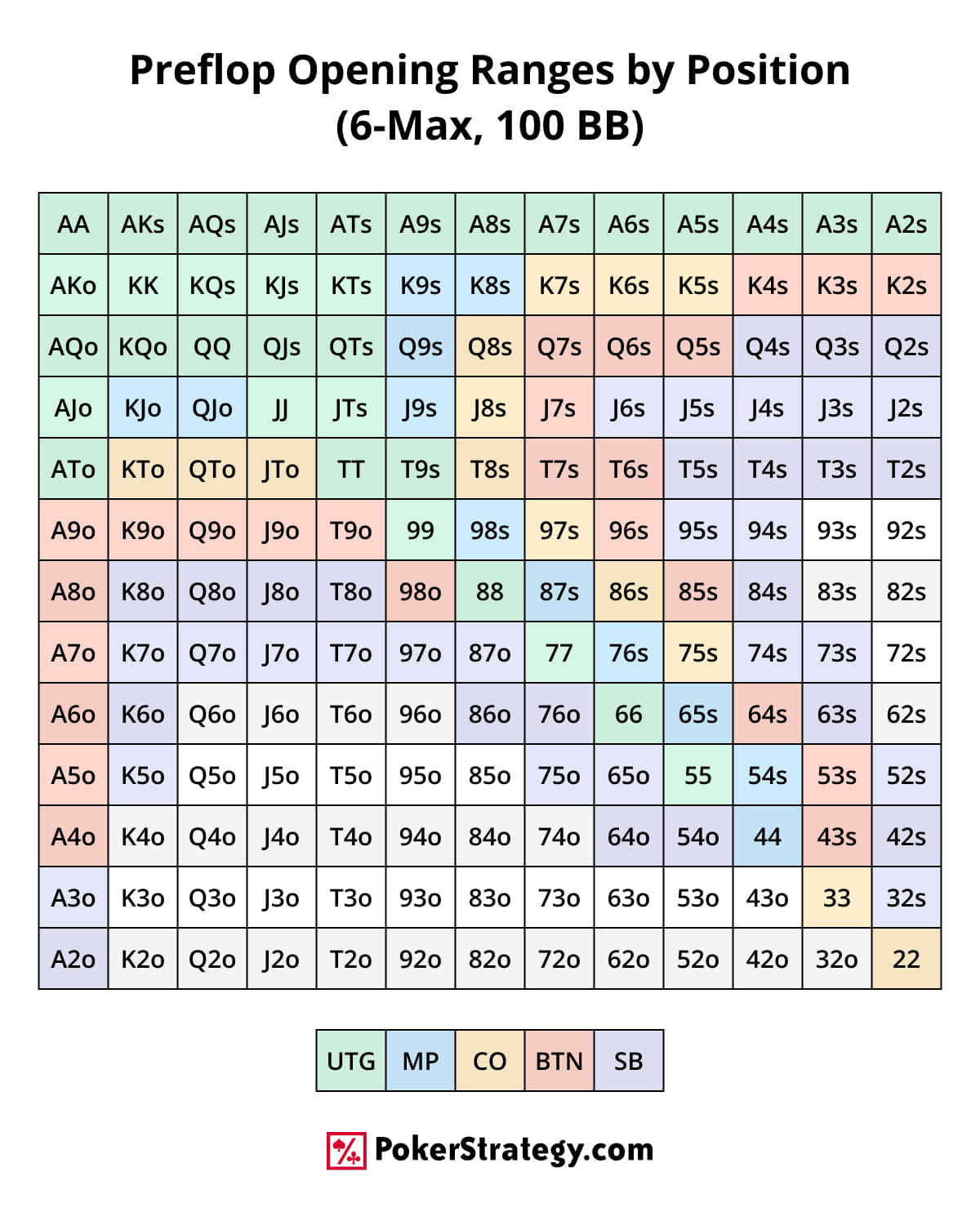
Your preflop hand selection should primarily be based on position, which you can then adjust according to factors like stack sizes and opponent tendencies. Here’s a quick guide to positional ranges:
- Early position: Raise a tight range that includes premium hands like medium to big pocket pairs, broadways, and a few speculative hands.
- Middle position: Raise a fairly tight range that includes early position hands, plus a few extras that play well, like KTs and QTs, as well as strong suited connectors like JTs and T9s.
- Late position: Raise a wide range of hands that include all pairs, broadways, suited aces, suited kings, most offsuit aces and kings, suited connectors, one-gap suited connectors, and some weaker hands.
By adjusting your starting hands based on position and game conditions, you give yourself a much better chance of playing profitable hands postflop.
Preflop in Different Poker Variants
Preflop is a concept used in poker games that feature community cards.
In these formats, such as Hold’em and Omaha, players receive their private cards first and make their initial betting decisions before any shared cards are revealed.
On the other hand, in variants like Stud and Razz, which don’t have community cards, the first betting round is known as third street. In Draw, it is known as the pre-draw round.
Preflop Charts & Tools
There are a number of tools available that you can use to improve your preflop poker strategy.
Equity calculators can be used to analyse hand strengths against particular ranges, while solvers can be used to figure out tough situations or review tough preflop spots. For beginners, we recommend starting with poker hand charts, which are constructed from GTO ranges. Poker preflop charts give you a visual guide showing you which hands to play from each position. You can learn them as a baseline for your preflop play.
The most essential preflop ranges to learn include push-fold for short stacks, as well as open-raising ranges from each position. Then, you can move on to three-betting.
Below are starting hand charts that illustrate standard open-raising ranges from all positions in 6-max cash games when playing 100 big blinds deep.
Common Preflop Mistakes to Avoid
The preflop betting round is arguably the most important stage in a poker hand. Here are some common preflop mistakes to avoid:
- Playing too many hands: Playing too many hands will land you in awkward and costly spots postflop, especially if you are in early position.
- Limping pots: Limping is a weak, passive play. You invite other players into the pot, who can call or raise behind you, and you give up initiative postflop.
- Bet sizing: Betting too much will price weak hands out of the pot, while betting an inconsistent amount can give away your hand strength.
- Three-betting in the wrong spots: Three-betting is very costly when you get it wrong, such as attempting to three-bet bluff into a strong early position raise.
- Not adjusting to opponents: Other players at the table will differ in the hands they raise or call with preflop. If you don’t adjust, you’ll miss opportunities to bet or spots where you should fold.
Cleaning up these preflop errors alone can dramatically improve your win rate before you even reach the flop.
4 Preflop Betting Tips for Beginners
If you’re new to poker, focusing on a few simple preflop principles will help you avoid trouble and play more confidently:
- Play tight from early position: Only open strong hands from early position, such as premium pairs (Aces, Kings, Queens) and strong Broadway hands. This reduces the risk of running into stronger hands later in the hand.
- Open wider from late position: When you’re on the button or cutoff, you can open a wider range of hands, including suited connectors, weaker aces, and smaller pairs. Late position gives you more information and control over the pot.
- Adjust your bet sizing: Use consistent raise sizes based on your position and stack size. A standard 2–3 big blind open-raise works for cash games, while tournament play may require slightly larger sizing to account for antes and shorter stacks.
- Avoid limping: Limping (just calling the big blind) is usually a weak preflop play. It gives other players cheap chances to see the flop, forfeits initiative, and often leads to tricky postflop situations.
Master these basics first, then use poker preflop charts to gradually expand your preflop ranges as your experience grows.