

Quick facts by PokerStrategy
- Under the Gun (UTG) is the initial player to act preflop in Texas Hold’em or Omaha.
- Being UTG is the most challenging seat at the table due to the lack of information.
- Adapting strategically while playing from the UTG seat is crucial to avoid costly blunders.
- UTG ranges are the tightest of any position due to the position disadvantage.
What Is Under the Gun (UTG) in Poker?
“Under the gun” is a poker term used to describe the initial acting player in a round of betting before the flop. In a full-ring Texas Hold’em game of 9 or 10 players, UTG is the first player to the left of the big blind. It is perhaps the most significant position in poker because UTG must act without knowing anything about the plans of the other players at the table.
So, what is under the gun in poker? The nomenclature describes a specific seat and its issue. Acting first in a round puts a player at a strategic disadvantage and requires a defensive hand choice strategy.
The phrase “under the gun” is a military term for being under fire or pressure. In poker, it’s used to capture the pressure the first-to-act player feels in every hand.
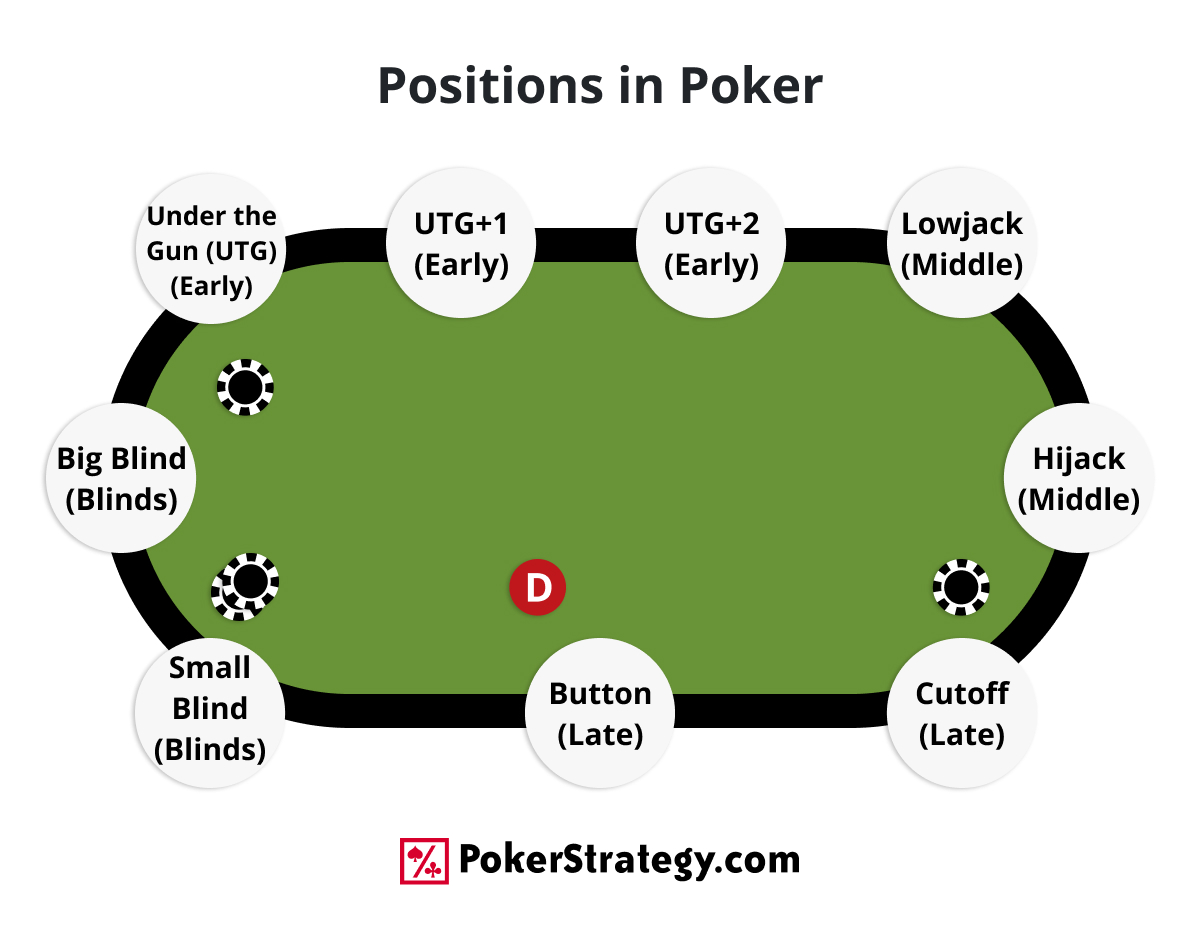
How UTG Works
In poker, position is everything. Being UTG means you are first to act in the preflop betting round.
Here’s how it typically breaks down at a 9-handed table:
| Position | Player |
|---|---|
| 1 | UTG (Under the Gun) |
| 2 | UTG+1 |
| 3 | UTG+2 |
| 4 | LJ (Lojack) |
| 5 | HJ (Hijack) |
| 6 | CO (Cutoff) |
| 7 | BTN (Button) |
| 8 | SB (Small Blind) |
| 9 | BB (Big Blind) |
The UTG player acts immediately after the big blind posts and must choose whether to fold, call, or raise. This decision is made without knowing how the rest of the table will respond.
Because UTG is first to act, it is considered the worst position at the poker table. All other players can respond based on your decision. Consequently, the UTG position demands a tighter and more cautious approach.
Under the Gun Poker Strategy
Playing from under the gun is fundamentally about tight, disciplined play.
Here are key strategic considerations for UTG:
1. Tight Opening Range
Since you are acting first, your range of hands should be stronger than from later positions. A standard UTG opening range in a 9-handed game might include:
- Pocket pairs: 88+.
- Broadway hands: AK, AQ (suited or offsuit), sometimes AJ suited.
- Suited connectors: Rarely – only the strongest (e.g., KQs).
Opening too wide from UTG is a common leak, especially for newer players. You’re more likely to face raises, calls, and 3-bets from later-position players with better information.
2. Raise Rather Than Limp
Limping, or open-limping from UTG, is almost always a bad idea. It invites multiple players to see a flop and exposes you to positional disadvantages post-flop. Always raise or fold from UTG. A standard raise size of 2.5x to 3x the big blind is typical in cash games.
3. Plan for 3-Bets
If you raise UTG and get re-raised (3-bet), you should have a clear plan. With premium hands (AA, KK, QQ, AK), you can continue or even 4-bet. With marginal hands (like AQ or JJ), you may need to fold to aggression depending on the opponent and stack depth.
4. Table Awareness
If you’re at a tight table, you can open slightly wider. If the table is loose and aggressive, tighten up even further. Adjust your range dynamically based on the playing tendencies of others.
Under the Gun in Poker Example
Let’s walk through a real-world UTG example:
- Game: $1/$2 No-Limit Hold’em (9-handed).
- You’re in UTG with A♦ Q♦.
- You raise to $6 (3x the BB).
- UTG+1 folds, but Hijack 3-bets to $18.
- Everyone else folds.
In this scenario, you need to evaluate the Hijack’s tendencies. If they’re tight, AQ might be a fold. If they’re loose or aggressive, calling or 4-betting could be viable. Being UTG makes your decision harder because you’re out of position for the rest of the hand.
UTG Advanced Considerations
In tournaments, UTG ranges depend heavily on stack size:
- Short-stacked (10–20 BB): Only shove premium hands (e.g., TT+, AQ+).
- Mid-stacked (30–50 BB): Open tighter, avoid speculative hands.
- Deep-stacked (100+ BB): Can add hands like KQs, 99, AJs.
Adjusting correctly to stack depth prevents chip spews and optimizes your tournament life.
Table Dynamics
At a passive table, opening UTG becomes slightly safer because you’re less likely to face a 3-bet. At aggressive tables, you may face a raise or isolation attempt frequently, requiring a stronger range.
Multi-Way Pot Risk
Hands played from UTG often result in multi-way pots, especially if you raise and get multiple callers. This reduces your equity with marginal hands. Favor high card strength and strong post-flop playability.
Reverse Implied Odds
Hands like small pocket pairs (e.g., 22–66) suffer from reverse implied odds when played UTG. If you hit a set, it’s not always easy to extract value or avoid cooler spots. Limit speculative hands to later positions where they perform better.
UTG in 6-Max Games
In 6-handed games, UTG becomes more dynamic. The first player to act is technically UTG, but the range opens up due to fewer players and reduced positional disadvantage.
Typical 6-max UTG open range:
- Pocket pairs: 66+.
- Broadways: AJo+, KQo+.
- Suited broadways: KJs+, QJs, Axs.
Here, being UTG isn’t as restrictive, but still demands solid hand selection.
UTG vs Other Positions
It’s important to always remember where you are in the hand in terms of betting. Failure to do so will invariably lead to disaster./p>
UTG vs Button
The Button is the strongest position in poker, allowing the player to act last post-flop. The contrast between UTG and Button is stark:
Because of this disparity, many players exploit UTG openers from the Button with frequent 3-bets.
| Position | Strength | Strategy |
|---|---|---|
| UTG | Weakest | Tight, cautious |
| Button | Strongest | Wide, aggressive |
UTG vs Cutoff
The Cutoff (right of the Button) is also a late position and allows more speculative opens. Where UTG may fold A9s, the Cutoff can raise it profitably.
Understanding what ‘under the gun’ means in poker is crucial for long-term success. It’s more than just a seat at the table; it dictates how tight or loose you should play and influences every action that follows. Players who master UTG strategy demonstrate discipline, awareness, and adaptability – all hallmarks of advanced poker skill.
From preflop hand selection to post-flop execution, being UTG challenges players to minimize risk while maximizing potential. Whether you’re playing live or on top-rated online poker sites, full-ring or 6-max, knowing how to act under the gun in poker separates average players from strategic thinkers.
Frequently Asked Questions
Where did the term “under the gun” originate?
The term comes from military slang, where a person “under the gun” is in a high-pressure situation or being fired upon. In poker, this phrase captures the pressure felt by the player who must act first in the hand.
When to raise under the gun?
You should raise UTG when you have strong starting hands, especially in full-ring games. Examples include:
- Premium pocket pairs (JJ+).
- High suited Broadway hands (AK, AQ).
- Occasionally suited Aces or strong connectors (in 6-max).
Avoid speculative or marginal hands that could land you in trouble post-flop.
What is the strongest position in poker?
The Button is the strongest position. The player on the Button acts last post-flop and can control pot size, steal more often, and gather more information before acting. In contrast, under the gun is the weakest position.