


The poker theory of everything
Grigoriy 'ahlinpoker' Skrypnik says that instead of giving poker players fish, we should give them a rod so that they can fish for themselves.
Some time ago I happened to translate a video announcement from a German coach, and it included this quote:
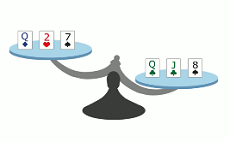
Pseudo- and semi-baked concepts such as Playability, Initiative, Position, Protection, Semibluffs, Action Killer Cards, Board Runouts, Perceived Range or Elastic Calling Ranges won the attention of the poker community, and the equity could only watch sadly as mathematical precision and thinking disappeared from the game.
This is a very eye-opening thought, yet it doesn't reveal the whole picture.
Let's brush it up
Most of you watched a poker training video at some point. The most popular formats are "live" play and session reviews. The producers demonstrate the practical aspects of their play, while commenting on the action. You will often hear something like: "I bet for value and protection in order not to let him draw for free, and to make my betting range non-polarised".
What a nightmare... 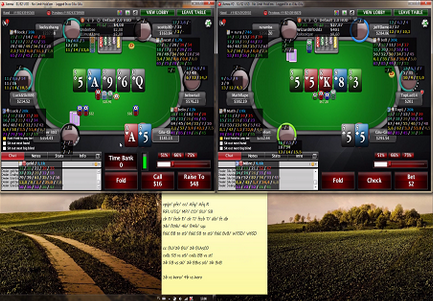 It's like when a teacher tries to explain basic maths to his class by using rocket science.
Saying something like this is better:
"I bet because my equity against my opponent's range is higher than 50%".
Both phrases mean pretty much the same thing, but only the second one explains the reasoning behind the bet, and only the second one will really teach students to make decisions not only in this particular spot but in all similar future spots. The second one gives them a rod so they can catch their own food, instead of a fish they can only eat once.
Although, it's still not enough. Let's say, a coach has a set on a wet board. In this case, his move is justified: he'll have 50+% equity against his opponent's range. But this is only one of many variations. The coach plays a narrowed-down range which derives from his chosen pre-flop range. A set is its better part. But what about the rest? If he says:

"This turn is good for our range, and we have the initiative after previously betting 75% of the pot. So here we should bet with 70% of our range, and this hand is obviously in it's value sub-range".
Every time when a coach explains his bet or his check he should say something like this. He should name the betting frequency and his goal – value or bluffing.
This is the simplest and most flexible poker rod. This is the whole poker, the whole GTO, The Nemesis concept. If we were previously betting, then usually we should continue. If we were previously calling, then usually we should keep calling. Remember those rules? They explain how to play in almost any spot. We only need to determine the betting frequency for a particular card: 75% or 65%, 80% or 50%. We already know that in total we should have X% frequency on all flops, turns and rivers. This is dictated by poker math when we choose to bet Y% of the pot.
You don't need a fish, you don't even need a rod

That's it! No pseudo concepts to drive you crazy. Honestly, I have pity for beginners trying to grasp the basics. Content producers drown them in a river of pseudo moves and pseudo strategies. Not many can really swallow and digest it all. Many are just confused.
This is why so many players are stuck at the micros. That's why at NL50 we see so many players c-betting in 80% of cases and leaving only 40% for a second barrel.
Poker education shouldn't supply a wide range of rods for all different kinds of fish (insert the infinite list of pseudo concepts here). And it shouldn't be one flexible rod either (GTO). It should supply tools of the trade (poker math) and teach players to make their own rods (frequency calculations).
