


Are the micro stakes too low to learn poker?
Can the stakes get so low that the lessons learned might hold you back, rather than progress, as a poker player?
While there is no doubt that there is a monumental gulf between micro stakes and Play Money, does how much money you start playing poker with make a big difference?
The motives to start at micro stakes are understandable. It’s the smallest financial risk you can take to cut your teeth at the game, under arguably the softest conditions. You don’t risk much and it doesn’t take as much effort to get better than the competition.
However, can the micro stakes be too small to take poker seriously? While it may be easier to turn a profit, many have a problem with discipline. As much as we try to distance ourselves from being results orientated, at the end of the day it’s much easier to motivate yourself to play and learn if the money means something. The wins have to be worth fighting for, and the losses have to hurt a little, in order to maintain the energy to keep playing. Nobody wants to 12-table for six hours a night for the prospect of winning $4.28.
The balance of challenge and skill
Paradoxically, if something is too easy, it can be harder to learn. There is actually quite a large body of research by psychologist Mihály Csíkszentmihályi on this very topic. He surmised that in order to perform at your peak, you needed to find the right balance of challenge and skill. A task had to be hard enough to keep you focussed, but your skill level needs to be sufficient enough to keep you from crumbling. If a task is too easy, or your skill level too high, you would get bored. If it was too difficult, you would likely collapse under the pressure.
The appropriate amount of skill and challenge will vary between people. Some of us need a big challenge to keep us motivated. Others need to feel secure in our own skillset and perform better when we have a big advantage. The chart below gives you an idea of what you yourself might lean towards.
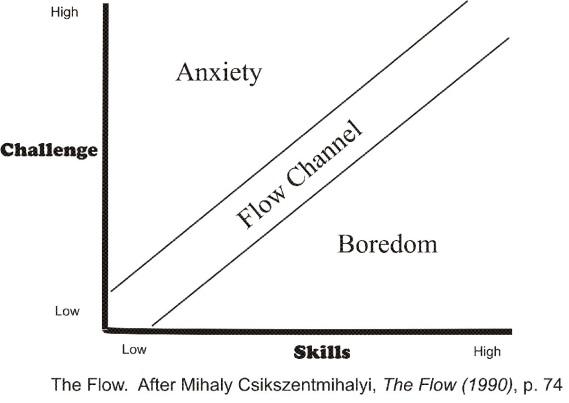
If you are the sort of person who needs a challenge, it might make more sense for you to start at a stake that could prove costly financially. If you like to feel a bit more secure in your skill set, you are probably going to learn better comfortably and gradually climbing the stakes using the micro levels as your starting point.
Developing discipline

While the pressure is much stronger the higher you go, this is not to say that choosing the micro stakes option is without its own challenges. There is one skill that successfully crushing the micro stakes will give you that will benefit you forever, and that is discipline.
Maintaining focus when the money doesn’t mean anything is not easy. Folding when it only costs $0.25 to appease your curiosity is tough. This is a level where often the rake can punish you, making it twice as hard to stay motivated. Manage this, and you’ll create a bedrock in your skillset where the emphasis is on making the right decision, regardless of the money on the table.
There are a lot of professional poker players who simply would not have the discipline to play the micro stakes over a large sample. He may be Public Enemy Number One now but when Chris Ferguson turned $0 into $10,000 (Known for many years as ‘The Jesus Challenge’) he did something many of his high stakes peers could not (Our very own Cornie4Ever did the same thing). Likewise, Barry Greenstein and Chris Moneymaker’s heroics at Play Money deserves recognition.
Maybe the challenge and motivation that comes with starting at meaningful stakes is the more valuable approach for new players starting out, but that certainly does not mean that learning at the micro stakes isn’t a valuable experience that prepares you well to climb the ranks in poker. Also, the beautiful thing about online poker, unlike live, is that cash never has to be a barrier for entry, and you can always find a stake you can afford.
Would you advise a new player to start at micro stakes, or does the money have to mean something? Let us know in the comments.
