


Sit and Go Beginner Strategy
A Sit & Go tournament (SNG) is a variant of Texas Hold’em Poker which you will often see on TV. A prize pool is made up from all of the participants paying an equal entry fee to the tournament.
The goal in a SNG is to win all of the chips from all of the players. Whoever loses all their chips has to leave the tournament. The last 2 or 3 players win the prize money.
Do you know already what Texas Hold’em Poker is and how a Sit & Go Tournament works? If yes, then you can directly start with our strategy. If not, you can read this article to learn the rules.
How does this strategy work?
The right play in a Sit & Go depends on how much chips you have compared to the size of the blinds, the forced bets made by two players in every new round.
That’s why at the beginning of each game you compare your chip stack with the size of the Big Blind:
- You have a lot of chips means more than 12 Big Blinds
- You have few chips means 12 Big Blinds or less
With more than 12 Big Blinds: How to play before the flop?
If your chip stack is bigger than 12 times the big blind, protecting your chips is more important than taking a risk. Not losing chips is more important than winning chips.
Our poker experts came up with a table which tells you exactly what the best play is once you get dealt your two cards at the beginning of a new round.
| Your cards | Early | Middle | Late and Blinds |
|---|---|---|---|
| AA, KK, QQ | Raise / All-in | ||
| AK | Raise / All-in | ||
| JJ | Raise / Fold | Raise / All-in | |
| TT, 99, 88 | Fold | Raise / Fold | |
| 77 | Fold | Raise / Fold | |
| AQ | Fold | Raise / Fold | |
| AJ, AT | Fold | Raise / Fold | |
| KQ, KJ | Fold | Raise / Fold | |
| All other cards | Fold | ||
Step 1: What cards do you hold?
Check the first column for your cards. The table uses common abbreviations based on the English card names, one letter or number per card. For example the 10 is represented with a T.
If you can’t find your cards, the last row is the right one to look at.
Card symbols
|
|


Examples
|
|


Step 2: What is your position at the table?
Each table column stands for a different position which is only a term for “how many players have to act before me in the betting round?"
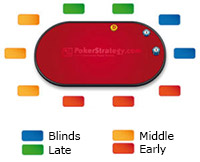
- Blind position: You are one of the two players who paid a blind.
- Late position: You are one of the two players counter-clockwise next to the blind position.
- Middle position: You are one of the three players counter-clockwise next to the late position.
- Early position: You are one of the three players counter-clockwise next to the middle position.
If there are less than 10 players, then not all positions are used. For example, with 7 players there is no early position.
Step 3: What is your action?
With the right column and the right row found, look at what is written in the respective cell.
- Raise/Fold: If nobody raised before, you raise. Otherwise fold your cards. You also fold when somebody raises again after you.
- Raise/All-In: You always raise. If somebody raises before or after you, you raise again. Ideally you can get all your chips in (all-in) before the flop cards are dealt.
- Fold: You fold. The only exception is when you paid the big blind and have the option to check. Then of course you should check.
Tip: Always raise to around 3 times the big blind + 1 big blind for every player who called before you. If you are raising after somebody else’s raise, make it around 3 times his raise.
With more than 12 Big Blinds: How to play after the flop?
If the game didn't finish already in the first betting round, there are up to 3 more betting rounds to come. Again our poker experts designed a chart which helps you with every decision:
| You hold | Flop | Turn | River |
|---|---|---|---|
| Top pair or better | Bet / Raise | Bet / Raise | Bet / Raise |
| Strong draw | Bet / Raise | Bet / Raise | Check / Fold |
| Any other cards | Check / Fold | Check / Fold | Check / Fold |
Step1: What is your poker hand?
The best possible combination of your 2 cards and the 3 to 5 community cards which lie open on the table make your poker hand. There are two playable poker hand categories:
Poker hands in the category "Top pair or better"
| Poker hand | Your cards | Community cards | Description |
|---|---|---|---|
| Top pair |   |
   |
One of your cards makes a pair with the highest community card. |
| Overpair |  |
|
Your cards are a pair which is higher than the highest community card. |
| Two pairs | |
|
Both your cards make a pair with a community card. |
| 3 of a kind | |
|
Your cards are a pair which match one of the community cards. |
| Monster | Any even better poker hand: straight, flush, four of a kind, full house, straight flush. See rules of texas hold'em article | ||
Poker hands in the category "Strong Draws"
| Poker hand | Your cards | Community cards | Description |
|---|---|---|---|
| Strong 2-card flush draw |  |
  |
Your cards are suited and two community cards match the suit. |
| Strong 1-card flush draw |  |
 |
You have an ace or king that matches the suit of three community cards. |
| Strong straight draw |   |
  |
Your cards and the community cards give you four sequential ranks. |
Step 2: What is the current betting round?
The columns of the table you should look at is determined the following:
- Flop: The 2nd betting round. There are 3 cards open on the table.
- Turn: The 3rd betting round. There are 4 cards open on the table.
- River: The 4th betting round. There are 5 cards open on the table.
Step 3: What is your action?
With the right row and column, look up your action:
- Check / Fold: You invest no money. If possible you check. If somebody bets you fold.
- Bet / Raise:
- If nobody has bet yet, you bet around 2/3 of the pot.
- If somebody bets before you, raise 3 times his bet + the pot.
- If there was a bet and a raise before you or a raise after you, bet all your chips (All-in)
Remember: If you get to the river with a strong draw and you have missed to complete your draw, you should give up and check and fold to any action.
Special case: Free play from the big blind
In case you had the option to check from the big blind and see the flop without investing more chips, you should be more careful. In this situation, treat any top pair as trash and fold it if any player bets. All other poker hands you play the same way as described before.
With 12 Big Blinds or less: How to play before the flop?
When the blinds increase and your chips stack goes below 12bb, you now increase the aggression and play more hands. You will now only be pushing (going all in) or folding. Our poker experts have developed two simple charts to use in the following situations:
1. Everybody has folded before you – You follow the Push-or-Fold chart
2. Somebody entered the pot before you – You follow the Re-Push chart
The Push-or-Fold chart
You will always use this chart when everyone has folded so far and your chip stack is 12 big blinds or smaller.

Step 1: What are my cards?
To find your cards quickly, check your highest card and look for the category on the left column. Afterwards you can find your exact card combination in the next column.
If both of your cards are of the same suit, then the combination is called suited and marked with an “s”. JTs for example means
If your cards are of different suits, then the combination is called off-suited and marked with an “o”. Examples of JTo would be
If there is neither an “s” nor an “o”, then both combinations are covered. AK for example includes both AKs and AKo combinations.
A” –“ between two combinations means that all the combinations between them are included.
AA-99 includes AA, KK, QQ, JJ, TT, 99.
K8s-K4s includes K8s, K7s, K6s, K5s, K4s.
 Step 2: What is my position?
 Step 2: What is my position?
To determine your position follow these simple steps:
1. Start with the two players who bet the two blinds. The first one is
the small blind, the next one is the big blind.
2. The next two players counter-clockwise are in late position.
3. The next three players are in middle position.
4. The next three players are in early position.
Step 3: Do I push or fold?
Look at how many big blinds you have and compare it to the number in the cell. If the number is equal or greater than your chip stack size, you push. If it’s smaller, you fold.
Re-Push Table
The table below shows which hands to re-push if somebody entered the game before you and you have 12 big blinds or less.
| Your stack | Opponent in early position | Opponent in middle position | Opponent in late position | Opponent in the blinds |
| 7-12BBs | AA-TT, AK, AQ | AA-77, AK, AQ | AA-55, AKs-A7s, AKo-ATo, KQ | AA-22, AKo-A8o, AKs-A2s, KQ |
| 1-6BBs | AA-88, AK, AQ | AA-77, AK, AQ, AJ | AA-55, AK-A5, KQ-KT, QJ | AA-22, AK-A2, KQ-KT, QJ, JT |
Step 1: What is the position of my opponent?
In the top row you look for the respective position of the opponent who entered the game before you. In case more than one opponent entered the game, use the position of the first opponent.
! In case two opponents or more are all in, you should continue only with AA-JJ, AK and fold all other hands.
Step 2: How many big blinds do I have?
In the first column you select the correct row based on the number of big blinds in your chip stack.
Step 3: What cards do I re-push?
If your hand is in the selected cell, then you should push. Otherwise, you should fold.
Special case – Free play from the big blind
The only situation in which you will be able to see the flop without being all in is if you had the option to check from the big blind. In this situation, play Top pair and better and Strong Draws, by betting and raising as you have learned already. Check/fold all other hands.
You have a lot of chips, but everybody after you has less than 12 bb
It could be the case that you have more than 12 big blinds, but every player after you has less than 12bb.
If nobody entered the game before you , use the Push or Fold chart with the amount of blinds the biggest chip stack after you has.
If somebody entered the game before you, and he and all the players after you have less than 12 bb, you use the Re-Push table with the amount of blinds the player who entered before you has.
Bankroll Management
You should think of an appropriate amount of money that you are willing to invest in poker. This is your bankroll.
We have designed a strategy that you can find in the table below to protect your investment and ensure that you have a long lasting and successful poker career.
| Your Bankroll | Suggested Buy-in |
| Less than $30 | $1 or lower |
| $31 - $60 | $2 or lower |
| $61 - $100 | $3 or lower |
| $101 - $200 | $5 or lower |
| $201 or more | $10 or lower |
Tip: Having the money to enter a tournament doesn’t mean that you should necessarily play it. We suggest that you start from the smaller buy-ins and gradually progress through the buy-ins as you become more experienced and comfortable with the game.
Summary
Now you know how to play Sit & Go
What to recommend here?
Where to guide him?
Do we want to do BRM at all?
Open push table is not final yet.
Is the Repush table too complicated?
Do we want to explain the positions twice?