What causes this difference? I always thought some differences were caused by balancing and forcing opponent to shove if we make slightly marginal call, but that's not the case here since sb can shove 100% as long as bb call's under 20%.
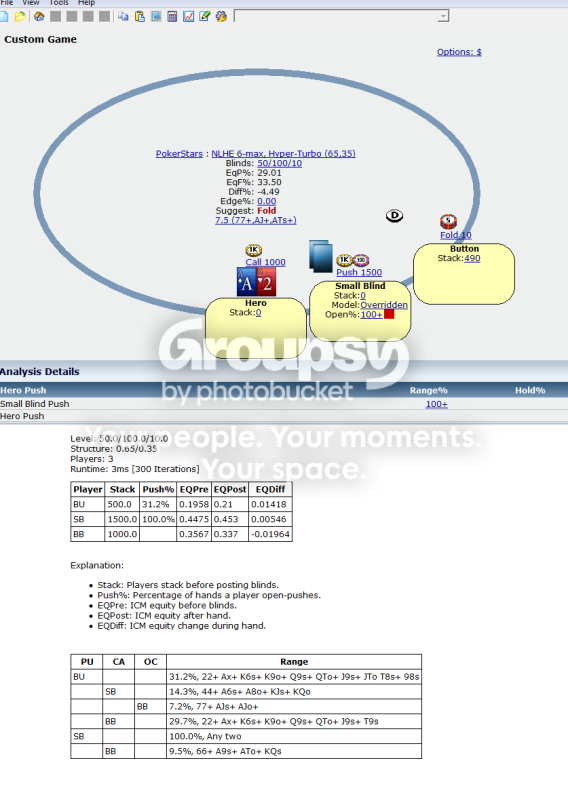
What causes this difference? I always thought some differences were caused by balancing and forcing opponent to shove if we make slightly marginal call, but that's not the case here since sb can shove 100% as long as bb call's under 20%.
wiz is exploitive
nash is equilibrium
you will always have more calling hands in a nash ATC v BB range because you need a few -$EV calls to reach equilibrium
Originally posted by lessthanthreee
wiz is exploitive
nash is equilibriumyou will always have more calling hands in a nash ATC v BB range because you need a few -$EV calls to reach equilibrium
But in this situation there is no point in making -EV call as it doesn't change pusher's range. I can't imagine nash advocating -EV plays.
this is hard to explain but ill try my best.
if you make a +$EV decision you are exploiting your opponent's range.
if you make a nash decision you are merely negating all the EV.
You can't have a nash range that ONLY includes +$EV decisions, that isn't nash because every hand will exploit your opponent.
If you KNOW 100% that your opponent shoves X% you can call an exploitive range (Ie. all +$EV hands). If you want to negate all of your opponents EV and use a neutral EV (nash) strategy you must reach an equilibrium. This equilibrium has to include hands that are -$EV against his nash range.
Use a different example for BvB nash. SB shove 50% BB call 25%. If you then take those exact stacks and put all the same information in wizard, you will get a different call range for the BB. This is because wizard is exploiting the SB. But nash is not.
using your example above, 66 is a FOLD in wiz, but a CALL in nash.
put this same hand in wiz and give the BB 66. it will be -EV to call 66, but withing the nash range. this is needed to reach equilibrium.
since its both the same spots i think the difference is in some variables that are not shown. It has to be the same math wise, but may be wizz has some other things in the calculation that nash doesnt. It doesnt makes any sense for wizz to give -ev plays. Its rly interesting spot. I see your explanation but it doesnt makes any sense at least to me. Why should any hand that is out of the equilibruim be +ev. Aint the equilibrium the point when its unexploitable for both and if we not play with it and our opponent goes with it we lose? I mean if we call wider than the equilibrium we both lose, that is obv. How can we exploit villians range when we expect to lose itlr / if we say that he doesnt adjust to us calling wider than nash / ? Rly interesting spot.
im sorry, i have no other way of explaining it. ive tried thinking, but i just cant think of another way to explain it.
maybe PM pzhon and see if he can come explain it more mathematically. he knows the math better than I do.
I think I understand your explanation, <3: By calling Nash, we prevent our opponent exploiting us (itlr) by shoving very wide. But in order to do this, we are going to have to call some hands that are -$EV vs his range. I.e. we have to sacrifice some $EV in certain particular hands in order to keep his shoving range (in a given spot) to an equibilibrium range and prevent him from profitably shoving ATC on us too often.
My guess is that Wizz deliberately downgrades the importance of achieving a longterm equilibrium vs a given opponent (such as Nash achieves) in order to find only +$EV plays, which explains why Wizz typically has you calling tighter and pushing wider.
The other things in the calculation that PetChoveka mentions should represent the mathematical implementation of this exploitive element.
[^^ may be total bollocks, ofc]
Or could nash take some future hands into account? (as you lose EV every hand this bubble keeps going like this)
Originally posted by Tim64
I think I understand your explanation, <3: By calling Nash, we prevent our opponent exploiting us (itlr) by shoving very wide. But in order to do this, we are going to have to call some hands that are -$EV vs his range. I.e. we have to sacrifice some $EV in certain particular hands in order to keep his shoving range (in a given spot) to an equibilibrium range and prevent him from profitably shoving ATC on us too often.My guess is that Wizz deliberately downgrades the importance of achieving a longterm equilibrium vs a given opponent (such as Nash achieves) in order to find only +$EV plays, which explains why Wizz typically has you calling tighter and pushing wider.
The other things in the calculation that PetChoveka mentions should represent the mathematical implementation of this exploitive element.
[^^ may be total bollocks, ofc]
well if he is gonna shove with 100% anyway that doesnt makes lots of sense, bc if we make -$EV calls that aint gonna change his range in future spots like this and i dont see a point in doing this. Your explanation would sound rly good if the villians range wasnt 100%. I mean why should we get into -$EV spots when we know his range and we know what we should call in order to be +$EV. I`m not sure if i explain the things understandable.
I have another idea about that. It aint much possible, but still. Since when we fold we lose certain amount of $EV that equals to 1BB, so we are -1BB there in $EV when we fold. I just wake up so i`m lazy to calculate it in other things so i`ll use BBs for the $EV i hope u`ll understand. My idea is that one of the calculators / nash or wizz / can be using different point from whitch the decision gets +$EV. I mean if it has -0.9BB it has better expecter results than fold itlr. If some of u is interested in doing the calculations and post them here it would be great. If not i can do them later or tomorrow / if i dont get lazy, but i`ll try bc its rly interesting spot /. And as far as i know none of the calculators / nash and wizz / dont include future calculations / not sure about that, u can correct me if i`m wrong /.
this is why i said the SB 100% isnt a good example.
also remember that equilibrium assumes the other players are in equilibrium as well. if its 3 handed and the other guy is a fish, you want to be tighter than nash even vs a reg shipping nash on you, because the fish will make EV mistakes which benefit you.