Cliffs: imho, BRM is rather not about variance, but about having room to explore which games one can beat.
Before I start ranting even more, I'd like to know more about your 'model player' and the assumptions you make about him, such as his non-poker income, expenses, assets, liabilities, poker track record.
If he's an 'ambitious amateur' who has a real job, then I assume that the job has a potential to pay €2K+ a month at least eventually, because otherwise, given that you assign him 37% ITM in the €10 Twister (when 1-tabling, I assume), it's +EV for him to take a sabbatical year and print money while the games are still good, having 36% ITM 4-tabling.
But if he does have a decent salary, he can cut the life expenses a bit (if he's not saving money up yet) and 'inject money into the bankroll', thus being able to play the same optimal stakes (hourly-wise given his skill level - don't forget that if he moves up too far, he'll get beat up by regs) without the need to move down. If he 'goes bust', he can just wait for a month and start out fresh. By playing lower stakes than optimal, he wastes time that would be spent on extra working hours or just recuperation.
It's an adage among live poker players (whose winrates converge slowly and downswings last for months because of small numbers of hands played, you know) that the bankroll is the amount that one is ready to invest into poker lifetime, almost regardless of whether it's available right now or will come in after salary is paid.
Not only is it true for online poker too, but I'll widen the bankroll definition even further (making it sound like a heresy for the generally overly conservative poker players, lol):
The bankroll is the total value of liquid assets that the player can acquire within a reasonable time and is ready to invest into poker.
Stories like the one I've linked above (note that the guy didn't even have to sell a $10K car, and many of us have such hardly useful things that we can sell in emergency, incl. the laptop that I'm typing this on) show that, even after the Black Friday, poker can quite reliably deliver such a big 'interest rate' on investments that it's +EV to even borrow money or simply get a stake in the poker community (a few hundred suffice) and pump it into the grind if one has a recent history of beating the same games comfortably (which seems to be an assumption behind your loose BRM strategies).
I don't do business, but I've seen entrepreneurs opine that poker players are in heaven because the latter enjoy lower risks of ruin while having an opportunity (and even striving) to be 100% solvent, while real-life businesses usually have to be chronically in debt and face 2-figure risk of ruin percentages to have a shot at success.
That said, moving down for a while might be appropriate because it saves extra time for the grind that would be wasted on seeking a stake or a consumer credit. But it's not really quantifiable, boils down rather to personal preference than to risk simulations.
Myself, I'm 100% solvent, but that's because the stakes that I can beat at all are so low that they put little pressure on my net worth. I'm not getting my feet wet in Amaya's $15s+ because I'm pretty sure I'd get beat up hard there, not by the variance alone, but by a combination of variance and stronger regs.
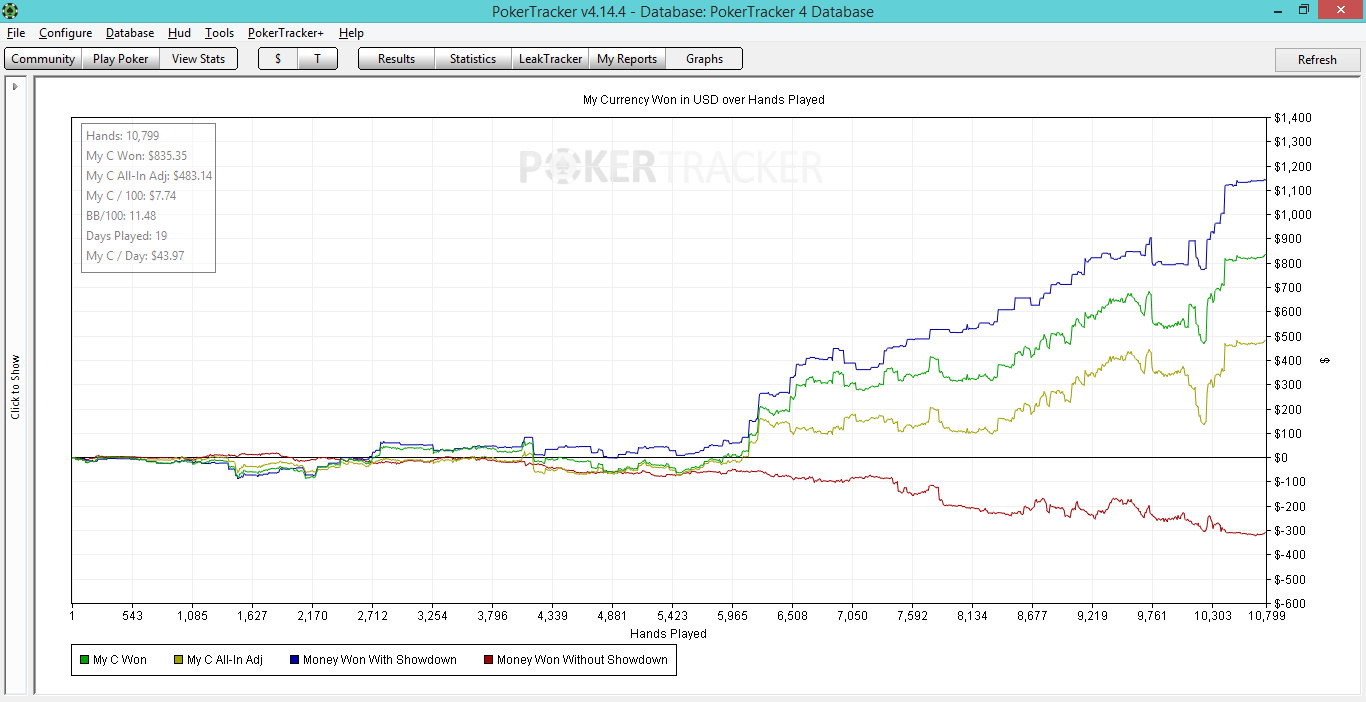
It doesn't mean I have no BRM at all; in fact, I've dropped a few K just to learn which games (incl. MTT staking) I can beat and which I can't; moreover, I would have dropped more if I followed standard BRM guidelines, but I'm one of a kind as far as personal issues. Probably that's the main reasoning behind BRM nowadays: some amount of money is required to measure one's winrate in a certain game reliably. This process is becoming easier nowadays, though, because, in PLO (esp. 5-card) and hypers (esp. lottery), all-ins and prize pool multipliers account for such a big portion of overall variance that all-in adjusted chip winnings are a measure of skill that converges fast before a huge monetary downswing happens. In 2006, when the seminal book 'The Mathematics of Poker' with BRM chapters came out, HUDs weren't widespread and I'm not sure if the all-in EV was a thing at all, people were judging their skill by actual results (they still do in live poker).


 )
)