The lie people have been telling about the red line
Some time ago, while I was researching on the said topic, I read multiple times something like this: "Don't worry about your red line, as long as green line is up, you are fine". Thats the single biggest lie I've ever seen someone tell to another poker player. And for a good amount of time I believed in it. I was crushing 2NL and 5NL with a poor rediline, but never tried to improve it, because my green line was fine, since the blue line was pretty good.
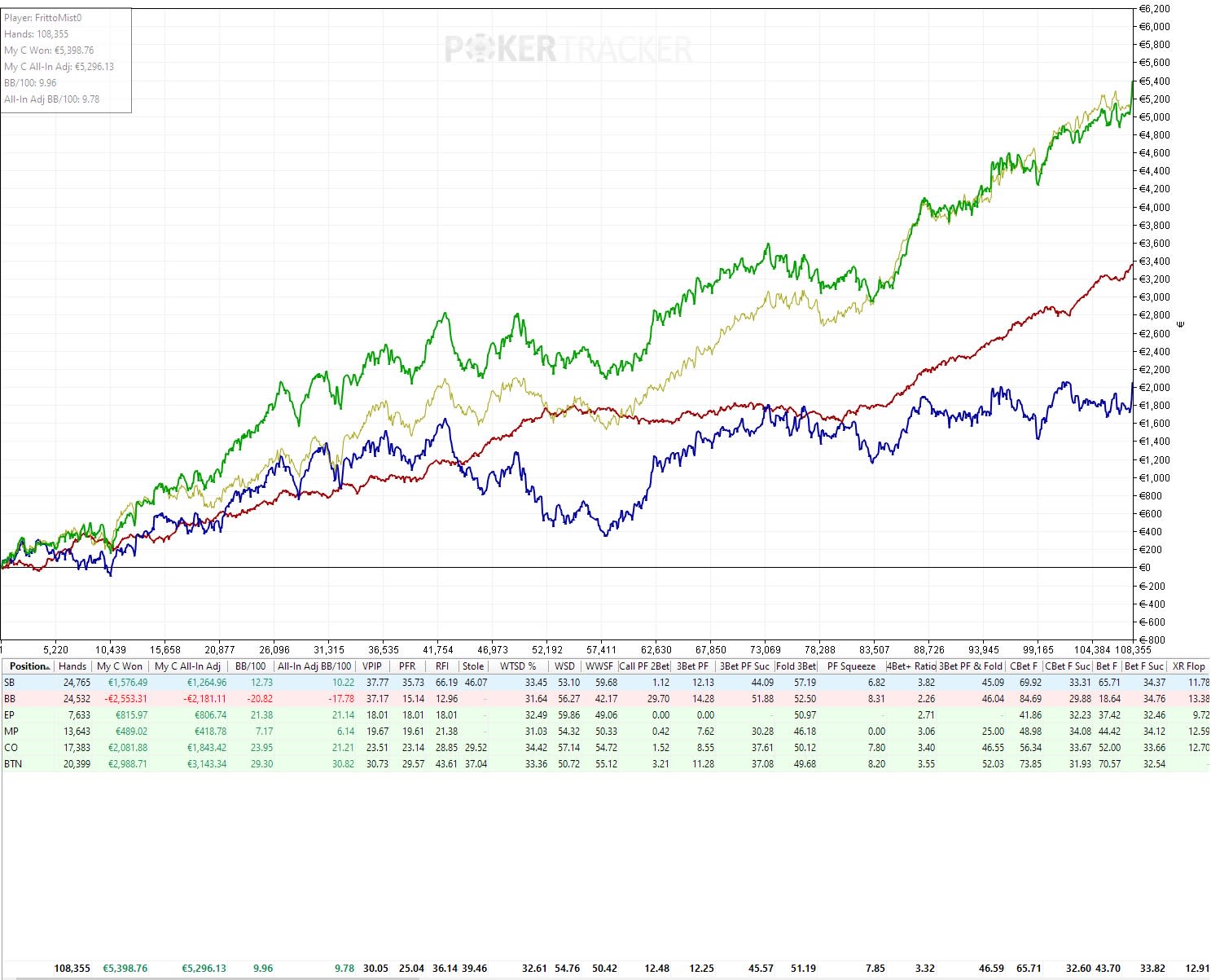
Thats a pretty big lie because the red line shows which type of player you are. The biggest winners at any given stake are the aggressive ones. And I'm not sure about you guys, but I've never seen an aggressive player with a red line that drops faster than the speed of light.
The red line is what separates the good regs from the top regs. The red line is what separates the poker players that play at the level 2 (the ones who think of what you can have) from those who play at the level 3 (the ones who think what you think they can have). The red line is what separates the players who can hand read well from those who can make your hand reading skills not so great. But I'm not talking about a red line resulting from crazy monkey poker, where you just click the raise and bet button without thinking about your play. I'm not talking about maniac aggression, I'm talking about smart aggression. The one that manages to improve your red line without sacrificing your blue line. I'm not saying that if you win mostly from your red line you are a bad player. I'm just saying that I believe most of the value from poker comes from getting value out of the weaker players, and that is accomplished by the blue line.
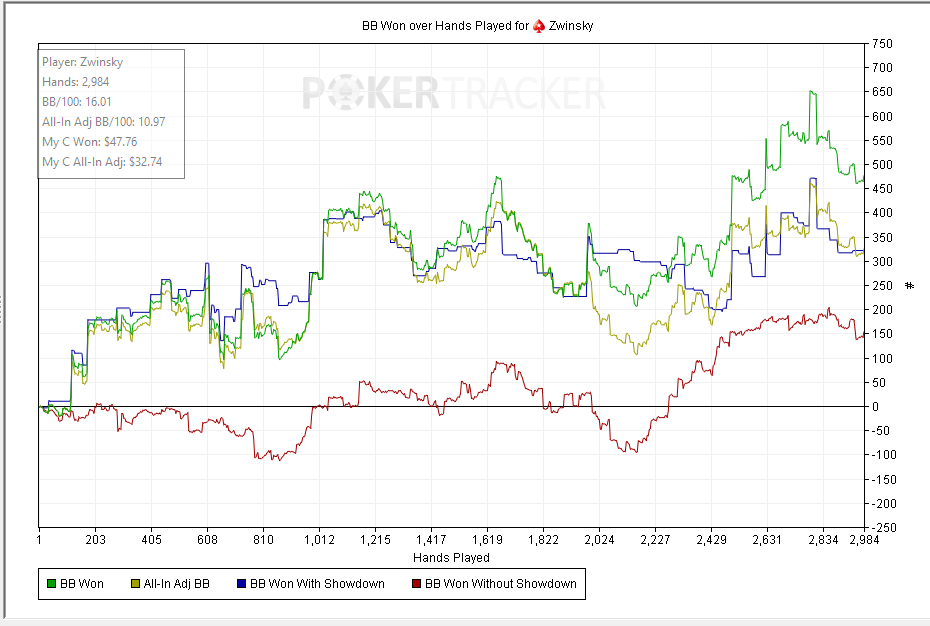
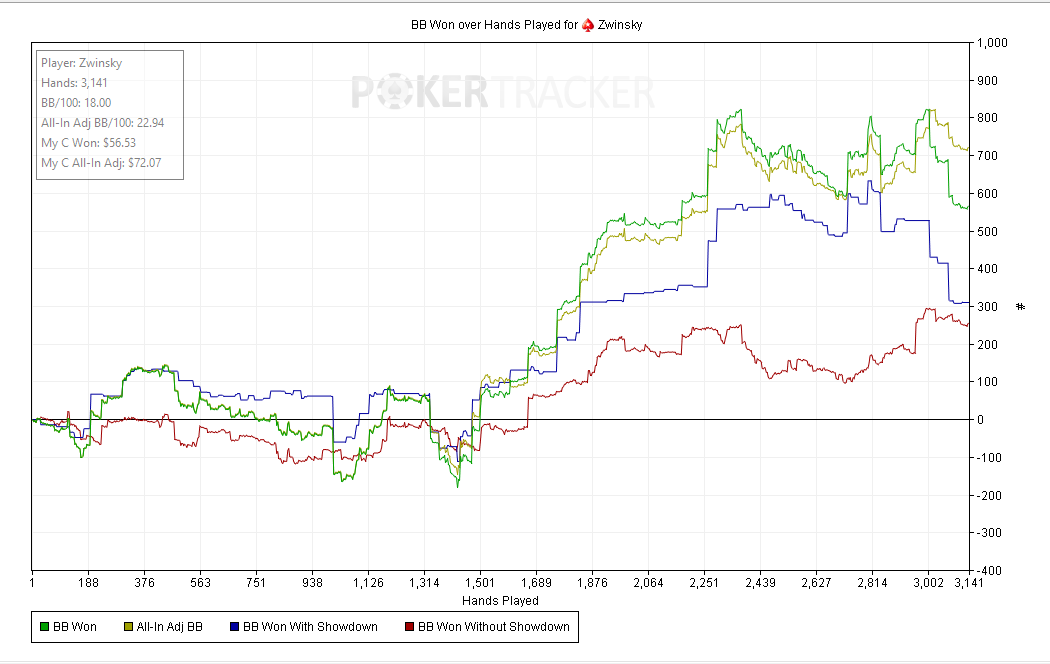
And I've experienced that in practice. At NL2 and NL5 I had no problem with my redline because my blue line was straight up so there was nothing to worry about. At least it is what people say. But at NL10 I noticed a big difference on how the game plays. Look at those two graphs, from two different sessions from this month for example:

This graph looks nice because not only the showdown winnings are good, but mostly because the non showdown winnings are not so bad. Observe that showdown winnings account for 8 buy-ins and no showdown winnings sum up to -4 buy-ins, resulting in a profit of 4 buy-ins and a winrate of 9 bb/100 in the session, which is nice. Look at the next graph now...

This one has even bigger showdown winnings (10 buy-ins) but the red line drops faster than the previous one, resulting in a boring break even session. Thats not a coincidence. One's winrate should increase a lot with improvement on the red line.
So when I realized I was leaving money at the tables with my red line, I started studying what could cause it and how I could improve it. There are a lot of things you can do to improve your red line, and I will go through some of them briefly, but the most important indicator, in my humble opinion, of one's aggressiveness is the stat WWSF (won when saw the flop). It tells you the percentage of the pots you won, considering only those in which you saw the flop. It basically tells you how often you win a hand postflop. Not coincidentally, the good graph has a WWSF of 49%, while the bad one has a WWSF of 45%.
When a player has a high WWSF stat, together with a high W$SD stat, I have no doubt this player is a pretty big winner. If someone can take several pots postflop and still have the goods in showdown, it means that this player is aware of his opponents ranges and his own range, allowing him to: put pressure in the certain spots where villain will have a hard time realizing his equity; steal the pot when villain is weak and capped; attack board textures that favours his range, winning the pot more often; and still knows when to give up so that he doesn't end up getting caught.
For these reasons my main concern right now is to improve my red line in order to maximize my winrate. I've already set some targets in terms of strategy and I have some places to start, which I think are good ways to improve overall aggression, mainly postflop but also preflop:
3-bet a lot preflop. Most regs have a 3-bet percentage from 5% to 8%. My target is to get it up to 9%. This should help increase non showdown winnings a lot.
Steal wide from late position. Most people at NL10 have a fold SB and BB to steal stat higher than 65%. Thats huge and should be exploited. Right now I'm opening 60% OTB and 56% on the SB. Button looks good but SB should definitely increase up to 60% as well.
Increase c-betting frequency, specially in position. People underdefend in a variety of board textures and that should also be exploited. My current c-bet % is 55%. Target is to get it up to 60%, at least when IP.
Attack high c-bettors. This is a thing I have to work on. Most people c-bet like 70%+ and thats too exploitable. Versus those players we should check/raise a lot of flops when OOP and float them a lot, specially in position.
Attack checking ranges. People at NL10 have extremely unbalanced checking ranges. This should be exploited. That can be accomplished by many moves, like: delay c-bet the turn a lot when villain double checks vs hero; bet twice OOP with an uncapped range on good board textures for hero's range when villain skips flop c-bet; bet a lot vs missed c-bets BB vs SB and BN vs CO. Its important to be careful with this because we become highly exploited ourselves but I don't expect villains to realize this and fight back. Pay attention to those players who have low c-bet %. Their checking ranges are usually stronger, so they are harder to exploit and should be avoided.
Adjust versus players who don't fold to c-bets. Our red line can suffer vs this type of player because we often fire one or two barrels and give up, and villain simply doesn't fold. Versus this type of player, check/raising more flops and triple barreling more runouts are better strategies than betting once or twice.
Bluffcatch with reads and good blockers. I used to underestimate the capability of the NL10 field to bluff, but I can see now that they are bluffing in many spots where we should bluffcatch. Also, their 3-betting ranges aren't as tight as one might think, so we shouldn't be giving up too easily postflop, specially in position.
Thats what I'm gonna be working on in the near future. Hopefully I will be able to come back here with good news about my red line results. How is your redline? What do you do (or don't do) to keep it good, without dropping faster than the speed of light? Good luck out there, and lets get this red line at least a little bit up.