
GGPoker rush:
We're 200BB deep here. And after his reraise on the flop I fold him. Should I have shoved here or is my fold correct?
GGPoker rush:
We're 200BB deep here. And after his reraise on the flop I fold him. Should I have shoved here or is my fold correct?
First, we still want to keep making cbets on the flop like you did, so checking back to avoid getting shoved is the actual mistake someone could fall to start doing. Theoretically Villain is not supposed to shove but to check-call 50% of his range (and then check-call broke another junk of his range), that calling range should include a lot of overpairs like :Kx::Kx:, :Qx::Qx:, :Jx::Jx:, ...
The reality though is, people tend to check-shove once they decide to continue their hands instead of check-calling twice because they don't want to get "outdrawn" or have to "face another difficult decision" and their (valid) calculation is that they might fold out higher pairs. That's the scenario when someone defends somewhat solid frequencies. Against those we should just stack-off.
The other possible scenario is your opponent being one of the many abc-regs and nutpeddlers, on GG afaik it's full of those. They play purely hand-strength orientated in a disciplined way and these customers will always have the goods (trips+) when investing "big". Against such overfolding players when fighting back just bet-folding ourself is best.
At 200bb similar to 100bb in theory we should have a mixed strategy folding 25% of our :Ax::Ax:. Against unknown you still want to make sure you are not getting bluffed and gii accordingly. If you'd have a well balanced 4bet range, you would also hold quite some one-pairs that are lower than :Ax::Ax: to :Kx::Kx: (25%). By just always going broke with :Ax::Ax: and :Kx::Kx: and fold lower pairs you could simplify towards a 75% broking range with this subcategory which is close to optimum (65%). Assuming you 4-bet :Ax::Ax: only though, I would recommend using a randomizer for your :Ax::Ax: like stacking-off only when having an additional double-backdoor-flushdraw or a single backdoor-nutflushdraw (which also rep a ~75% frequency). Generally spoken in order to consistently make the best play possible, it is required to observe your opponents, otherwise relying on a balanced approach like I have described above.
Going all-in will not "lose" you money because it's the theoretical base line, but finding the right folds actually "makes" you more money as it is an exploitative higher EV-line. That's pretty counterintuitive.
Well very few players do this sort of x-r move without trips+ or at least oesd type draw even in 3bet pot. So when we get to 4bet pot I would be usually giving more respect than in 3bet one.
Few things to consider is that we have very AA heavy range here so we are not often connecting this low board. So some players might be capable of making moves but problem for that is that pool probably won't fold AA easily at all so it's less likely.
Another thing is your hand having K and Q. So when we cbet here what are we hoping to call? Most likely hands to continue are draws, trips and high overpairs. But when we have KQ it does block high overpairs we would crush. We also don't have anything to interact with flop. It should rarely hit opponent either but still perhaps bit more often than our 4bet range. So question is if we are potentially better off checking this combo? Its usually also tough to get much value from weaker pockets as opponent usually assume we have AA.
Now once we bet and got raised we should continue theory wise equity driven. Making this particular combo somewhat weak. So if we think of our AA support we could have:
- pocket pair beside AA
- One or two bdfd
- Straight draw
- Trips or boat
- 3
With our hand we only have one bdfd so that's not that much. Another pocket would give us 2 more strong outs. Bdfd you can count as one out. Straight draw being 4+ outs. 3 is kinda weak but does block boats. Trips or boat obviously practical nuts.
So I would not mind folding this AA but I would also question cbet little bit.
Thanks, and now that I read it like this, checking would have been better. Then he probably would have bet on the turn, and I could have decided based on the size whether to call or fold.
Originally posted by upsssssss
Thanks, and now that I read it like this, checking would have been better. Then he probably would have bet on the turn, and I could have decided based on the size whether to call or fold.
God, no. Did you read my WoT?
Originally posted by Mascherano95
First, we still want to keep making cbets on the flop like you did, so checking back to avoid getting shoved is the actual mistake someone could fall to start doing.
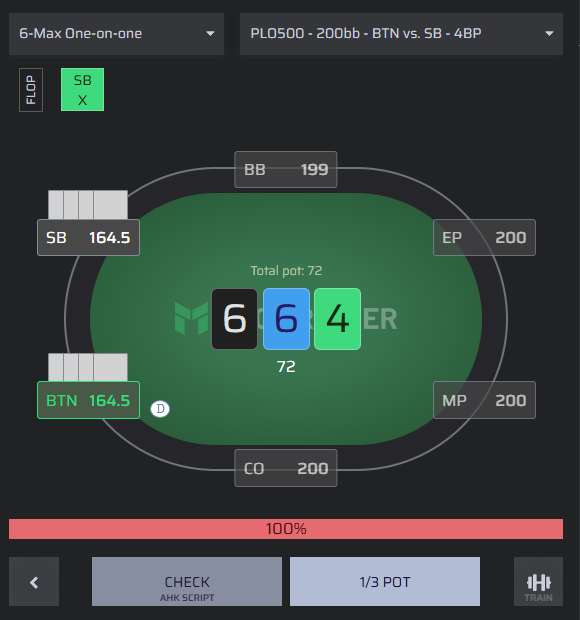
Solver (but SB vs BTN) when 200BB's deep cbets 100%. We have a huge range advantage. Unfortunately we can't bet more than 100% of our range with 1/3pot because that's not possible.
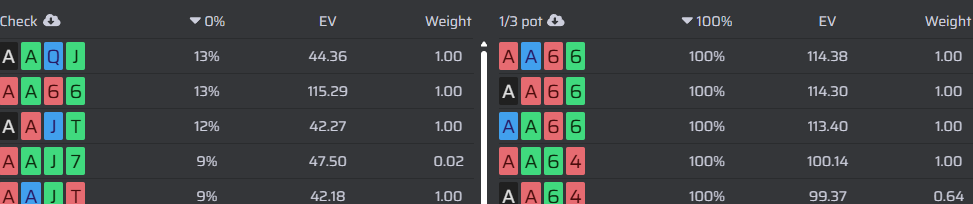
Our check-back range with :Ax::Ax: is ~0%. With an EV(bet) twice as high, averaging up to a difference of massive 50bb's checking back is fundamentally a blunder. 
Problem is that solver tends to get value in these spots from hands that you rarely do get in reality. Potentially for multiple streets. E.g. some of A+pocket combos are likely quite sticky theory wise.
Pool likely has AA at least 80+% of time here and could easily be over 90%. So depending of player we can have very hard time to get any action if opponent doesn't have better than just single overpair (without sd). With that in mind it can be imo reasonable to have some checks.
This specific player seems to have vpip of 20 but obviously no idea if that is on decent sample. Meaning somewhat tight player.
Originally posted by ghaleon
Problem is that solver tends to get value in these spots from hands that you rarely do get in reality. Potentially for multiple streets. E.g. some of A+pocket combos are likely quite sticky theory wise.Pool likely has AA at least 80+% of time here and could easily be over 90%. So depending of player we can have very hard time to get any action if opponent doesn't have better than just single overpair (without sd). With that in mind it can be imo reasonable to have some checks.
This specific player seems to have vpip of 20 but obviously no idea if that is on decent sample. Meaning somewhat tight player.
Your assumption or perception is correct, but the conclusions you draw from it are very ad hoc. Vpip 20 is tight for PLO, but in terms of combinations, there are so many that miss every flop. A raise-rereraise is always stronger than a reraise-call, and an oop-flop check on a paired texture won't change that. And stronger ranges want to bet, weaker ranges want to check. Those are the theoretical basics. And as for player tendencies, which I largely agree with, there are other reasons why we shouldn't pre-adjust by default checking against them:
First, because we don't have details on his XR&XF ranges, and he hasn't made those moves yet. If he only check-raises trips or better and folds the rest, it's a great outcome to get the huge pot for free even though he has nothing. We're not invulnerable to backdoors yet. That is, each pocket pair has about 5% flop-turn equity, there are gutshots and BDFDs. A combination of these could improve his equity and entice him to call against a delay cbet + 2-barrel shove, which is actually bad in an auto-profit situation where we want to bluff as much as possible. With 20% pot-equity required for villain to make an odds-call, even 5% is not nothing. Furthermore a too-tight fit-fold strategy is also very easy to counter: You simply bet and fold, saving money if he has it. Not betting means giving away free cards and missing out on a potentially massive FE play that only needs to work one out of four times to auto-profit. It makes sense not to categorize hands before the river as "bluff" or "value." It's about equity denial.
Second, many tight (especially weak-tight) ABC-regs call too many kings and occasionally stack-off with them when they're not giving you credit. This isn't a huge departure from GTO, as solver also has kings (more than any other overpair) and it likes busting with them. These kings (among other overpairs and weak draws) wouldn't probe excessively often themselves, but rather try to somehow get to the showdown or keep the option open to call you occasionally. In such a case, we miss value. (They usually overfold on the turn anyway, so the value is limited to 1/3 of the pot, but in a 4BP, that's quite a few bb's.) These hands are more likely to call the flop and fold on the turn than to call the turn and fold on the river, as they prefer backdoors/redraws, which generally have less equity on the turn.
Third, facing a probe isn't exactly a dream scenario. Our hand is relegated to bluff-catching just like it was against a flop XR, this time with no chance of winning the pot without a showdown. Furthermore, since "probe turn in 4BPs" isn't the most reliable stat, we'd have to check all possible combos beside Aces to cover river runouts, which is a huge effort offside tables and a general EV sacrifice in terms to Nash. This line legitimately allows the opponent to put bluffs into a 2-barrel shoving range, eventually leading us to fold the best hand — an obviously terrible outcome. This is a completely unnecessary risk, since we don't have to do that if we opt for a 100% c-bet.
Finally (not relevant for micros, though), Aces, along with Trips, are right at the top of our value range. If we don't bet all of them them, we open our game to the danger of being exploited. Depending on how often we bluff, we may not be allowed to bluff as often, or we would continue to overbluff. Strong players could realize this, and as I mentioned before, the difference between in BB-EV's is significant in this situation. In a 4BP game against an unknown, I won't experiment: It's a high-variance situation by default, since more chips were invested preflop. Bet-call is less fancy than bet-fold, which in turn is less fancy than check-back. A check-back is super fancy and will simply be too costly if complicated parameters aren't met.