Skip to forum
A Blog to Somewhere...
 
Notifications
Clear all

A Blog to Somewhere: March Results

358 Posts
39 Users
0 Reactions
47.1 K Views

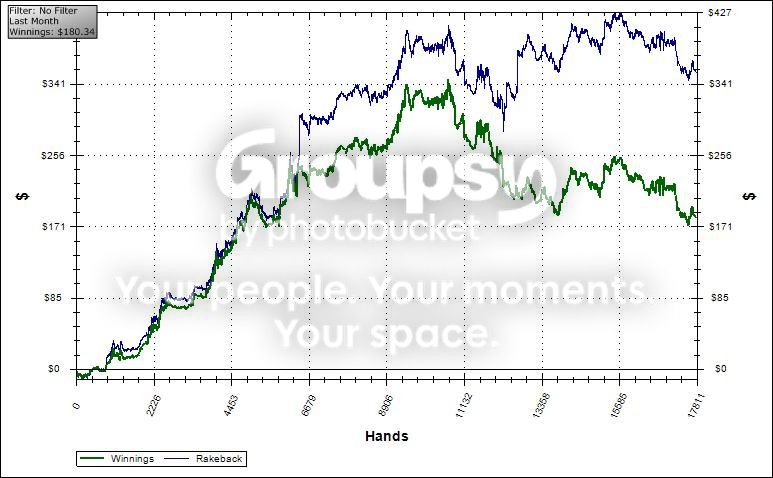
Day 5: I completed session 1 and 3, but not the second one. 500 hands, -7BB/100.

Over the last week or 2 I've ran break even and its been frustrating at times... I haven't played my best and my tolerance for the swings of poker hasn't been there either.

So, with a public coaching session in mind I decided to not grind out a load of hands today.

It turned out well. I think playing under a microscope forces me to play well and learn at the same time.

Tomorrow I'll be gold status on PS. Looking forward to reading the content.


Reply
Quote
PostFlopMonster
Joined: 03.02.2011

datsmahname

Hi! I watched your play on yesterday coaching session - very impressive =) But what impressed me more when I look through your blog - is methodical way you learn and play poker.
I play micros too. On FTP. Trying to switch from FR to SH. Do not have much of success right now. Hope that my fresh new "gold" status and ideas from your blog will help me a lot. =) Added your blog to favorites - I will follow you =)

Good luck at the tables! =)


Reply
Quote

May Results

1/5 for HUHU SNGs
-$55 SCOOP
-1.10 Donkament busto.
-$ 80

After no poker for 1.5 months I'm happy with these results. I know I played poorly in plenty of spots and have already made huge strides in getting back to where my game was. I'm also working hard on adding new elements to my game, and I'm enjoying the challenge.

Ran really well in my normal cash games to start the month which was nice given that I cashed out recently.

May goals:
[17k] 5K hands
[x] 5 HUHU SNGs
[2x] set up & meet w/ Coach @ least once.

June goals:
[ ] Move back up to old stakes by end of month (.5/1)
[ ] 4 articles
[ ] 1 HUHU article
[ ] 10K hands
[ ] 5 HUHU SNGs


Reply
Quote

Originally posted by PostFlopMonster
datsmahname

Hi! I watched your play on yesterday coaching session - very impressive =) But what impressed me more when I look through your blog - is methodical way you learn and play poker.
I play micros too. On FTP. Trying to switch from FR to SH. Do not have much of success right now. Hope that my fresh new "gold" status and ideas from your blog will help me a lot. =) Added your blog to favorites - I will follow you =)

Good luck at the tables! =)

Hey PFM,

Of course I remember, and I was glad to see someone taking an interest. So far I'm really enjoying the gold content. Hopefully you'll like it too.

Thanks for the kind words. I was also pretty happy with the way it went, especially when I could just admit that I didn't know what the best decision was in certain spots.

One area was definitely preflop. I've already spent some time reading gold articles in the last 24 hours improving my preflop game and I expect to have it down pat in a couple weeks.

I also need to improve the way I play small pairs postflop when faced with aggression. Another topic I've spent a little time on today.


Reply
Quote


One thing I've come to understand after 20 years as a student is that learning how to learn is deceptively important. Problems present themselves all the time, and having an approach for tackling them, even the basic ones can be very helpful. Having a plan aids in directing our attention to things that will help solve that problem.

With this in mind, and considering some recent feedback I thought I'd share a basic template you can use for improving areas of your game.

Today I spent some time working on my play with pocket pairs after the flop with an emphasis on marginal situations. Here's how I decided to go about it.
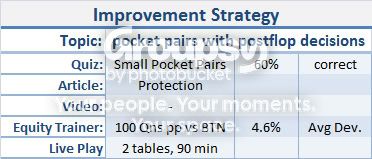
First i took a quiz that I expected would be difficult, and there are some good reasons for this.

Difficult tests, even ones that are nearly impossible to get perfect, have been linked to increases in long term learning. This has been supported scientifically, and is changing the way tests are administered in schools.

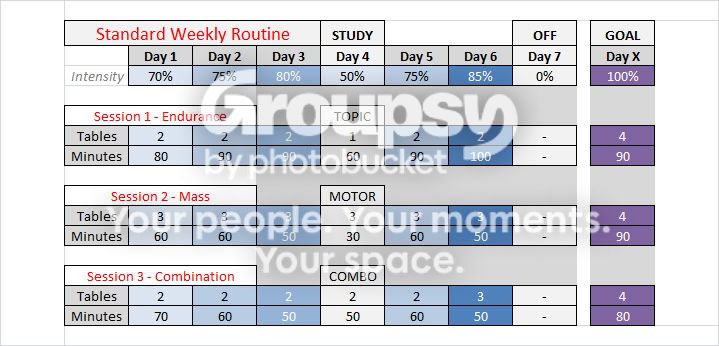
Second, I played the first session of the day 6 (see weekly plan) and made sure to use some of what i had learned after reading the justification for correct answers.

Then I used the equity trainer in equilab and used the Button ORC range vs all pocket pairs.

After that I read an article about protection (recommended from the Quiz results) to understand how I ought to play postflop with hands that are likely to be ahead BUT are unlikely to benefit from turn and river cards.

Having done these things I now know how to play pocket pairs better, and this is a fact. By taking an organized approach to learning I can be confident that I have in fact improved my game, and this confidence is important. Without knowing for sure I could easily squander my efforts to improve by failing to follow this approach next time around. Instead the confidence I've gained will aid me in future learning and will continue to improve my game in the long run.


Reply
Quote

Day 6:

Today's vital tasks were the strategy articles I read and the sessions I played. I also managed to do some additional study work.


Reply
Quote

Reply
Quote

It took me some time to understand the ideas he presents. I ended up reading A New Kind Of Science late last year. Its really something.

At the tail end of the first video they mention that Benoît Mandelbrot was in attendance at Wolfram's TED talk. This should give some ideas about why he was mentioned.

The entire plot you are seeing here can be represented by the equation Zn+1=Zn*Zn+Z1.


Reply
Quote
PostFlopMonster
Joined: 03.02.2011

Originally posted by datsmahname

Difficult tests, even ones that are nearly impossible to get perfect, have been linked to increases in long term learning. This has been supported scientifically, and is changing the way tests are administered in schools.

Wow! Very interesting. I didn't know that. I always thought tests are good way to check out how well you understand the subject, but not the way to improve. =)

datsmahname, btw how much time do you spend a day playing and learning poker?


Reply
Quote

Lately I've been giving it my full attention. Maybe 7 hours a day 6 days a week, but I only play about 4-5 of those and sometimes less.

Regarding your quote... I tried to find a source for it, and I'm sure I read an article about it in Scientific America Mind a few months ago... but after a bit of searching it didn't turn up. The basic idea is there, but I may have worded it differently than they would have.


Reply
Quote

I wasnt able to find that article... but here's one thats interesting.

Scientific America Mind: August/September, 2008 Issue. Page 52-59.

Quoting Scientific America Mind, Article titled "Minding Mistakes"
Error Detector
Hints of the brain's error-detection apparatus emerged serendipitously in the early 1990s. Psychologist Michael Falkenstein of the University of Dortmund in Germany and his colleagues were monitoring subjects' brains using electroencephalography (EEG) during a psychology experiment and noticed that whenever a subject pressed the wrong button, the electrical potential in the frontal lobe suddenly dropped about 10 microvolts. Psychologist William J. Gehring of the University of Illinois and his colleagues confirmed this effect, which researchers refer to as error-related negativity, or ERN.

An ERN may appear after various types of errors, unfavorable outcomes or conflict situations. Action errors occur when a person's behavior produces an unintended result. Time pressure, for example, often leads to misspellings while typing or incorrect addresses on e-mails. An ERN quickly follows such action errors, peaking within 100 milliseconds after the incorrect muscle activity ends.

A slightly more delayed ERN, one that crests 250 to 300 milliseconds after an outcome, occurs in response to unfavorable feedback or monetary losses. This so-called feedback ERN also may appear in situations in which a person faces a difficult choice--known as decision uncertainty--and remains conflicted even after making a choice. For instance, a feedback ERN may occur after a person has picked a check outline in a supermarket and then realizes that line is moving slower than the adjacent queue.

Where in the brain does the ERN originate? Using functional magnetic resonance imaging, among other imaging methods, researchers have repeatedly found that error recognition takes place in the medial frontal cortex, a region on the surface of the brain in the middle of the frontal lobe, including the anterior cingulate. Such studies implicate this brain region as a monitor of negative feedback, action errors and decision uncertainty--and thus as an overall supervisor of human performance.

... [the article goes on to discuss many things that may interest poker players] ...

I think the most important notion to gather here is that during a game of poker our brain is constantly attempting to learn when its presented with negative results. If we have not already learned what the correct decision is, our brains will automatically rely on negative results-oriented feedback to inform our future decisions, and this is potentially a very costly problem for us because--as we know--poker frequently punishes correct behavior.

By choosing to take tests which do give theoretically correct feedback we can once again use our brains incredible natural capacity to learn and fortify ourselves against the masterful trickery that poker can play on our minds.

I believe that over time our decision process can become stubborn but also very stable. In this way, focusing on a proper poker education very early in our poker career can help us to avoid learning bad habits.


Reply
Quote

Day 7:

So I'm going to try and more or less sustain the habit of playing 2-3 tables this week, and perhaps over the next couple weeks. Once Its totally normal for me to play 3 tables all the time for 70-80 minutes I'll push for longer sessions and more tables.

My goal is still to reach 300 hands/hr by the end of this month, and all things permitting to move up in stakes.


Reply
Quote
PostFlopMonster
Joined: 03.02.2011

datsmahname
I discovered a lot of useful things throughout your blog! And hope that it's only beginning. =)
Do you have ICQ or skype? I have so many questions. It will be great to talk to you.


Reply
Quote

yep, my skype alias is the same as here.


Reply
Quote

hey wat coaching was this? i would've liked to see it :f_cry:
really interesting article btw.


Reply
Quote

It was a private public coaching with TerrorBlade during the last FLHE silver coaching session.


Reply
Quote

Day 1:

Decent volume today. 200 hands/hr. I may or may not fit in some other play/articles depending on how tired i feel in the next hour.

Session 1 was basically break even.

The second session of the day was really frustrating. I manged to drop 40BB (80bb) in like 70 hands at just one table ... really weird stuff, but I reviewed every hand played and while i made a few mistakes it was nothing crazy. Set over set and was lucky that my opponent played it mubsy on the turn so i lost the minimum.

Some Maniac ran up a good stack and against such players you'll always loose the maximum... I did fail to notice a player leave, and the guy who came played much differently. I think I may have made a few mis-reads at first.

Last session i logged some time for PokerStrategy points and ran pretty well. I got to try out a couple things I had learned and the whole thing was a welcome change given how session 2 had gone.

But it was frustrating, and had I continued to lose in the 3rd session I expect I would have played poorly as well. This troubles me a lot. My tolerance for losses has diminished and right now this lack of mental fortitude is making me think that taking shots at higher stakes is not going to be a great idea right now.

SO to deal with this I'm going to spend some time studying before I play next. I find its easier to deal with bad beats when i study... and its because I know without having to convince myself that getting drawn out on or running into a hand is totally fine. It also helps me to think rationally about the mistakes I do make and change them rather than just being frustrated.


Reply
Quote
Waiboy
Joined: 18.09.2008

FWIW, I try to put a positive mental spin on hands where I know my opponent has made a mistake, regardless of the outcome. This has helped a lot keeping a positive mindset throughout a session.

If I'm not sure - or think I've made an error, hand marking acts as a trigger to allow me to put a line under the hand and move on.

Epic blog gets more epic daily btw. _cool:


Reply
Quote

i actually really like those tips. sort of like clearing it from your mind because you know you've committed yourself to looking at it later.

thanks for the props.


Reply
Quote

September 22nd, 2006

The lecture hall is dimly lit and features thinly cushioned seats, like the kind you see in older movie theaters. I'd been busy, sleeping little and working hard. The hardest I've ever worked in my life, but with good intention. I had fallen asleep in this room countless times last year but not today. He was talking about time management.

He was Dr. Richard Light, Harvard professor of education and guest lecturer. The title, "Engaging Students: What research reveals about how to make a difference."

"Billed hours, can anyone tell me what that is?" Someone spoke up, but I didn't hear them. He continued... A lawyer bills hours, tracks their time commitment, and sticks to it. No long lunches, no distractions during work time.

Apparently even among the best & the brightest, Harvard too was dealing with students flunking out. The most dramatic difference seemed to be in the way students managed their time, and these days my time was precious.

I had become desperate looking for a way to do everything, but rationality wasn't part of the plan. Time management or not, doing everything was never an option.


Reply
Quote