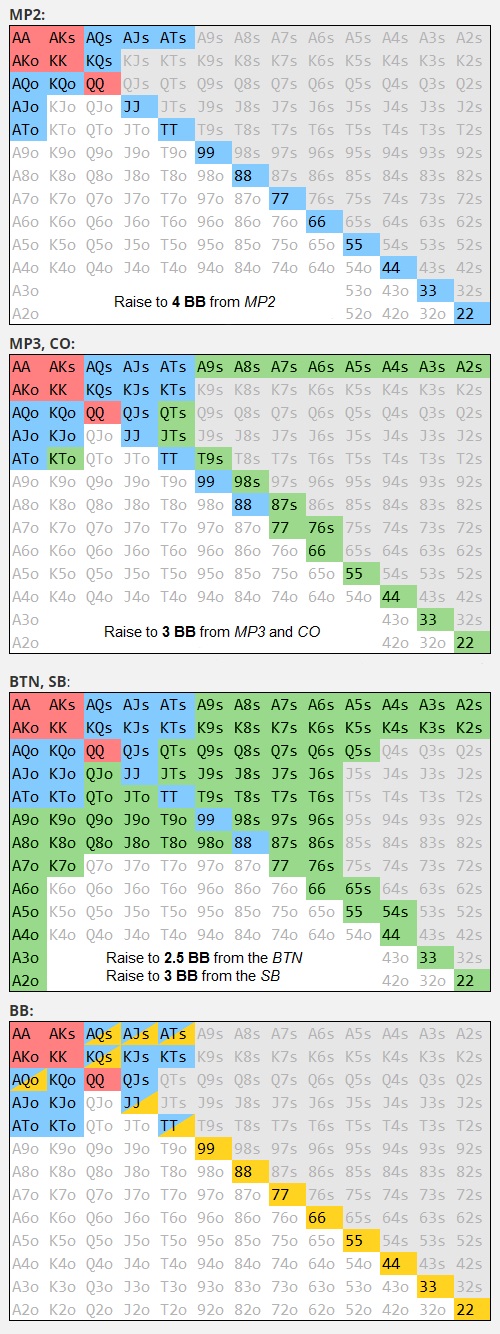
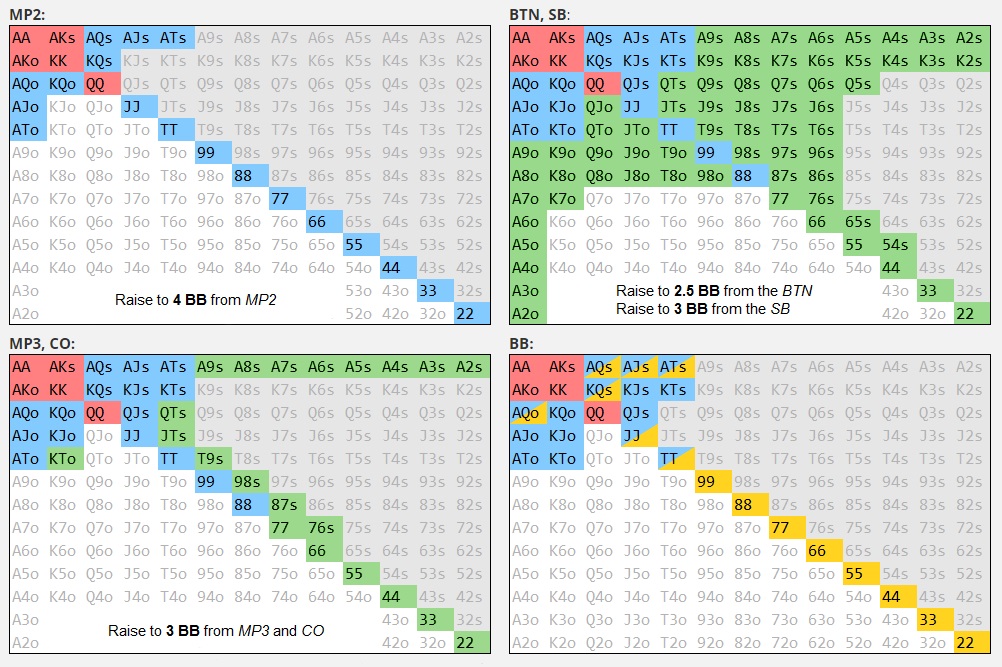
This article refers to lesson 1 of the beginners' course:
Beginners' course - Lesson 1
Lesson 6: 13/03/2015 Adjustments to the beginner strategy - Pre-flop.
Recorded coaching lesson 6
In this lesson we will show how a beginner can improve his game and develop an advanced beginner strategy.
You will learn ...
• ... what to take into account regarding an advanced beginner strategy.
• ... how to optimise your pre-flop play.
• MP2 adaption
• MP3/CO adaption
• BU/SB adaption
• BB adaption
• "Multi-way suited connector calls"
• Call on "top pair value"
What you should take into account regarding an advanced beginner strategy
The more advanced the strategy, the more difficult it is to specify it through predetermined ranges, sample charts and standardised playing styles.
Every player has to judge for himself when and how to play and take responsibility for determining whether his playing style will be most profitable in the long run or not.
Therefore, this article won't present any more sample charts or ranges. Instead you will be shown how to start thinking about spots and how to further improve your game on your own.
How you can optimise your game pre-flop
General note:
Observe your table, pay attention to players who are still to act after it's been your turn and write down notes on things that you've noticed.
Examples for possible observations
Your raises are often answered with a 3-bet:
If you realise that your opponents frequently 3-bet your raises, meaning raising again, then you should consider which hands are appropriate to continue with against these 3-bets.
Does it still make sense to raise with smaller pairs when you have to give them up against a 3-bet anyway? Should you rather just raise hands like AQ with which you could continue playing against a 3-bet for top pair value?
Your raises are frequently called by a lot of players
If you're constantly up against 3 or 4 callers on the flop although you've raised first-in to 3-4 big blinds, then you should consider increasing your raise size for stronger hands to 4-5 big blinds.
Players who constantly just call raises are often recreational players not following any particular strategy. Most of the time you will still have a better hand when playing against them, even when increasing your raise size.
MP2 adaption
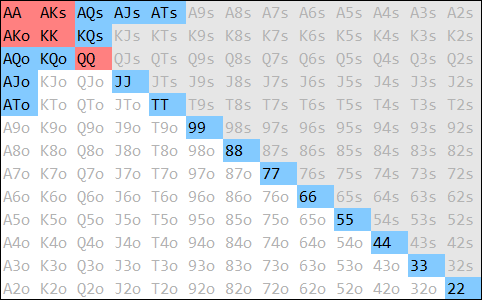
The first position at a short-handed table can be played very differently, either tight or very loose. The reason is that there are 5 more players still to act behind you and the dynamic at a short-handed table can vary much more in comparison to a full-ring table.
What can I change?
As said before, you should definitely try to adapt to the players behind you and the dynamic at the table. A good initial approach is to differentiate between tight and loose tables in general.
Example: When raising from MP2 you often only get the blinds or a single caller.
This would be a good table for playing more hands. Depending on how comfortable you feel, increasing your range to hands like ATs/ATo/KJs/KTs/QJs is recommendable.
MP3, CO adaption
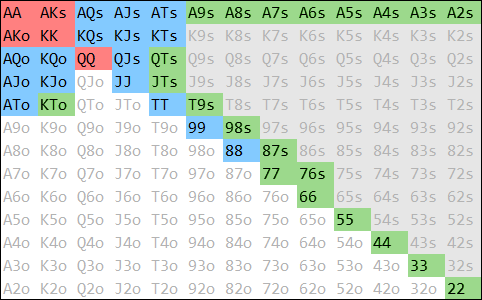
In this case, we're combining two positions. When you're first-in in the CO, you're always in a typical steal spot. That's not the case for MP3.
Therefore, it definitely makes sense to try stealing and raising more hands in the CO than in MP3, given that the BU is not really an active player.
What can I change?
When in the CO, you should try to extend the sample chart logically, thereby attempting more steals.
If other players limped before it was your turn, you don't really want to raise hands like 67s from the CO. However, if everyone folded, that hand is almost always strong enough to steal with.
The same goes for A9o. When allowed to raise ATo even when there limpers are in the pot, it's just logical that you can also try and steal with A9o in the CO, given that everyone before you has folded.
Again it is important to take into account the current dynamic at your table. If you know that the players behind you are playing loose and like to 3-bet, it is definitely not forbidden to play tighter than suggested in MP3.
BU, SB adaption
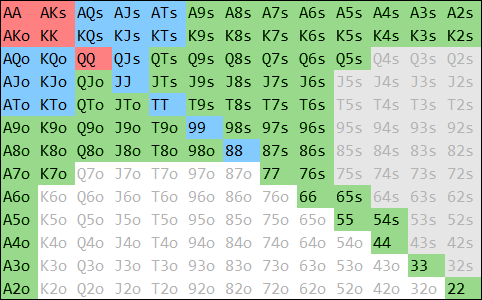
Especially on NL2 to NL5 these are the positions where the chart is really close to the optimum. However, even in this case you shouldn't forget that different types of opponents require different ranges.
Without any particular information or observation on the players behind you, there's no reason to deviate from the chart.
Playing looser than suggested by the chart in BU/SB is almost never recommendable since the chart itself is already based on a loose approach. Of course, you wouldn't want to play T7o against very loose opponents in the blinds.
What can I change?
Pay attention and adapt!
If your opponents frequently react with a fold, then simply continue stealing. If the SB/BB is playing very loose, either by cold-calling or 3-betting a lot, you should stop stealing and just fold with T7o/J7o/Q7o and similar hands.
If you realise that the BB has re-stolen more than 4 times against you, meaning 3-betting your steal raise, then even KQ is certainly strong enough in order to call his re-steal and play a possible top pair in that 3-bet pot like a monster.
However, always keep in mind that you shouldn't make adjustments like that whenever you are unsure about an opponent.
Hand discussions are the perfect way to check whether you've played and adapted correctly against certain opponents or not.
BB adaption
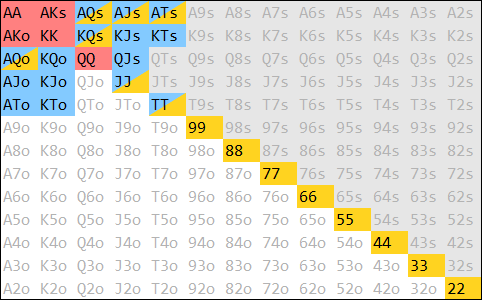
In this case, it's important that you don't start weird re-stealing moves, meaning to 3-bet your opponents' steals with any possible hand.
Re-stealing as a bluff usually just make sense when you're playing with stats from software tools like Hold'em Manager 2 or PokerTracker 4. Since beginners shouldn't use these tools though, we are playing without stats and consequently without bluff re-steals.
What can I change?
You should always feel comfortable at your table.
If you're not comfortable with raising KTo against two limpers in MP2/MP3, that's definitely understandable. In such a case, don't raise and instead simply check when in the BB. Obviously, it's much easier to play against one opponent. So if you're more comfortable with raising KTo against a single limper, simply do so.
Against players who frequently steal and attack the blinds when in CO/BU/SB, you should consider also including hands like KQ/AJ/ATs in your calling range, playing these hands just like AQ.
Remarks regarding CO/BU
Whenever you are in the last two positions in which you can play hands in position, it makes sense to start with so-called "top pair value calls" and "multi-way suited connector calls".
Multi-way suited connector calls
What does it mean?
Multi-way means that you're up against more than one opponent. Typical suited connectors are hands from 45s to QJs (for example 7♥ 8♥ ).
If you are holding such a suited connector in CO or BU, you can start calling in order to hit a post-flop monster whenever there was a raise not bigger than 4BB in front of you and at least one more player calling this raise as well.
This way you will be up against at least two opponents on the flop, increasing the probability to get paid off in case you are able to hit your monster.
With which hands can I do that?
Any suited connector from 45s to QJs
What do I have to take into account?
• Don't make this move in MP2 or MP3!
• Only do it with the presented suited connectors!
• Only call when the raise is not bigger than 4BB!
• Only call when at least one more player has called that raise as well!
• Only call when both opponents have at least 50BB in their stacks!
How do I continue with such a hand post-flop?
When it comes to playing suited connectors post-flop, simply stick to "Step 2.2: You've only called before the flop" in Lesson 2 of this beginners' course.
Special rule for suited ace-high hands
With suited ace-high hands like A♥ 2♥ you can basically play the same way as with suited connectors but you should only call with them when in the BU and when there is one raiser and two(!) more callers in front of you since the playability of these hands is a bit worse.
Top pair value calls
What does it mean?
According to our sample chart, if you're holding a strong hand like AQ, you should fold it in CO or BU whenever there was a raise in front of you. However, most of the time you almost always have a better hand than the raiser.
If you now start calling instead of folding with hands like AQ, you're gaining the advantage that your opponent will almost always continuation bet a favourable flop for you (A♦ T♣ 2♠ ), even as a bluff.
On the other hand, he will often play check/fold on unfavourable flops like 3♥ 6♥ T :club:, again leading to you to profit from it.
With which hands can I do that?
The more hands your opponent raises, the more hands you can call with for top pair value.
Usually, it should, however, be limited to hands like AQ/AJ/KQ since weaker hands lack the advantage in strength against the opponent's range.
What do I have to take into account?
Opponents that raise from MP2 have less hands in their range and tend to play tighter and more careful than players raising from MP3 or CO.
Therefore, it is recommended for beginners to only call with AQ against raisers in MP2 as long as you can't be sure that the player in MP2 has a looser raising range which enables you to call with AJ/KQ or even weaker hands on top value.
How do I continue with these hands post-flop?
When it comes to playing suited connectors post-flop, simply stick to "Step 2.2: You've only called before the flop" in Lesson 2 of this beginners' course.




 No Limit Beginners Course Coaching by confidant91.
 basic
basic

 J :heart:, K
  J :diamond:,
  J :spade:, K