

Full House
In This Guide
Quick Facts by PokerStrategy
- A full house consists of three cards of one rank and two cards of another (e.g., 8♠ 8♦ 8♣ 4♠ 4♥).
- It ranks fourth in standard poker hand rankings.
- Only three hand types can beat it: Four of a kind, straight flush, and royal flush.
- The strongest full house is Aces full of Kings (A-A-A-K-K), and the weakest is twos full of threes (2-2-2-3-3).
What Is a Full House in Poker?
A full house is a five-card hand that holds three of a kind and a pair.
More specifically, it consists of three cards of one rank and two cards of a different rank. Think of it as a three-of-a-kind merged with a distinct pair – both components must be present to form a full house.
A hand containing three Kings and two Tens (K♠ K♦ K♥ 10♣ 10♠) is a full house and is usually spoken of as “Kings full of Tens.” This naming convention always lists the three-of-a-kind first, followed by the pair.
Full houses are also commonly called “boats” or “full boats” in poker slang – a term that originated from riverboat gambling culture in 19th-century America.
How Does a Full House Rank?
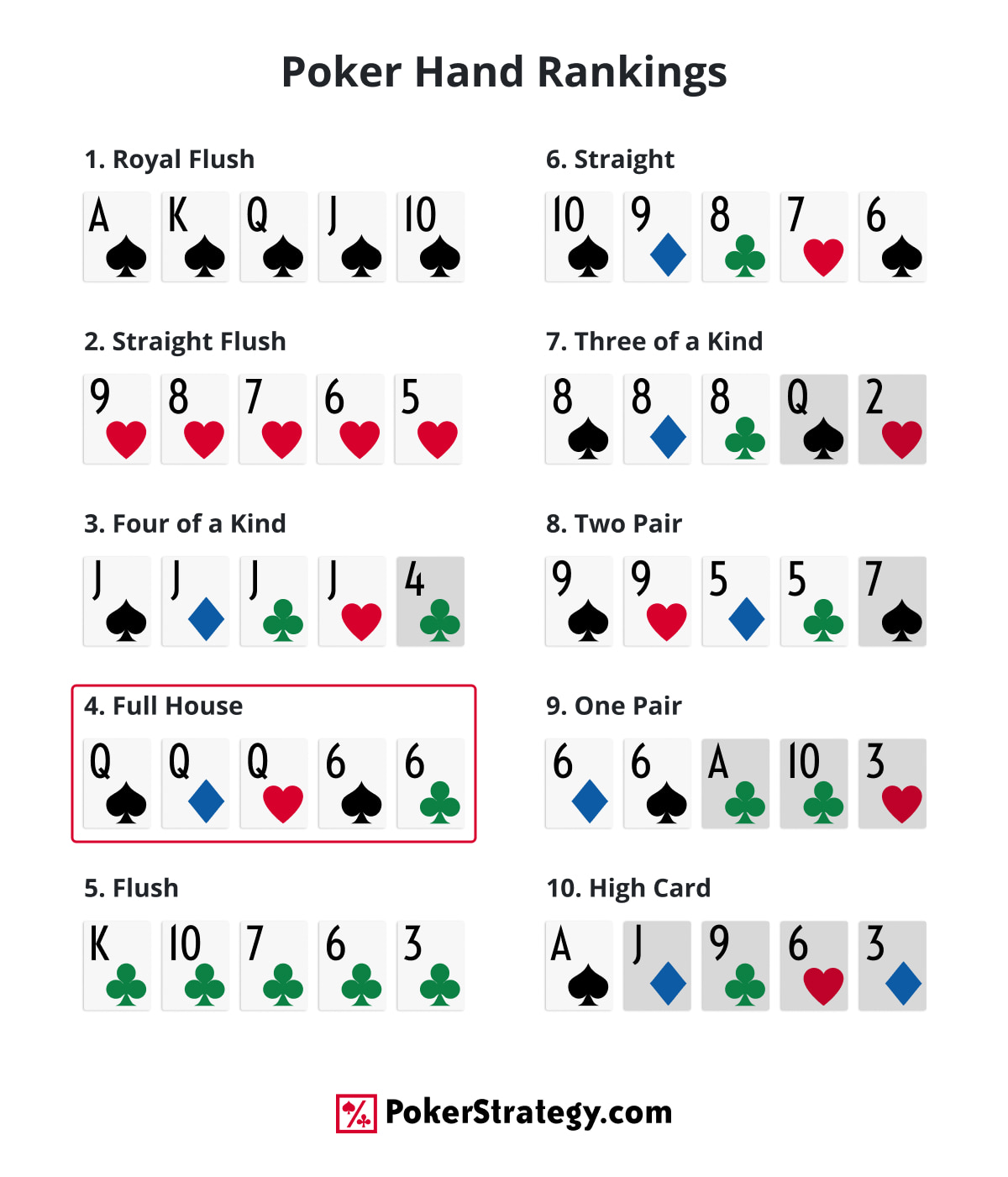
Based on the standard poker hand rankings, a full house ranks fourth overall – above a flush and below four-of-a-kind.
Poker hand ranked:
- Royal Flush
- Straight Flush
- Four-of-a-Kind
- Full House
- Flush
- Straight
- Three-of-a-Kind
- Two pair
- One Pair
- High Card
This means a full house beats all hands ranked fifth or lower, while only losing to the top three hands: four of a kind, straight flush, and royal flush.
Example Ranking (strongest to weakest of these hands):
- Four-of-a-kind (9♣ 9♦ 9♠ 9♥ 2♣)
- Full house (8♣ 8♠ 8♦ K♠ K♥)
- Flush (A♣ J♣ 9♣ 5♣ 2♣)
- Straight (9♣ 10♠ J♦ Q♣ K♠)
Examples of a Full House
Now that you understand what a full house in poker is, let’s look at practical examples.
A full house in poker is always made up of 3 like cards (cards with the same numerical value) and 2 like cards. The more cards that are dealt in a hand, such as in Texas Hold’em, the better the odds of finding these combinations. Below are practical examples showing how full houses form in actual gameplay:
Example 1 – Simple Full House
Hole Cards: 9♣ 9♦
Board: 9♠ 4♥ 4♠ K♣ 2♠
Final Hand: 9♣ 9♦ 9♠ 4♥ 4♠ (Nines full of Fours)
In this scenario, you flopped a set of nines, and the board paired fours, giving you a strong full house that will typically win the pot.
Example 2 – Premium Full House
Hole Cards: A♠ A♣
Board: A♦ 7♠ 7♦ 3♣ 2♣
Final Hand: A♠ A♣ A♦ 7♠ 7♦ (Aces full of Sevens)
This is one of the strongest possible full houses. With trip aces as your three-of-a-kind component, only quad sevens could beat you.
Both examples demonstrate the full house as an extremely powerful hand that will win most pots, especially on coordinated boards. You’ll encounter these scenarios regularly when playing on online poker sites, making it essential to recognize full house opportunities quickly.
What Are the Odds of Drawing a Full House?
The likelihood of making a full house depends on the game variant and which street you’re on. Here’s a breakdown from simple to more complex probability scenarios:
- Basic probability (any random hand): Texas Hold’em (by the river): The likelihood of making a full house or better with any two random cards is approximately 2.60%. This means you’ll see a full house roughly once every 38-40 hands that go to showdown.
- Starting with a pocket pair: If you start with a preflop pocket pair, the likelihood of flopping a full house is approximately 0.98% (around 1 in 102). This is relatively rare, which is why flopping a full house is considered a premium situation.
- Improving from a set to a full house: At the river with a set on the flop: If you flop three of a kind, there is approximately a 33% chance of making a full house by the river. This means that if you flop a set, you have good odds of improving to an even stronger hand.
| Cards | Odds |
|---|---|
| Two random cards | 2.60% |
| Flopping a full house with a pocket pair | 0.98% |
| With a flopped set | 33% |
A standard 52-card deck has exactly 3,744 possible full house combinations, making them relatively rare but not extremely uncommon in most poker games.
Important: Full Houses are more common in Short Deck Hold’em (also called Six Plus Hold’em) due to the reduced deck size. In this poker variant, the hand rankings are actually inverted – a flush beats a full house because flushes become even harder to make when cards with rankings from 2 to 5 are removed from the deck. If you play Short Deck, always verify the house rules regarding hand rankings before playing.
How To Determine Which Full House Wins
When two or more players have a full house, the winner is determined by a simple two-step process:
- Compare the three-of-a-kind components first: The player with the highest three of a kind wins. Example: K♠ K♦ K♥ 7♣ 7♠ beats Q♠ Q♦ Q♥ A♣ A♠ because three Kings rank higher than three Queens, regardless of the pair.
- If the three-of-a-kind components are identical, compare the pair components: The player with the higher pair wins. Example: 8♠ 8♦ 8♥ J♣ J♠ beats 8♣ 8♣ 8♠ 9♦ 9♥ because both have three eights, but Jacks beat nines.
If both components are identical (only possible when five community cards form the full house), the pot is split equally between players.
Important: Suits never matter when comparing full houses. Only the ranks of the cards determine the winner.
Full House in Texas Hold’em vs Full House in Omaha
Understanding the full house in poker is one thing, but knowing how this hand performs differently across variants is crucial for strategic play.
While full houses maintain the same hand composition (three of a kind + pair) across all poker variants, their frequency, relative strength, and strategic considerations differ significantly between Texas Hold’em and Omaha.
Understanding these differences is crucial for players transitioning between variants.
| Aspect | Texas Hold’em | Omaha/PLO |
|---|---|---|
| Hole Cards | 2 cards | 4 cards |
| Hole Cards Used | Any combination | Exactly 2 cards (mandatory) |
| Full House Frequency | 2.60% by river | 5-6% by river |
| Relative Strength | Very strong | Strong but more vulnerable |
| Average Showdown Value | Wins ~90% of showdowns | Wins ~70-75% of showdowns |
| Strategic Considerations | Usually good for all-in | Is it the “nut” full house |
| Most Common Scenario | Flopping set, board pairs later | Coordinating hole cards + paired board |
| Cautionary Boards | Double-paired boards (K-K-5-5) | Any paired board multi-way |
Common Full House Mistakes
Even experienced players can misplay full houses. Here are the most frequent errors and how to avoid them:
- Overvaluing weak full houses on dangerous boards: On heavily paired boards with high cards, your bottom full house may be vulnerable. On K♠ K♦ Q♥ Q♣ 8♠, holding 8♥ 8♣ gives you the weakest possible full house – any opponent with a King or Queen beats you.
- Slow-playing too often: Many players check strong full houses hoping to trap, but this often costs value. On wet boards with flush or straight possibilities, bet for value rather than slow-playing and missing bets from second-best hands.
- Not adjusting to stack depths: With shallow stacks (20-40bb), getting all-in with any full house is typically correct. In deep-stacked games (200bb+), even decent full houses may need to fold against massive bets from tight opponents.
- Misreading the board: Beginners sometimes confuse two pair with a full house. Remember: you need THREE cards of one rank and TWO of another. Two pair (8♠ 8♦ and 7♥ 7♣) is not a full house.
- Playing a full house the same way regardless of position: Early position with a strong full house? Consider check-raising to trap. Late position? Bet more liberally for value. Adjust your strategy based on position
Avoiding these common errors will help you maximize profit with your full houses while minimizing costly losses against superior hands.