


Was QQ really a fold on the final table bubble?
Dara O'Kearney reviews the insta fold of QQ on the final table bubble of the Main Event on Sunday night.
Ever since I wrote a book on ICM I get sent some of the most questionable ICM hands from the Main Event every year. Everyone sent me this fold of QQ from the Main Event final table bubble so obviously I had to look into it.

Big stack Joe Serock opened A6o from UTG+1 and Jonathan Tamayo insta folded QQ in middle position. For context Diogo Coehlo had less than 6BBs in the small blind, ramping up the ICM pressure.
This is what they were playing for:
| Place | Prize (in USD) |
|---|---|
| 1 | $10,000,000 |
| 2 | $6,000,000 |
| 3 | $4,000,000 |
| 4 | $3,000,000 |
| 5 | $2,500,000 |
| 6 | $2,000,000 |
| 7 | $1,500,000 |
| 8 | $1,250,000 |
| 9 | $1,000,000 |
| 10 | $800,000 |
Before I even jump into the sim, in Tamayo's defence there are certainly spots where QQ is borderline. I have seen similar spots recently where QQ is a mix at best against an early position open. In practical terms, he can almost certainly fold his way to another $200,000, which is life-changing money for a lot of people.
I think what surprised most people was the speed at which he folded more than anything. Let's dive into the hand.
Was it an insta fold?
This wasn't a perfect sim using Hold'em Resources Calculator as I am in Vegas without access to my main PC. This was a simplified Toy Game that allowed opens, raises and shoves. First of all, this is what Serock should have been opening:
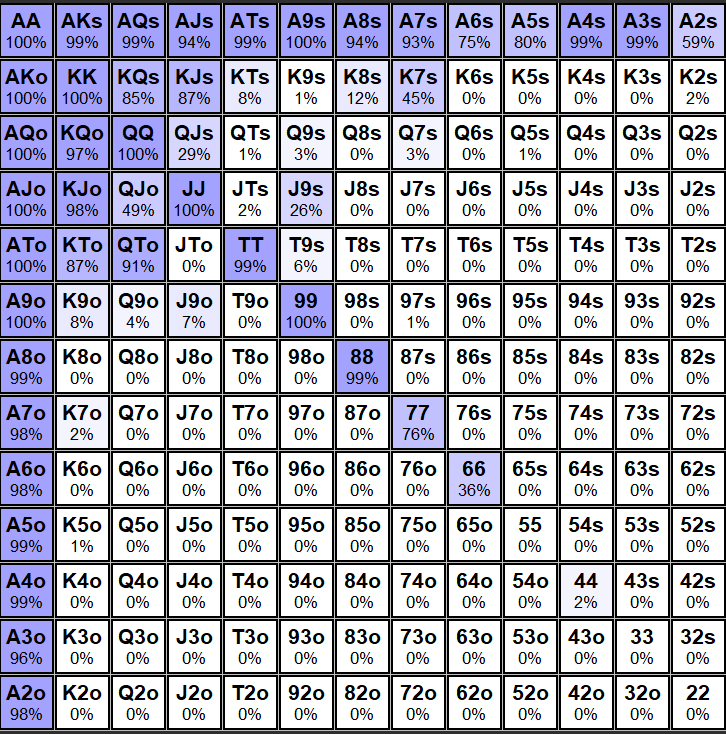
Serock was the chip leader at the time, so he got to open quite a wide range considering his early position and the ICM pressure. Notice how Ace-x heavy it is. When ICM is significant, blockers become very important. Opening Ace-x is profitable because you reduce the number of hands that will play back at you significantly. A6o is usually a trash hand from early position but Serock was right to open it here.
This is the ICM response that HRC gave Tamayo:
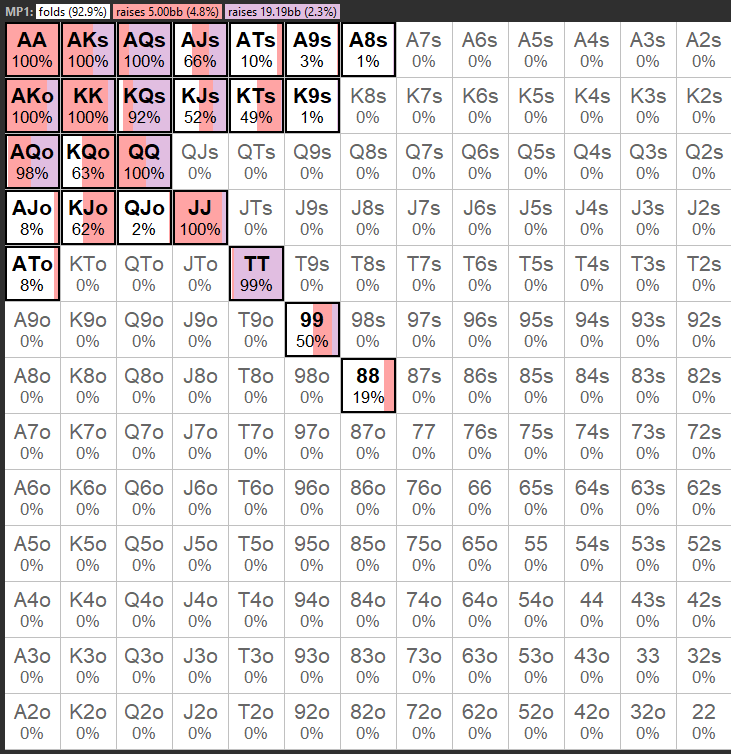
QQ is quite an easy raise. In fact it mixes shoving and raising. Even TT is a continue, it's only 99 onwards that start folding.
QQ makes $143,148 in equity as a shove, so it is worth 14 buy-ins. For context, AA makes $396,540 in equity as a shove. It's often a good idea to use AA as a baseline for judging how profitable an action is. KQo, for example, makes $3,097 as a raise, which does not seem like an action worth taking considering there is $10 million up top.
There is a useful rule of '5 and 10' here. If something makes less than 5% what Aces make, it can be a justifiable edge pass to reduce variance. If it makes more than 10% of what Aces makes, it should never be passed.
This might surprise a few people, it's actually quite a wide range considering there is such a short-stacked player at the final table incentivising the medium stacks to ladder.
It's mostly due to the fact that Serock's range is supposed to be so wide in this spot, it makes QQ all the more profitable. If we shove with QQ assuming it folds around to Serock, this is his calling range:
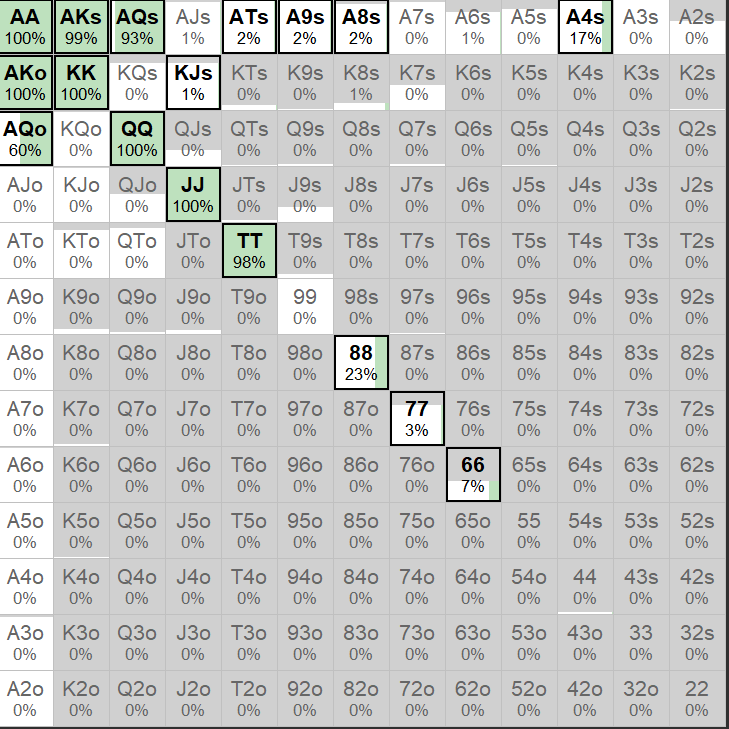
He has to fold 80% of the hands he opened and QQ is in good shape against all of the ones that call apart from AA, KK and AK. This is a very profitable spot for Tamayo.
People wrongly assume that severe ICM means we have to play like Nits all the time. In reality, the main reason for this is we are often dealing with much tighter ranges than normal, but when we are dealing with wider ranges (like that of a chip leader applying pressure as in this case) we don’t have to be as tight.
Again, in Tamayo's defence, I have 100% seen spots where QQ is a fold to an open on the final table bubble. Usually, the person with QQ is more threatened and/or in an earlier position, with more players acting behind to worry about. This is especially the case when a super short-stacked player is on the brink of elimination.
Another factor here is that the payouts are more top heavy than regular MTTs, which makes ICM less extreme. You are more incentivised to go for the win or a top three spot and less incentivised to ladder.
It's possible the prestige of making the final table and locking up seven figures may have influenced his decision. There is an emotional bubble where the Main Event final table is concerned, it is a career-defining moment that can open up new off-the-table opportunities.
Most importantly, he lives to fight another day with $10 million up top, so he may look back on the fold as the best decision of his life. Good luck to him!
You can get Dara's free book on effective poker study by joining his mailing list.
