


How to do poker drills
Dara O'Kearney shares what you should be looking at when you use the drill feature in poker solver trainer tools.

One of the biggest step forwards in poker training has been the ability to 'drill' spots with a solver. This is where we play a risk-free hand of poker in the solver and get a GTO score based on our play.
Everyone should be using the drills features at apps like GTO Wizard, but there are pitfalls many players find themselves falling into.
The first thing to say is that if it's your only form of study, you are missing out. There are two distinct stages of poker study - acquiring new knowledge and consolidating existing knowledge.
Drills are a form of the latter. They are the sort of thing you should do after studying, whether it is doing a hand review or learning from books, a coach or a video.
Drill high-frequency spots
The next thing to consider when drilling spots is the frequency of the spot. The hand you played that was a UTG vs UTG1 4bet pot might have been really tricky, but those spots come up rarely. BTN vs BB single raised pot, however, comes up so frequently that you need to get your strategy right.
When you do pick a spot to drill, study the preflop ranges first. Familiarise yourself with the shape of the ranges and hypothesise which boards favour which player. This will get you thinking in terms of range rather than hand when you do the drills.
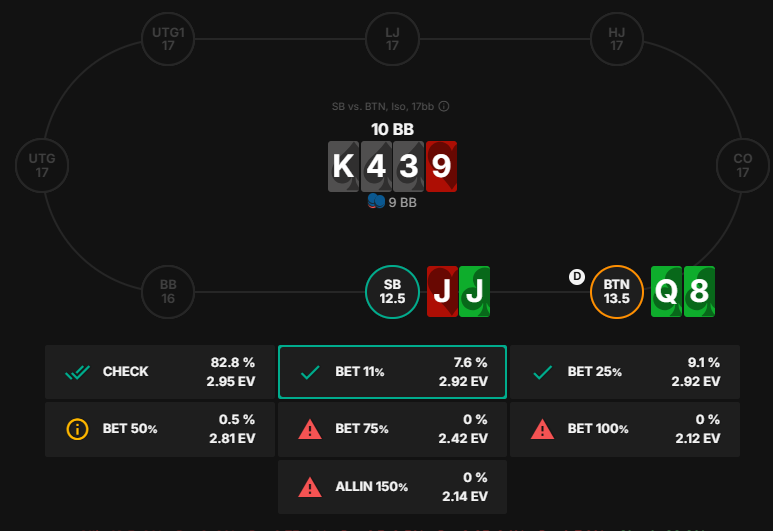
One thing my students get overly fixated on is the wrong metrics. They will, for example, pay too much importance to getting a streak of correct results. Or they will try to pick the highest frequency action every time.
For me, the only really important metric is EV Loss. This is how much you would lose if you played your strategy against a perfect player. Rather than trying to get your best streak ever or the highest frequency action, reducing your mistakes will have the greatest impact on your bottom line. The more you reduce EV loss, the more unexploitable your game becomes.
Ask what the exploit is
The benefit of drills is they turn study into a game, but remember it should also be study. If you blunder a hand, either mark it for later or break away from your drill right away to study the spot. Remember drills are about consolidating existing information, if you discover a blind spot you need to fill in the knowledge gaps.
Finally, whenever you review a hand, end by asking yourself how real-life opponents would play instead. Picking the perfect bluff-catching hand in your drills is great, but always ask how the regulars in your game would play. You don't want to play a GTO bluff-catching strategy against players who never bluff.

When you end by asking this question, you essentially drill the GTO solution and the exploit in unison.
You can get Dara's free book on effective poker study by joining his mailing list.
