


Is All-in Cashout good for your mental game?
Mental game coach Jared Tendler discusses the pitfalls and advantages of the new variance reducing offering from PokerStars

If variance didn’t exist, poker as we know it would not exist.
Many new clients, especially those players with less experience, come to me with issues related to a misunderstanding of variance. They understand the math of variance reasonably well in theory, but in practice can struggle to believe what is actually possible. They know a long stretch of hands where nothing goes their way can happen, but when they actually go through it, tilt is likely to pop-up, especially 'entitlement tilt', 'injustice tilt', and 'hate-losing tilt'.
My advice to all poker players with mental game leaks has always been to do as much work as possible understanding the fundamental math and strategy first, before tackling the mental game.The better you get at poker, the less a mental game issue will develop in the first place.
So naturally I was very interested to see the latest development from PokerStars, All-in Cashout, which essentially allows players to take their EV when they get all-in, for a small fee.
Aim to make the best possible decision
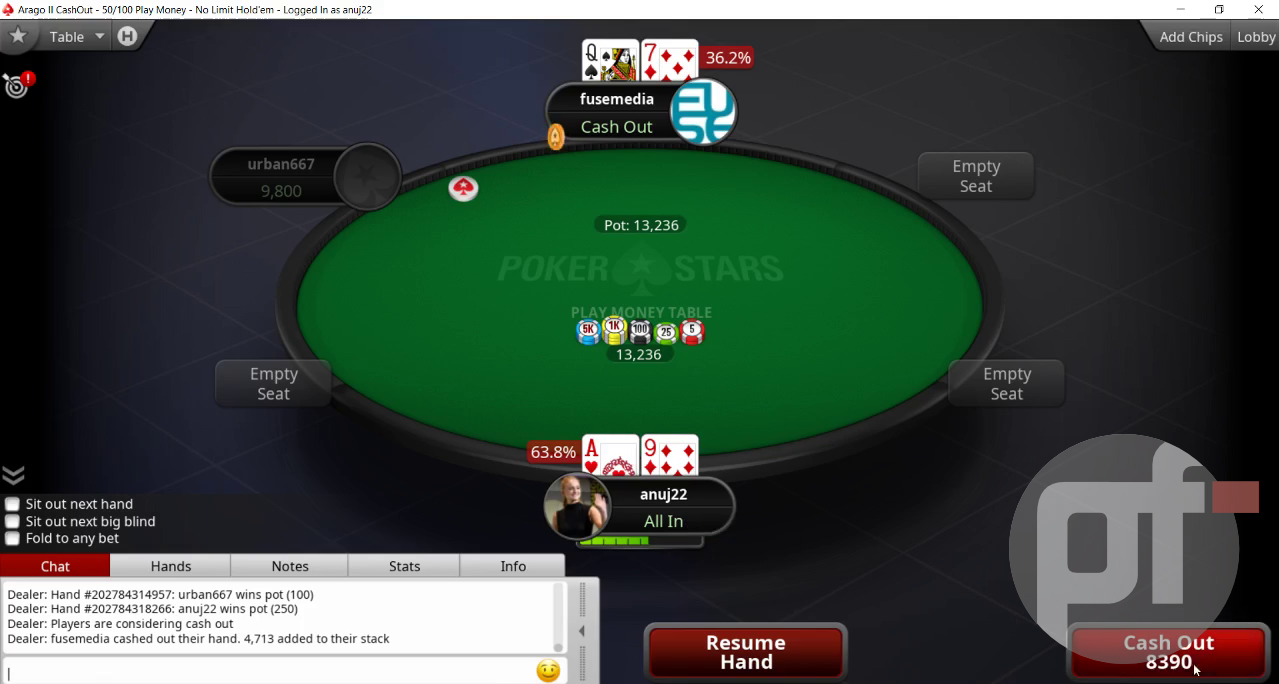
If you visit the poker forums the consensus seems to be that the 1% fee makes All-in Cashout completely unprofitable. That may be the case, but I can guarantee there will be grinders taking it even though they know better.
The brutality of a downswing is often so severe that a lot of otherwise talented players will act against their bottom line to avoid it. Everyone has their breaking point and PokerStars has found a way to make money when you hit yours.
As a poker player your aim should be to make the best possible decision you can make, each and every time, so I obviously would advise against taking All-in Cashout. If you find yourself wanting to take it even though you know sacrificing 1% every pot you use it would be too costly, I suggest you spend more time studying variance itself.
A short term advantage

However, there is a scenario where there could be a short-term advantage for taking it. If you have severe mental game issues you can use it as part of an overall strategy to fix the mental game issues surrounding variance so eventually you won’t need it.
In that way using All-in Cashout is what I call a ‘containment strategy’ similar to playing less tables, quitting before you go on tilt, or dropping down in stakes when you are on a downswing. All of these are expensive to your winrate in the form of opportunity cost. They are useful, just not long term.
If you have a tilt issue that is likely to erupt following a string of bad beats, treat All-in Cashout like training wheels. Focus on making the best strategic in-game decisions you can and work on your tilt issue away from the tables. Then, when you feel you are making improvements to your mental game, gradually ween yourself off it. Perhaps use it half the time, or only in the final 20 minutes of a session, until you eventually don’t need it at all.
Blindly using All-in Cashout just to avoid pain is a mistake, one which will not only cost you 1% every hand you use it but also in terms of your development. The longer you avoid correcting the cause of the mental game issue, the stronger the problem will become. If you do use All-in Cashout, use it with the goal in mind of eventually becoming mentally strong enough not to need it.
Have you been using All-in Cashout? How has your mindset changed since using it? Let us know in the comments:
