


Are the micro stakes too small?
With PokerStars testing the removal of 1c/2c, is it a sign that most players would play higher if they didn't have a choice?
Last week PokerStars started an experiment with their Belgian players, by removing 1c/2c games, which are currently the lowest stakes cash games. No doubt that this was to see whether casual players just play the lowest stakes they can find, or if there are some people who will play 1c/2c but would not play 2c/4c?
One of the greatest things about online poker, compared to live poker, is that it caters to so many more people and gives the market what it wants. Go to any live casino and the choice of games is very limited, and usually the smallest games are $1/$2 or equivalent. This is in part because of space and staffing costs for the casino making it the lowest game worth spreading, and also because it is the median stake level for a big portion of the market.
Online poker is great, however, because it allows players to start wherever their comfort level and bankroll dictates. It’s a real baptism of fire in live games jumping into a $1/$2 game as a newbie, but online you can start at $0.05/$0.10, move up to $0.10/$0.20, then to $0.25/$0.50, and so on, and by the time you are playing $1/$2 online, you presumably have ironed out a lot of the kinks in your game.
Some price jumps are bigger than others

While we should always retain this gradual system, there are certain price points in poker where the difference between levels is somewhat inconsequential. Is a 1c/2c player really going to be eclipsed in skill by a 2c/4c player? Probably not. At the other end, $100/$200 players are probably just as good as $200/$400 players overall.
It seems there are some jumps in stakes that are quite seismic, for example the jump from $0.50/$1 to $1/$2 I think most grinders would agree represents a massive change in affordability, required skillset and toughness of competition. However, there are other stake levels where the only real difference is the availability of the game.
Some low stakes players will simply play the lowest game possible, some high stakes players will play whatever stake the biggest fish is playing.
When the money means something
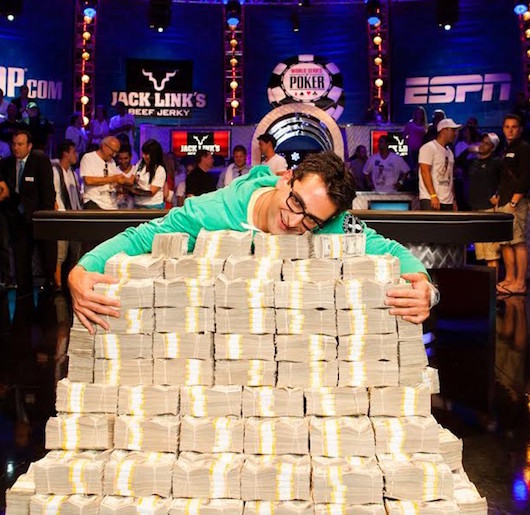
There is also the jumps in stakes where the differentiator is not so much the difficulty of the games, but the meaning of the money. Once you get to around the $0.25/$0.50 level, you are going to have sessions where your winning and losing results might equate to more per hour than a regular job in the western world, so they start to mean something. Likewise, once you start dipping your toes in waters where single pots are in their thousands, most of us recognise that this is serious money at stake.
In this respect, the biggest jump in stakes, and maybe the most meaningful change in price point, is the jump from Play Money and freerolls, to real money cash games. It’s a difficult thing to get people to part with actual money, something business people refer to as ‘the penny gap’, suggesting that it is harder to get a customer to spend a penny than it is for them to go from spending a penny to, say, a pound.
In poker, once the players invest their own money, no matter how small, they start to take the game seriously (and some of them finally find the fold button).
Should the lowest stakes be bigger (or smaller) than 1c/2c? Let us know your thoughts in the comments.
