


Security Reminder: Protect Your Poker Accounts
Following the high profile hacking of the 2+2 poker forum this week, we give you a few important reminders on how to protect your computer and poker accounts from security breaches.
 This week poker forum 2+2 was shut down after getting hacked, with the security of thousands of accounts being compromised. Members have been advised that if they have the same passwords on other sites, to change them as soon as possible.
Hacking is unfortunately all too common in online poker, and in recent years high profile players like Daniel Negreanu and Greg Raymer have been the victims of costly hacking attempts.
So this seems like a good time to remind you of some simple things you can do to prevent your own poker related accounts from being compromised:
Don't give anyone access to your computer
It should go without saying, but never leave your computer in the hands of someone you do not trust. One of the tricks of hackers is to covertly install malware on your computer, in order to gain access to your personal accounts.
This is not just in person that you should heed this advice. The same issues can arise if you allow someone access to your computer remotely via screen sharing software such as TeamViewer. In poker, this software is often used when one player is sweating another in a coaching session.
Always keep your computer protected with the latest software
Make sure your computer and internet browser is up to date with the most recent operating systems available, because these often included the latest security updates. Likewise, it is a must to make sure you have a reliable anti-virus programme like Norton, and keep it updated.
Phishing
 Phishing is a way of attempting to acquire passwords and information via email, by posing as a trustworthy source. So for example, you may get an email from your bank asking you to update your details, but when you click on what looks like a link to your bank, it is actually a hackers site waiting for you to input your details.
Not only does phishing happen via email, it can also happen via things like MSN or Facebook, with hackers posing as friends to lure you into a false sense of security.
Be very wary of any trusted source that asks you to log-in to their site via an email, and especially one that asks for your personal information via email reply. As a safety measure, instead of clicking on the links in an email, separately open that sites main homepage and access it that way. Also look out for emails with spelling and grammatical errors from professional sources, as well as emails that just look poorly presented for such an established company.
Finally look out for "masked URLs", which is where a hyperlink might appear to go to the official site, but actually goes elsewhere. This is usually as simple as right clicking on "edit hyperlink" on the URL to see if it differs from what is presented to you.
Consider having separate computer just for poker
If you are a serious player and have significant sums of poker money online, you might want to consider having a separate computer which you use only for playing poker. That means no Skype, MSN, Internet Explorer, or any other programmes, to be used on it ever.
Not only does this mean that you vastly limit the chances of getting your poker accounts hacked, it will have the secondary benefit of reducing the number of distractions you encounter while you are playing.
Multiple email addresses
It is also a good idea to have a number of separate email addresses for every sensitive account you hold. So a separate email address for every bank or credit card you own, and likewise a separate email address for every poker room account you have. This may seem excessive, but the likelihood is if your poker accounts were ever compromised, the hacker would be knowledgeable of poker and start attempting to log into every major poker room using your email address.
Passwords
 It sounds obvious, but avoid passwords that are easy to guess, in fact, it probably makes sense to make them unrelated to poker. If your password is poker123 or WSOP2012 then you are asking for trouble.
Make sure your password has at least 14 alphanumeric characters, including special characters. Most poker rooms have a barometer of the security level of a password when you go to change it, so make sure you have one rated as very difficult to guess.
It is very important that you do not use the same password across multiple accounts. If your password is the same at your bank, your poker rooms, your forums, and your Facebook account, the hacker only needs to guess it once to get access to everything. Make sure your passwords differ from site to site, and get into the habit of changing them regularly.
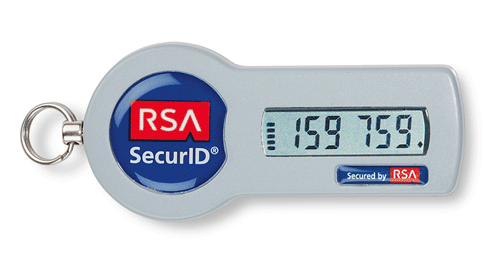
If the poker room you play at offers an additional wall of security, for example an RSA token, don't miss out on using these excellent precautionary tools.
