How ICM changes post flop strategy
Using the new ICM features at Postflopizer, Barry Carter gives you the low down on post flop analysis when ICM is significant.
Our friends at Postflopizer have just introduced ICM calculations, including bounty calculations, to their post flop offering. This gave me an excuse to review some post flop hands and share some of the lessons I have learned about post flop ICM.
When reviewing postflop ICM hands, the way to extrapolate knowledge is to run the exact same spot in ChipEV too. The difference between the strategies will point to how ICM should change your strategy in general.
This is not a perfect apples-to-apples comparison, however. The reality is the preflop ranges and the post flop bet sizes would be different initially, so you can never make a perfect comparison. In this instance, I have compared the same ranges, which is HJ vs BB single raised pot, 25BBs effective, with a small bet, big bet, and shove as an option for each player on every street. This is a toy game, not a perfect example of what the bet sizes should be.
The big difference is that in the ICM example, we are on the bubble and the BB has a 2-1 chip advantage over the HJ. There are also some short stacks at the table adding ICM pressure.
The flop is AQ9 rainbow and in ChipEV world this is what the BB does first (in ChipEV world the BB defend would be wider, but I went with the prefilled ICM range for this spot):
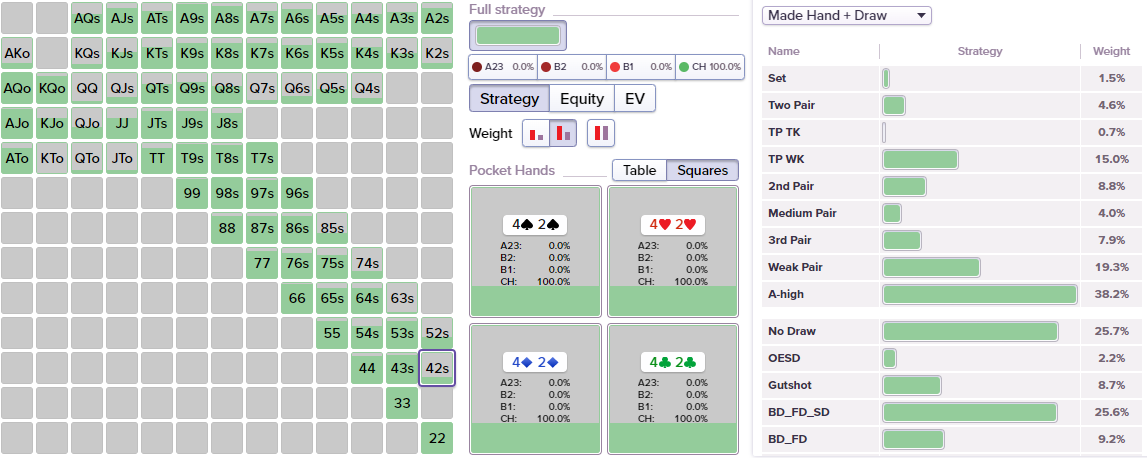
No surprises here, the BB tends to check 100% of the time to the preflop raiser, especially on Ace high boards where the HJ has a significant range advantage. In this case, it is 66% in favour of the HJ.
However, with the exact same ranges, this is the BB first action in the ICM example:
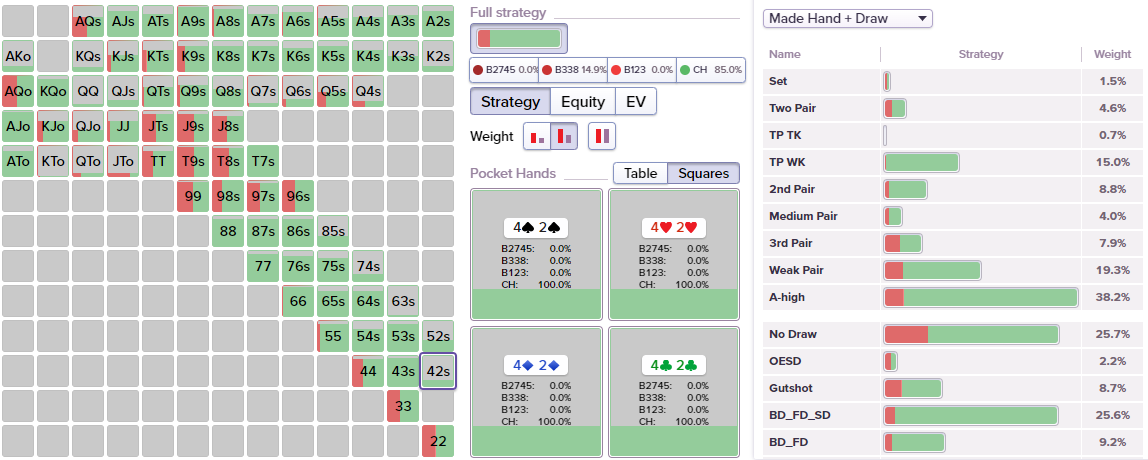
The BB leads out 15% of the time despite being at range disadvantage. This is because they cover the HJ and can exert significant ICM pressure on them. This is perhaps the first rule of post flop ICM, the covering player can be much more aggressive.
One of the reasons why can be demonstrated when we look at what happens when the BB checks. First in the ChipEV example:
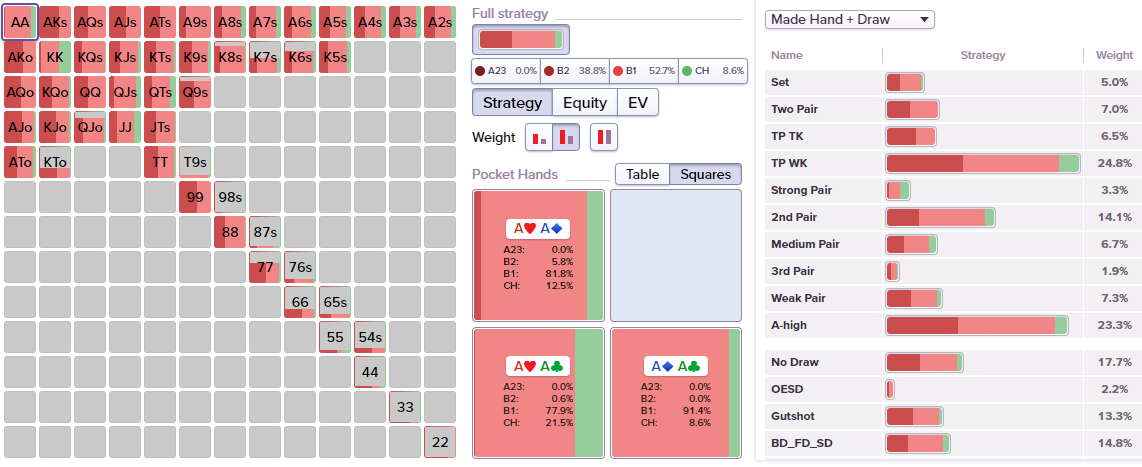
The HJ bets almost all the time here, because they have significant range advantage. They mostly use a small sizing but there is a significant big bet range too, which is typically done with strong but vulnerable hands like Ax. Hands that want to get more money in now while they are ahead, but have plenty of turns they do not like.
Compare this to what happens when checked to in ICM world:
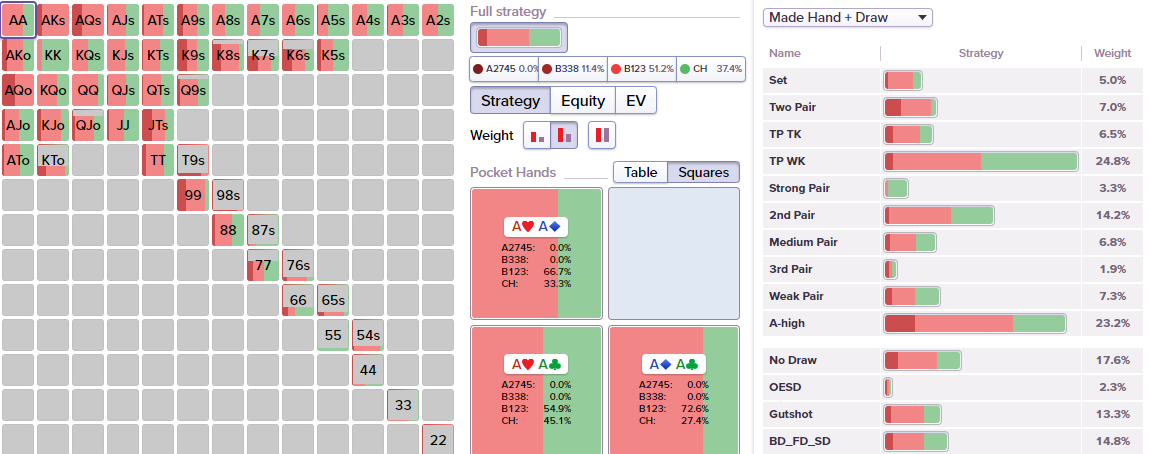
Two things are self-evident. First of all, the HJ is much less aggressive, because they are covered by the BB. They do not want to get check/raised here and be put in the ICM coffin. A hand like KK almost never bets, even though it can get value in ChipEV world it would just have to fold too much in ICM world.
This is why the BB leads out more as a first action. It's less to make the HJ fold often, it's more to get value because the HJ has to check back more often.
The second noticeable difference here is that the bet sizes go down, we see much less big betting from the HJ. This is another cardinal rule of post flop ICM, players at risk will take lower variance options. Checking and small betting keep the pot small and give us relatively easy decisions later on in the hand, compared to putting a lot of money in with a big bet and then facing aggression later on with more chips committed.
Let's now look at what happens when the HJ fires out a small bet, first in ChipEV world:
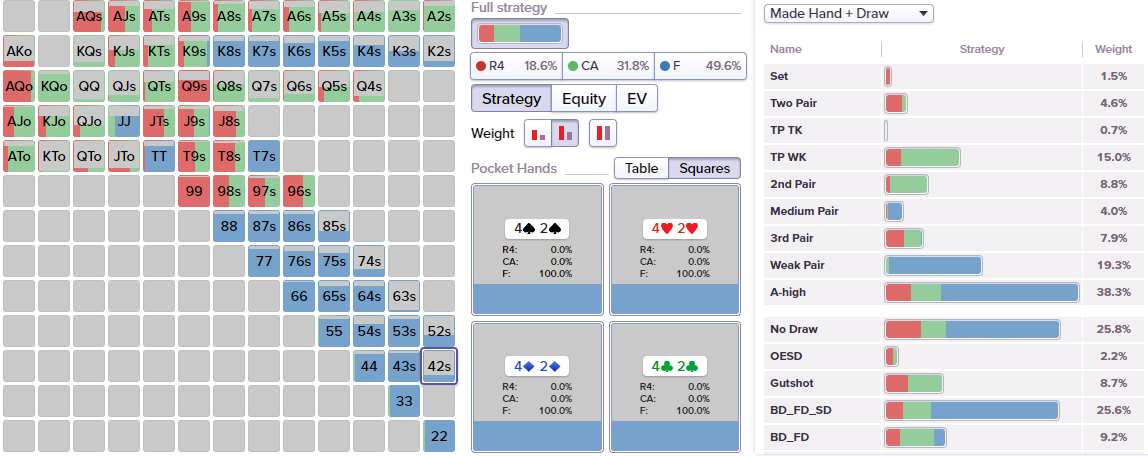
And then in ICM world:
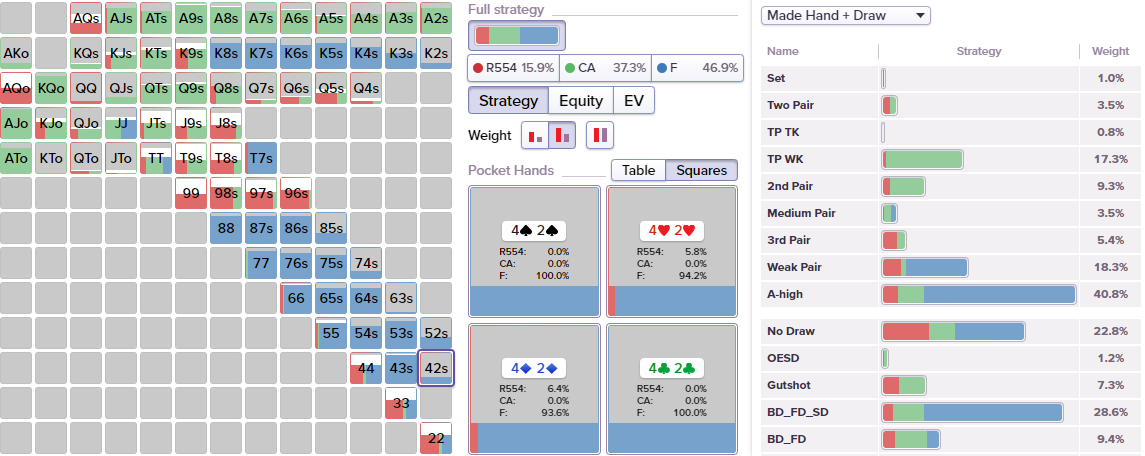
The response from the BB is quite similar with a few wrinkles. They fold less in ICM world. This is likely because they can exert ICM pressure on later streets, and because the HJ will slow down a lot more often on the turn and river.
There is less raising with Ax hands that want value from the BB in ICM world. This is because the HJ is much more likely to fold, so these hands are played passively to extract more value later. The bluffs in ChipEV world are hands like JTs and T8s that have gutshots or double backdoor draws, because they are semi bluffs with some equity against the HJ's calling range. In ICM world small pairs have been introduced as bluffs, these are hands with very little equity indeed and the only way to make money with them is to get the HJ to fold.
The big difference between the raising ranges is that in ChipEV world we expect to get called a lot, in ICM world we expect folds a lot. The range adjusts accordingly to reflect these outcomes. Just to confirm that, this is the ChipEV response from the HJ when the BB check/raises:
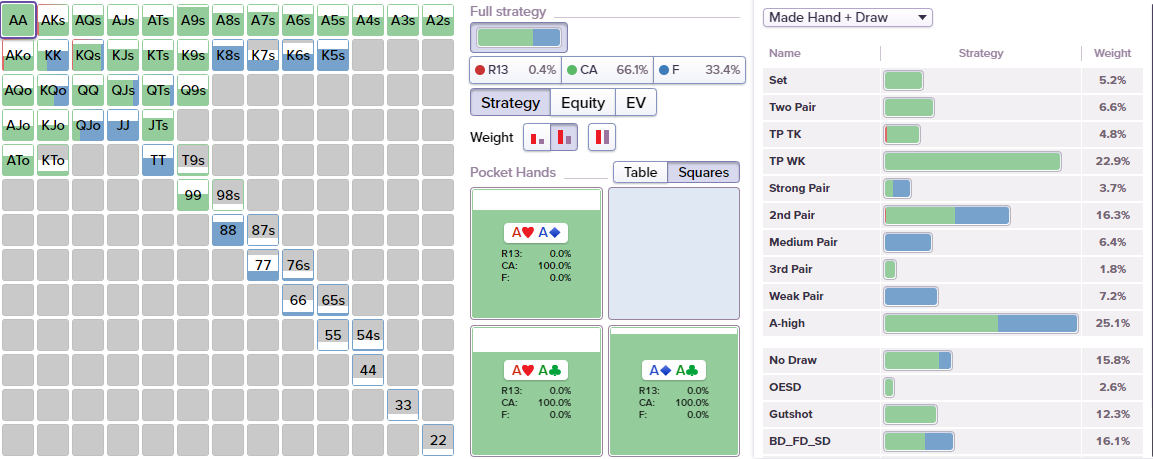
And this is the same situation with ICM
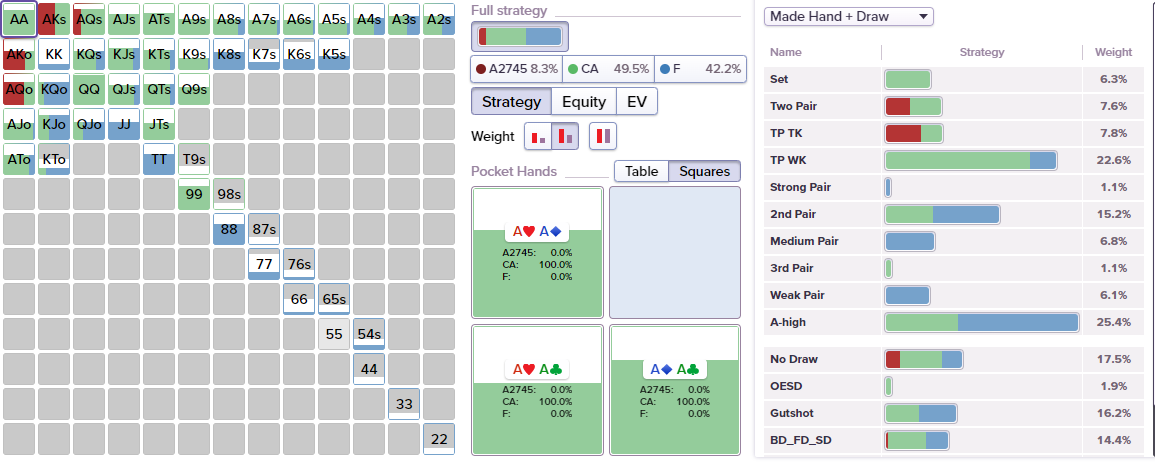
In ChipEV world the HJ folds just 33% of the time, in ICM world they fold 42% of the time. In ChipEV world the HJ never raises because it does not want to fold out bluffs, but in ICM world the HJ shoves some of the time with strong hands. This is because the HJ is happy to get folds, even with top pair top kicker, to take the risk of being outdrawn off the table. This is another fundamental rule of post flop ICM, fold equity is the most important form of equity, it's never a bad result if your opponent folds equity in ICM extreme situations.
I am going to do some more of these articles but to recap, in ICM post flop spots:
- The covering player can be more aggressive
- The covering player can lead more because the covered player should check back more
- Bet sizing goes down
- Low variance lines are favoured
- Fold equity goes up in importance
Learn more about Postflopizer

In a world of advanced poker software one of the biggest barriers to entry can be understanding how to use the tools in the first place before you even try to work out what their outputs mean.
The GTO revolution started because of PIOSolver, which changed the game for advanced players. But it has been frustratingly difficult to use, in some cases even set up.
Step forward Postflopizer from our partners at ICMIZER. This is billed as 'the first solver you will actually use' and that is exactly why you should pay attention. This is a solver you can use to review your own post-flop hands seamlessly and easily.
Players who are new to solvers can quickly jump into doing their own solves without having to consult a lengthy manual or tutorial video. It has an intuitive interface with all the needless elements removed for simplicity.
It is also very quick..but reassuringly not quick enough that you would ever have to worry about it being used as RTA.
Perhaps the best reason to consider using Postflopizer is that it's a one time payment. No expensive subscription fees every month, pay once, use forever!
Postflopizer features
Postflopizer includes all the features you would expect with a post flop solzer, and then some. You can expect:
- Advanced strategies for post flop hands - just input the ranges, bet sizing and the flop!
- OOP vs IP EV and equity analysis
- See how different types of hands play in different situations
- Advanced nodelocking - adjust the strategy to reflect real life opponents
- Parrallel analysis - jump between two different solves to compare and contrast
- ICM postflop analysis
Our editor Barry Carter was an early user of Postflopizer and he had this to say:
My next book with Dara O'Kearney is all on exploits, ie. nodelocking. Trying to use the nodelocking feature on PIOSolver was incredibly frustrating, but with Postflopizer it really was just a few intuitive button clicks. I'd recommend it for its simplicity alone, but it really is a bargain too with it's one time payment option instead of a subscription.