


Should $10k main event buy-ins increase?
Is the increasing interest in high roller events a sign that the standard $10,000 main event buy-ins should increase?
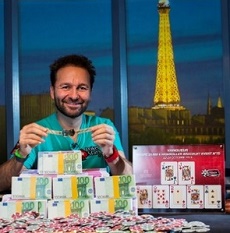 |
| KidPoker's latest bracelet was a high roller |
The high roller event was once a novelty on the circuit. A $10,000 Main Event was considered very high stakes anyway, so to have a side event with a bigger buy-in was a rarity.
Now most EPT/WPT/WSOP festivals have high roller events ($15,000-$25,000), and in many cases a super high roller event with a buy-in of $100,000+. The super high rollers tend to attract around 40 players - which is very respectable when you think of how ridiculous the buy-in is.
The standard high rollers, however, often command very strong numbers. Well over 100 players at each event and usually closer to 200. This is how big the fields in some EPT and WPT main events were less than a decade ago. In fact I have heard many pros say that the high rollers feel like the main events used to around the time of the boom.
Because high rollers established themselves so well on the circuit, is it a sign that $10,000 is now too small a buy-in for the EPT/WPT/WSOP main events? Should high rollers get promoted from being side events to the official main events?
$10k is still $10k
| High rollers vs Main Event in the last twelve months |
| A selection of $15,000-$25,000 high roller events compared to the $7,500+ Main Event from the same festival:
EPT Deauville: 85 vs 782 London (Season 9):112 vs 647 Berlin: 107 vs 912 Barcelona: 180 vs 1,234 London (Season 10): 119 vs 604 Prague: 137 vs 1,007 PCA (2014): 198 vs 1,031 WPT WSOP: |
When the WSOP began in 1979, $10,000 was worth the equivalent of about $32,000 today. In 2003 when the poker boom happened, $10,000 was worth about $12,000 in today's money. So it is not as if $10k is just not worth that much money any more.
$10k is still a jaw dropping sum of money for anyone to be playing in a single game that the average man could not begin to afford. In fact it probably feels worth much more because of tough economic times.
However when poker exploded, there was so much money being wagered that it was inevitable that some people would amass big bankrolls and no longer get excited about $10k events.
There is clearly a demand for high roller events, given the numbers are usually pretty strong for them. Perhaps the biggest sign that there is a healthy high roller scene out there is the fact that there was 166 players in the $111,111 One Drop event last year.
For anyone involved in the poker industry, there is an obvious big advantage to having high roller events. The unknown recreational players and online qualifiers get naturally selected out of the field, meaning that we have made-for-TV final tables and famous winners almost guaranteed.
This is great for the televised poker broadcasts, great for the sponsors and great for the sponsored players. It is a way to go back to the good old days when all the same faces were at the final table. The days before TV Pros had to navigate through large fields of unknown (and becoming increasingly more skilful) competition.
Is it time to replace the $10ks?
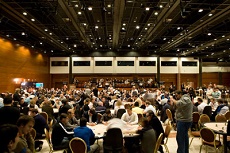 |
| $10k fields will always be much bigger |
I could never see a $25k or $100k event at a WPT or EPT event becoming the official main event on the regular tour, and I doubt tournament organisers or the majority of the poker community feel any different. High rollers are fascinating to observe and fill a gap in the market, but they could never replace the normal main events.
High rollers will never appeal to most recreational players and they would get little interest from online satellite players because the seat value is a prize most people would want to cash out instead. Recreational and satellite players are arguably the bread and butter of live tournaments. The recreational players make them profitable, the satellite winners significantly increase field size.
You would also miss out on the great organic marketing stories that make poker so appealing. Stories like 'Plumber wins $1 million' or 'Man turns $5 satellite into six-figure score'. These stories, in particular the one of accountant Chris Moneymaker turning $30 into $2 million and a world title, are what makes poker such an appealing game.
Two poker markets, one poker tour
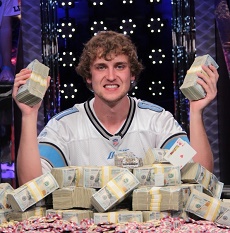 |
| $10k events are aspirational |
At the moment there seems to be two very distinct live poker markets, and neither of them necessarily suited to the 10k events. We have the high rollers, obviously, and at the other end of the equation, mid-stakes events are positively booming.
The $1,000-$1,500 events at the WSOP are getting thousands of runners, as are regional events like UKIPT, the Estrellas Poker Tour and the Eureka Poker Tour.
But the $10k events are still important because they bridge the gap between these two markets, in that they remain a perfect aspirational sized event for mid-stakes players and big enough prize pools for the high stakes guys.
Most players are not bankrolled for 10ks, but there are plenty who can afford to take a shot in a satellite or who are good enough to get staked into them. Even though they may prefer high rollers, the $10k events create such huge prize pools that the elite players can't ignore them.
While I don't think $10,000 buy-ins are ideal for either market alone, they are the perfect middle ground where both markets can meet. Pricing them any higher would be a mistake.
Do you think the EPT/WPT/WSOP should increase their buy-ins? Do you think that there is a case for even lowering the buy-ins to maybe $5,000? Give me your views in the comments box.
by Barry Carter
