


How similar are chess and poker?
Following the success of Jennifer Shahade in both disciplines, Barry Carter looks at the marriage of these two mentally taxing games.

This column was inspired by n10juan over in our Italian community, who is a big chess and poker enthusiast.
People who do not understand poker would likely laugh if it were compared to chess. To untrained eyes chess is a stoic, studious and high society game, while poker is considered by some to be degenerate seedy gambling. To those that know both, however, the strong link between the two is undeniable.
It turns out chess and poker have even deeper roots than you may have guessed, as both are thought to be Persian in origin. The legend has it that mathematician Sissa Nassir invented the game to distract the King from his grief at the loss of his son, who died in battle.
If there is one player who is currently demonstrating the bond between the two, it is Jennifer Shahade, who is known for excelling in both.
The big difference is money
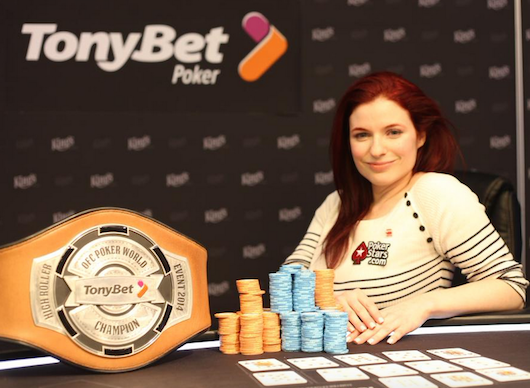
Earlier this year she put on an exhibition where she simultaneously played three chess and three poker matches at the UKIPT event in the Isle of Man. Just last week she won the biggest ever Open Face Chinese Poker tournament for €100,000.
Before she made her name in poker, her brother Greg, also a chess master, had a lot of media attention when Tom Dwan played him at chess for $50,000. Dwan lost.
Dwan was by no means a great chess player, but this prop bet was by no means reckless. Unlike poker, it is not commonplace for chess matches to involve money, especially playing for one’s own. Greg Shahade admitted that the match against Dwan was very difficult, because the pressure of playing for such high stakes was unusual.
This lack of money is why you see a lot of chess masters migrating over to poker, including world number five Hikaru Nakamura and former child prodigy Jeff Sarwer.
More similarities than differences

Skilled poker players and chess masters share a lot of traits. Concentration, patience, planning, anticipation of the moves and adaptation to the opponent. Not to mention that both games have an incredibly strong psychological component.
My colleague informs me that a game of chess plays out similarly to a poker hand. The early stages of chess are like preflop and flop, which tends to be quite simple, predictable and straightforward. Whereas the later stages of chess are like the turn and river, where the stronger tactical minds will thrive.
Then of course, we have to address the variance in poker. You could play ten heads-up matches against Phil Ivey and although you would expect to get crushed overall, it would be a surprise if you didn’t at least win a couple of them. However, you could play a hundred matches against chess master Alexander Grischuk and not even come close to winning once.
The variance factor
This disparity between skill and variance, however, is precisely why there is money to be made in poker and not chess. Bad players win in poker, which is why bad players play. This also means that all you have to do to win at poker is game select well. In chess, there is no such thing as ‘bumhunting’ – the bad players do not find themselves playing the good players, and everyone is very aware of how well they stack up against the field.
I still don’t have a clue how to play chess and have always found it intimidating. I always imagined it to be incredibly complex and required the players to think 50 steps ahead of their opponent. However, I am fortunate to have met many great chess players who play poker, who have helped bridge the gap between the two games.
Most notably, this fascinating TED talk by Jennifer Shahade which explains how chess players think in ‘decision trees’ to chunk together key decisions, which reminds me very much of how poker players think in terms of ranges instead of every single possible hand.
Do you play chess? What has it taught you that has helped in poker? Let me know in the comments.
