


Folding a with less than a BB in satellites l Strategy with Barry

There are some spots where relying on the solver would get you into trouble, and often they will be satellite hands. One of the most important things to understand where ICM is concerned is that your strategy is not just dictated by your own stack and hand, but by the stacks of the other players in the tournament, even those not involved in the hand and even those not on your specific table.
This is exacerbated in satellites and on the bubble. A hand which has a clear decision in a vacuum at your table could have the complete opposite decision if you are aware of what's happening on the other tables. This is mostly based around the concept called the "collision effect" in poker, which is the likelihood of other stacks colliding with each other, potentially giving you a pay jump or a cash.
Folding to survive an orbit
This is a perfect example of a hand I played over the weekend. We are on the pure bubble of a satellite, and I am 30 of 31 players, with 30 players getting a ticket. I am the SB with less than a big blind. The CO limps, and if I complete, I am all-in against the CO and the BB. I have a very favourable hand for such a situation, AKs, but there is just one problem.
I have opened up the table with the shortest player on it, and he is going to be forced all-in with 0.4bbs the next hand.
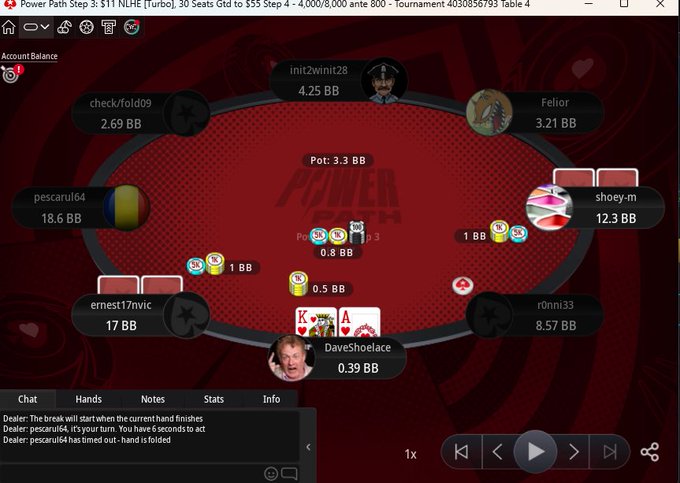
If you put this hand into a solver, this would be a clear call. This is because solvers don't account for future game simulations particularly well.
The fact is that if I fold this hand, I will have the better part of an orbit to survive. This is a PowerPath where the blinds go up very quickly, so I'm not confident that I can survive the whole orbit, but I certainly will survive a few more hands. The other player on the other table, however, is going to be forced all-in. What is most likely to happen is one or two other players at his table will limp to try and reduce his odds of surviving.
It's not an exact science, but below I have put an estimation, using PokerStrategy Equilab, of how often I win if I call versus how often the player on the other table wins if three of his opponents limp. In both instances, the BB is shown as 100% of hands, and the players that limp are shown as roughly the hands which might VPIP in this spot.
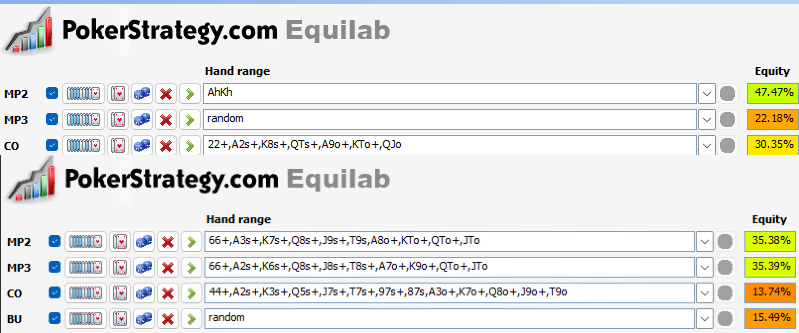
As you can see, I don't even win my hand half the time when I complete. If I fold the next hand, the super short stack player will not survive 85% of the time. So, by calling, I'm a 47% underdog, but by folding, I become an 85% favourite to win a ticket.
What actually happened in the game was that I folded. The next hand, the short-stack player quadrupled up, but fortunately for me, a player I wasn't even observing on a different table went all-in, lost, and I won my seat. This is another argument for folding. The fact that we get several hands before we are forced all-in, potentially a whole orbit, means that we give everyone else in the tournament an opportunity to make a mistake.
And that is satellites in a nutshell. You often make your money from mistakes that are made when you are not in the hand.
