FULL PREFLOP GUIDE, RULES AND RANGES
Spoiler
PART 1- PREFLOP: Detailed [SH] 6 Player Preflop Guide
! Before you read this article, make sure you understand the following:
• Rules of Texas Hold'em & Poker Strategy.
What will you learn:
• The importance of position
• Which hands to play before the flop
• How to use hand charts
• How to manage your poker bankroll
What hands can you play before the flop?
Every great poker player asks himself "Why?" before any action at the table. And the "why" is always to win the most money in the long run. But how do we achieve that goal preflop? First, you need to ask yourself if you are in a blind stealing situation or not.
A "Short Handed" poker table has 3 to 6 players.
Low Jack/Early Position (LJ), High Jack/Middle Position (HJ), Cut Off (CO), Button (BU), Small Blind (SB) and the Big Blind (BB)
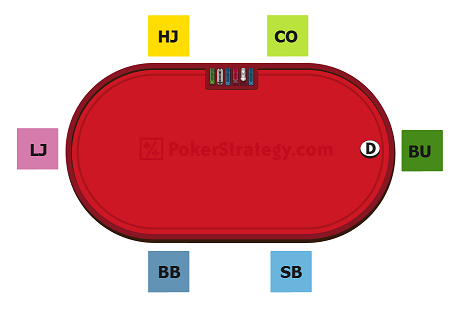
When less than 6 players are seated, the early positions are removed. So at a table with 4 players, there are only positions from CO to BB.
The blinds play a vital role in poker as we know it. Without them, you would have no incentive to play and you could wait for Aces, go all-in and nobody could beat your strategy. But the blinds are there, and you have to fight for them. From the early and middle positions of LJ and HJ you are far from the blinds and cannot directly attack them as you have a lot of players to get through. So you will be playing very few hands. This contrasts with the CO, BU, and SB positions - here you are close to the blinds and should be trying to take them down frequently.
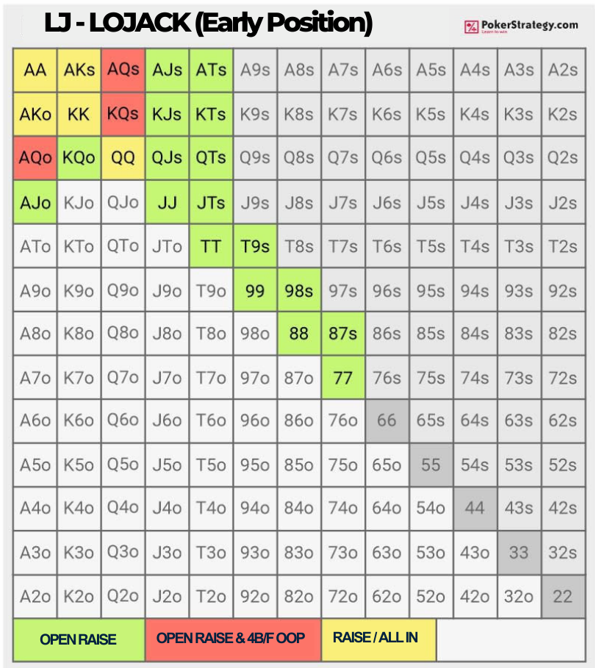
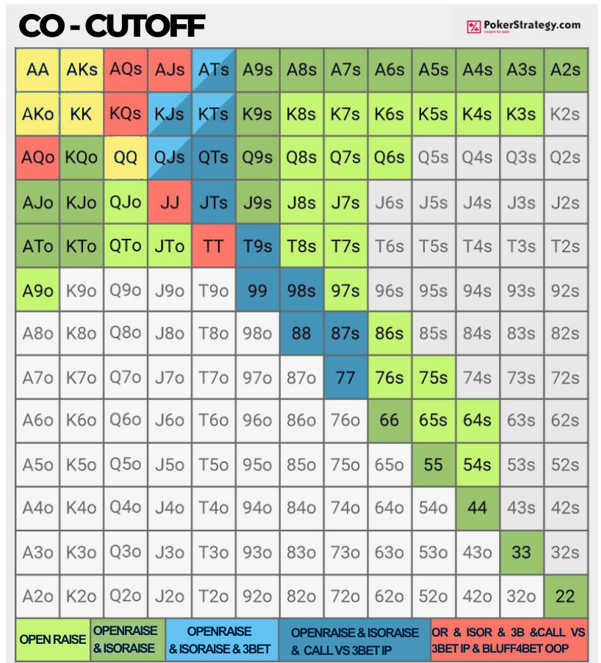
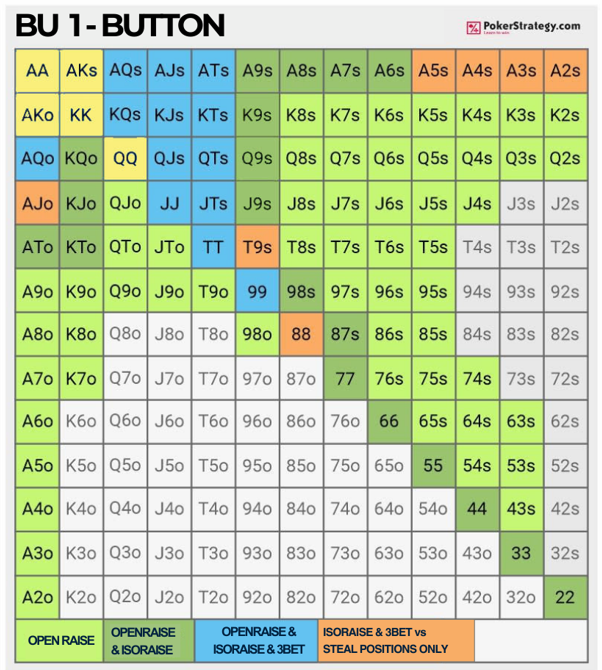
The following ranges (range = a collection of all the possible hands you can have) will show you which hands are worth entering the pot with from each position. The abbreviations they use are as follows:
A = Ace, K = King, Q = Queen, J = Jack, T = Ten
"s" stands for "suited" and means that both cards have the same suit or "colour"
"o" stands for "off-suit" and means conversely that both cards have different suits or "colours"
So ATs stands for:
A♥:T♥:, A♣:T♣:, A♦:T♦:, A♠:T♠:
while KJo stands for:
K♣:J♦:, K♣:J♥:, K♣:J♠:, K♦:J♥:, K♦:J♠:, K♥:J♠:, etc.
Open raise
These hands are only raised if everyone before you has folded. We fold if there has been any action, for example, if a player has limped or raised before us.
Isolation raise
Hands we raise if there are limper(s) who just called before us without raising.
3Bet
Also called a re-raise. We are allowed to raise these hands if there has been a raise before us.
3Bet vs Steal
We only 3-bet these hands if the raise before us was a steal. A steal is whenever the opponent from the CO, BU, or SB is the first to open the action at the table with a raise, i.e. nobody limped or raised before him.
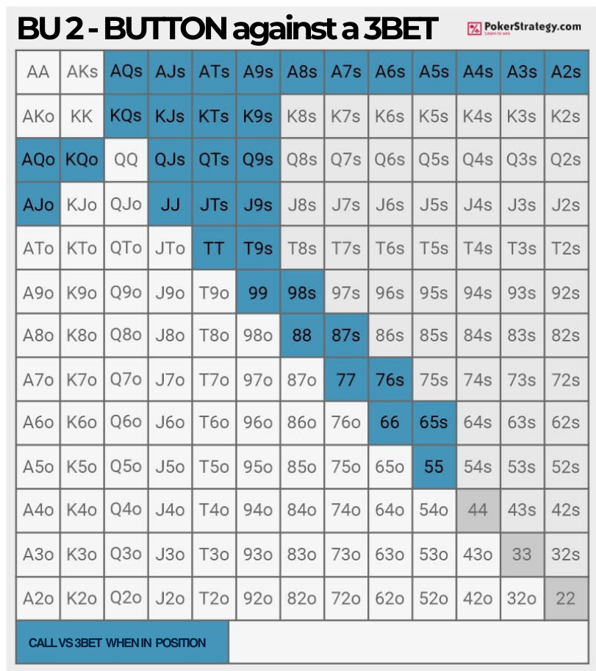
Call VS 3Bet IP
We can call these hands after we raise and get 3-bet, while we have position on the opponent i.e. we will act after him on the flop. If we are Out Of Position (OOP), the hands are not called to 3-bets.
Bluff4Bet OOP
We 4-bet these hands (re-raise opponent's 3-bet) after we have raised, an opponent behind us has 3-bet us, and we are out of position. If there is further action after our 4-bet, we still fold.
LJ/Early Position:

From the LJ, every colour-marked hand is raised to 3 big blinds if we are opening the action pre-flop.
HJ/Middle Position
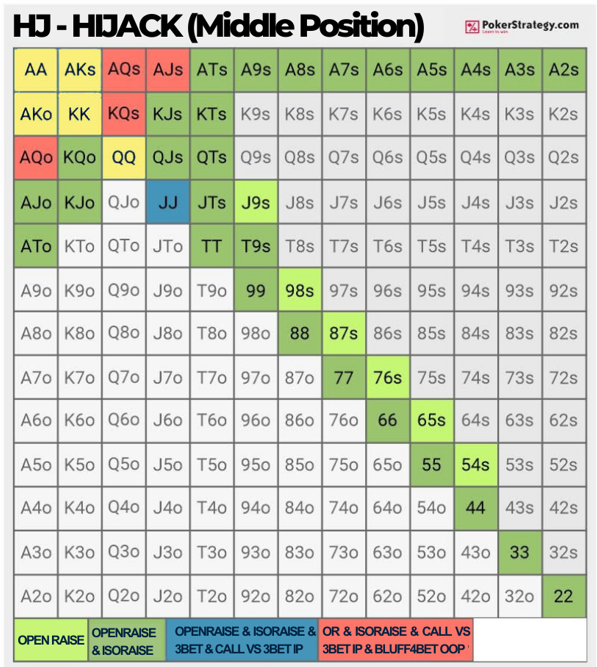
From the HJ, every colour-marked hand is raised to 2.5bb if the Lojack has folded.
CO:

From the CO, every colour-marked hand is raised for 2.5bb if everyone before us has folded.
BU 1:
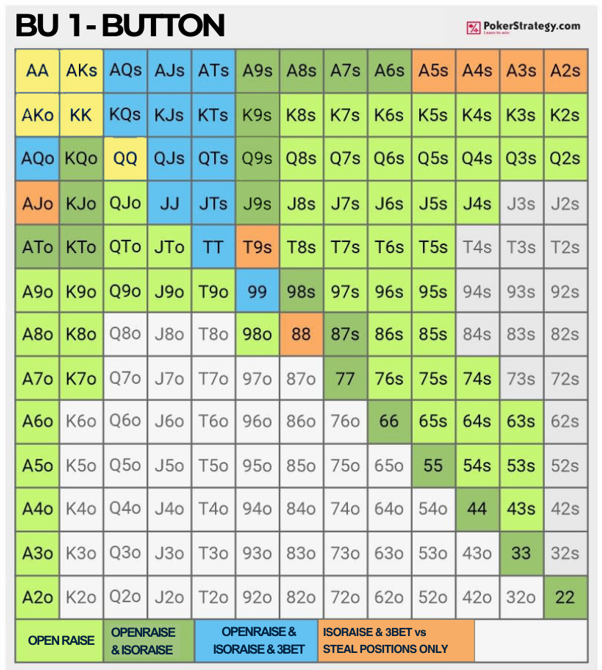
From the BU, every colour-marked hand is raised for 2.5bb if everyone before us has folded.
BU 2: Call vs 3Bet
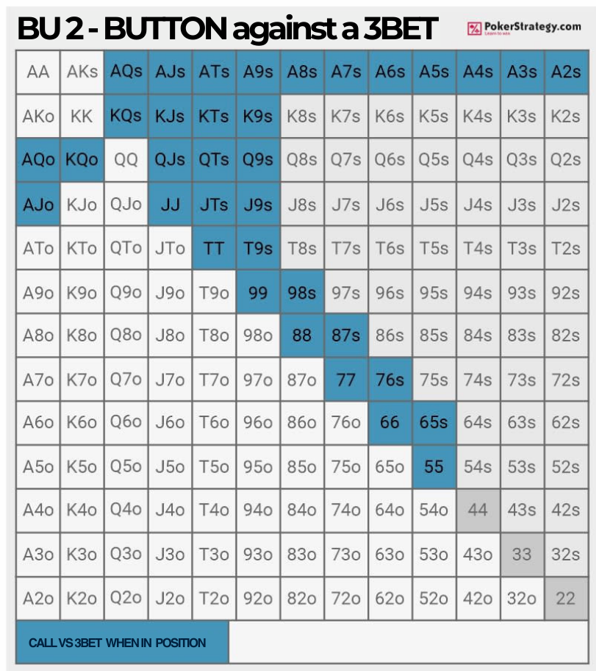
These hands are called if we raised on the BU and are re-raised (3Bet).
SB:
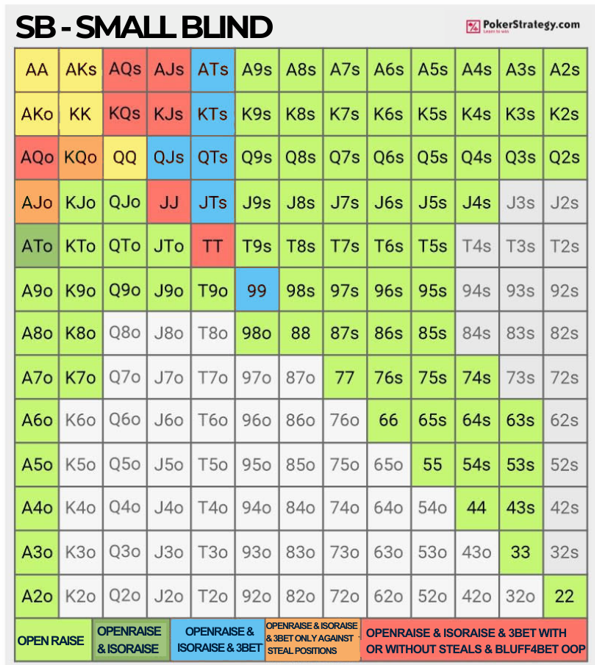
From the SB, every colour-marked hand is raised for 3bb if everyone before us has folded.
BB 1: Raise and 3Bet

BB 2: Call against a Raise
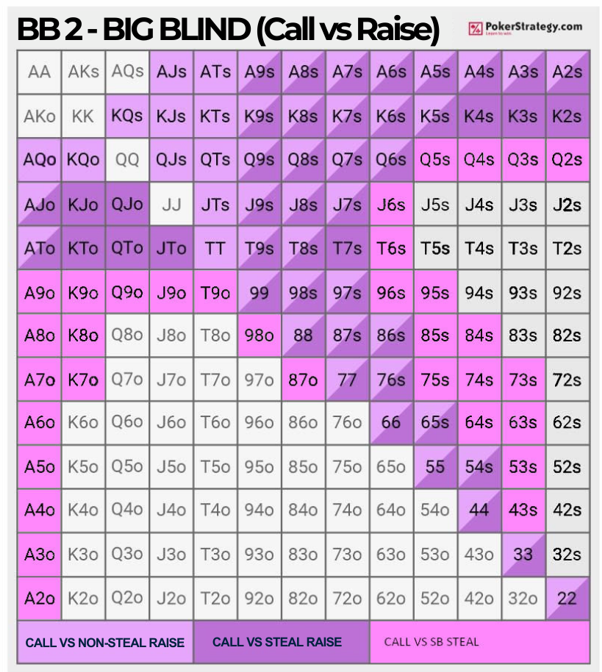
All ranges in one image file for saving and use:
Spoiler
Side by side:
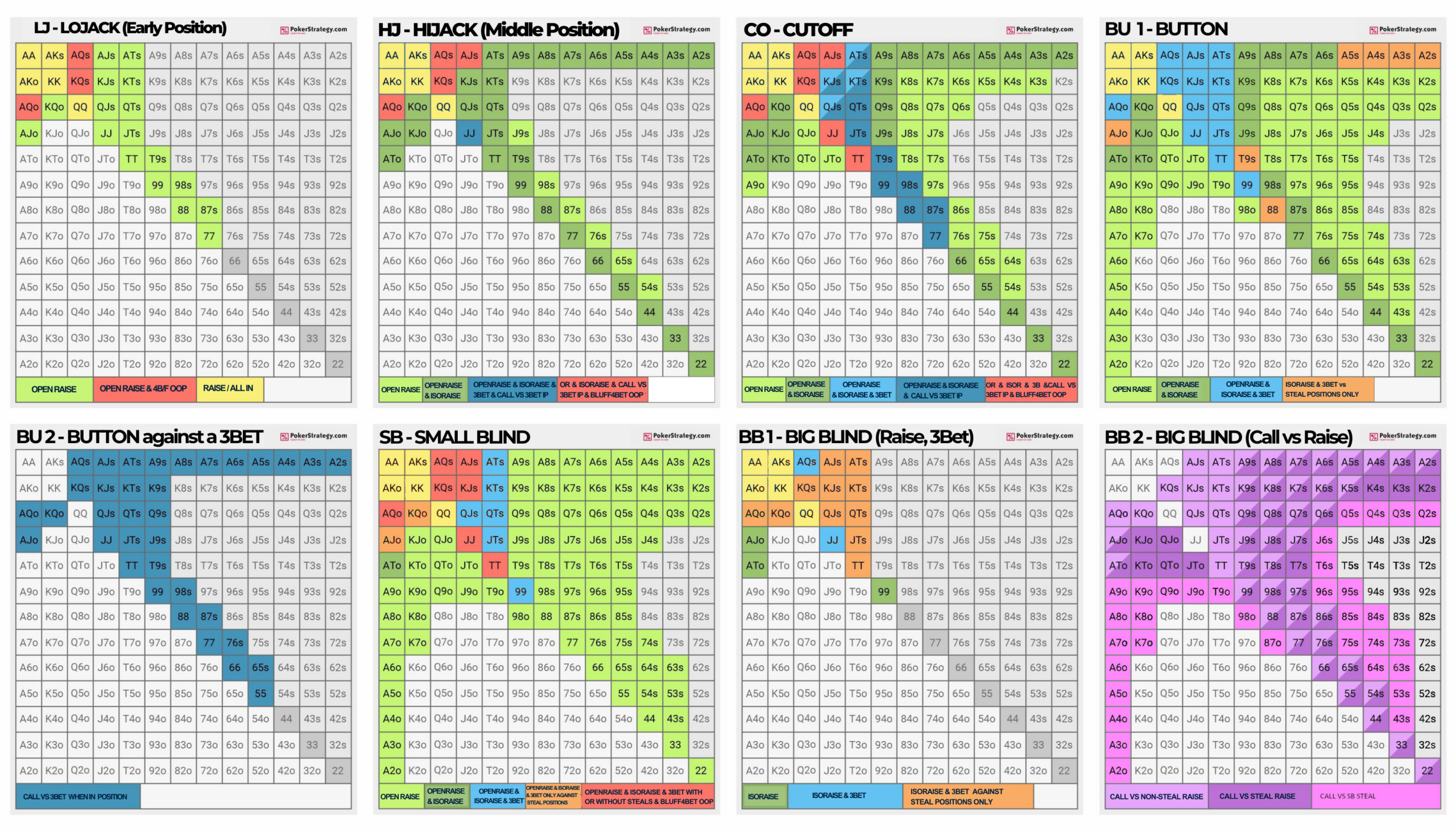
Note on limpers: If you hold a hand that you are allowed to raise after limps and you are in position to the limper, then you raise it for 3bb + 1bb per limper. For example, in the BU against a limp from the HJ, A♥:J♥: would be raised to 4bb, if the CO has entered, it would be raised to 5bb.
If you hold a hand that you are allowed to raise after limps and you are out of position to the limper, then you raise it for 4bb + 1bb per limper. For example, in the SB against a limp from the LJ, K♠:Q♠: would be raised to 5bb, if the BU has limped behind him, it would be raised to 6bb.
Preflop monsters
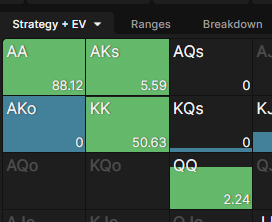
Marked with Yellow Colour in our charts, every preflop monster will be played aggressively, raised and re-raised until we go All-in. Preflop monsters are AKo, AKs, QQ, KK, AA - In every position, these hands are raised, 3Bet, 4Bet, and shoved All-in.
Special rule for 3Bets vs Early Positon:
Against a LJ(EP) open, i.e. against the first position at the table, we 3bet ONLY the HJ/MP, ranges i.e., JJ+, AQ+, AJs+, KQs. This applies to all our positions except for the BB.
We do this because the raising range from the LJ is the tightest and very strong, and 3-betting too loosely could quickly become unprofitable. In the BB, we use the normal 3Bet range because it is already tighter than that from the HJ/MP.
How much do we 3Bet and 4Bet?
If we are in position (IP) we re-raise(3Bet) to 3x the opponent's initial raise. One exception is if the opponent min-raises to only 2bb, then we 3Bet 4x his raise.
If we have more than one opponent, we add the amount they called to our 3Bet.
Example: HJ raises to 3bb, CO calls, we are in the BU with A♥:A♠: and now 3Bet not only to 9bb but to 12bb.
If we are Out Of Position (OOP) to the opponent, then we 3-bet for 4x the amount. If we have more than one opponent, we again add the amount they called to our 3Bet.
If we are IP on the opponent we 4Bet for 2.5x his 3Bet. Exception, the opponent 3Bets smaller than 3x, then we 4Bet 3x.
If we are OOP to the opponent, we 4-bet 3x his 3Bet size.
Special rule for Pocket Pairs:
We can only enter the pot with pocket pairs like 2♥:2♠: if the charts indicate we should, otherwise we fold them. The only exception is this special rule - if there has been a raise and at least one call to the raise before us we can call all pocket pairs.
Special rule for Suited Connectors: If we have at least 4♥:5♥: or a better Suited Connector (SCs), in the Cut Off or on the Button, and there has been a raise AND a call to this raise before us, then we are allowed to call these SCs.
Min3Bet rule:
When you face a min-3Bet preflop, you can basically call all hands that you raised. Your opponent gives you a good price to see the flop, and you only have to win the hand very rarely later on to play profitably. We will classify a Min3Bet as a 3Bet of at most double what you originally raised.
SPECIAL BIG BLIND RULE VS MINRAISE: when we are in the BB and face a Minraise from any position, we are allowed to call every suited hand, every A high, and every Broadway. (For example: J♣:T♦:+/Q♠:T♥:+ etc.)
SPECIAL BIG BLIND RULE VS vs. OPEN COMPLETE from the Small Blind: With "Open complete," we mean that the Small Blind only fills up and limps in the SB when all other players have folded. When in the Big Blind, we raise every hand that we would open raise (steal) ourselves in the SB vs. BB - refer to the Small Blind Chart to know what range you will be raising against an open complete.
SPECIAL BIG BLIND RULE vs. MINRAISE from the Small Blind: If the SB player makes a Minraise steal, i.e., only raises to 2bb, and we are in the BB, then we must call every hand that we don't 3Bet, regardless of how strong or weak it is.
Blind Posting Rule: When a player enters the table or sits out, he can opt not to wait for the BB and pay the blinds to play right away instead. This is called "Blind posting" and is very unprofitable. We will never do this ourselves and will have the patience to wait until we are in the regular BB position!
How do we treat a player that Blind posted?
When selecting the hand strength, we ignore this one player and act as if he had folded. However, as soon as we raise a hand, we must consider the extra money from him and raise it to 4bb.
FULL POSTFLOP GUIDE, RULES AND RANGES
Spoiler
PART 2- POST-FLOP: Detailed [SH] Postflop Guide
What will you learn in this part:
• How to assess your hand strength post-flop.
• How to react in various common situations.
• Special rules and guidelines.
A note before you dive into this post-flop guide:
Since post-flop play is very complex, it's impossible to cover all situations that may arise in a condensed entry-level strategy. This guide provides templates and tools for the most common scenarios you will encounter at the tables. Whenever you are unsure about a situation, please post hands and questions as a reply in this thread, ask in the accompanying live streams, or reply under the released videos.
Step 1: Determine which category your hand belongs to.
To make this post-flop guide work, you must always first recognise which category your hand belongs to on the flop, turn, or the river. The hand categories we recognise are as follows:
Made Hands: These are all hands that are already good to very good. This category includes:
- Strong Draws - Open-Ended Straight Draw (OESD), e.g., you hold 7♣:8♥: and the flop is A♣:5♠:6♦:. Flush Draw (FD), e.g., you hold A♥:2♥: and the flop is 5♥:T♥:K♣:. Note: Strong draws are only considered made hands on the flop and turn; on the river, they are considered worthless hands.
- Top Pair - You hold, for example, A♣:K♠: and the flop is K♦:6♣:2♦:.
- Overpair - You hold, for example, K♣:K♠: and the flop is T♦:6♣:2♦:.
- Monster - This category includes all hands that are 2 Pair or better: trips, straights, etc. (Note: On paired boards, we classify as monsters-only hands with trips or better, i.e. additional pair or overpair to the board is classed as a made hand only.)
Bluff/Worthless Hands: Any hands that don't fit any of the above categories.
Monster Draws on the flop: A monster draw is a flush draw and OESD at the same time. We always play a monster draw aggressively on the flop and are ready to go all in. For example, if the strategy on the flop says that we would play a monster check/call, then we will play the monster draw check/raise to 3x. In any situation on the flop where we get raised, we continue to re-raise for 3 times the opponents raise or go all in. This rule only applies to the flop, from the turn onwards we only hold the “Strong Draw” category even with a flush draw and OESD
Unraised Pot (Nobody raised before the flop): If we are sitting in the big blind and get to the flop for free because nobody raised before us, then we always play for 2/3 pot on the flop against 1 opponent. If we have 2 opponents or are now on the turn, then we continue playing exactly as in point "Step 2.1.2: You raised before the flop (Raised Pot) and are playing Out Of Position (OOP)!"
Step 2: Determine how to play your hands.
The first question after we have determined our hand category we have to ask ourselves is: Are we playing "In Position" (IP) or "Out Of Position" (OOP)?
- We play IP whenever we get to act after our opponents after the flop is dealt.
- We play OOP whenever we have to act before our opponents after the flop is dealt.
Step 2.1.1: You raised before the flop (Raised Pot) and are playing In Position!
If we raise before the flop, we are the so-called “preflop aggressor” (PFA), which we also call the "preflop raiser"(PFR) in single-raised pots.
Flop vs 1 opponent
If we're IP and have only one opponent, we fire a 1/3 Pot Sized Bet (PSB) with every hand we hold. This bet when we bet first as the PFA is also called the continuation bet (CBet). If the opponent min-raises our CBet (min-raise = a raise to the maximum of double our bet), we call with every hand from the "Made Hand" category, except for our monsters. Against raises larger than a min-raise we fold all made hands except for monsters. Monsters are always raised to 3x their raise and put all-in against any further re-raises.
Note: It is strongly recommended that you learn how odds and outs work and integrate this knowledge into your own play style using the beginner's strategy. In appropriate situations, strong draws and gut shots will continue to be played against a raise according to this mathematical rule and will no longer automatically fold against a raise that exceeds the double bet amount. Further information on this topic and how to apply it correctly can be found here:
Odds & Outs Basics
Implied Odds Basics
Short Video Form:
Odds & Outs
Implied Odds
Flop IP vs 2 or more opponents
IP with 2 or more opponents: all made hands are bet for 2/3 PSB; We Check/Fold worthless hands. If an opponent raises to double our bet(minraise), we call every hand from the Made Hand category that is not a monster. If the opponent's raise is higher than a minraise, we fold every hand except for our monsters. Monsters are always re-raised to 3x the opponent's raise and we go all-in against any further re-raises.
Turn/River IP
Regardless of the number of opponents, we only bet hands from the Made Hand category for 2/3 PSB; everything worse than a Made Hand is played as Check/Fold. If an opponent minraises us, we call every hand from the Made Hand category that is not a monster. If the opponent more than min-raises us, we fold everything but our monsters. Monsters are re-raised to 3x raise amount and put all-in against any further re-raises.
Special Rule - Donkbet: If you were the aggressor on the previous street, but an opponent leads into you on flop/turn/river anyways before you had the chance to act, you call up to his 2/3 PSB with Made Hands with one exception: Monsters. Monsters will be raised to 3x of the opponent's lead bet, regardless of the donkbet size.
Step 2.1.2: You raised preflop (raised pot) and are playing out of position (OOP)!
Flop
Worthless hands are checked/folded.
With any strong draw or monster, we check/raise to 3x. Against another raise, we call strong draws up to 2.5x, and with monsters, we go all in.
All other made hands are checked/called up to 3/4 pot.
Turn
Worthless hands are checked/folded.
If we don't have the initiative: With any strong draw or monster, we check/raise to 3x. Against another raise, we call strong draws up to 2.5x, and with monsters, we go all in.
All other made hands are checked/called up to 2/3 pot.
If we have the initiative, or all players have checked on the flop: We bet for 2/3 of the pot with every made hand. Against a raise, we call strong draws up to 2.5x, and with monsters, we raise to 3x.
River
Worthless hands are checked/folded.
If we don't have the initiative: We bet every monster directly for 2/3 of the pot; against a raise, we raise to 3x. Against another raise, we go all in.
All other made hands are checked/called up to 1/2 of the pot.
If we have the initiative, or all players have checked on the turn: We bet for 2/3 of the pot with every made hand. Against a raise, we raise to 3x with monsters and go all in against another raise.
Step 2.2.1: You called preflop (Single-Raise Pot) and are In Position!
FLOP: You hold a worthless hand against 1 opponent
You will fold worthless hands to any bet.
If the opponent checks on the flop, you fire a 1/3 Pot Sized Bet (PSB) with 100% of them.
TURN/RIVER: You hold a worthless hand against 1 opponent
You check and fold worthless hands to any bets on the turn or river. This applies even to e.g. a top pair that turned an overcard and became a second pair.
Flop/Turn/River vs 2 or more Opponents with a worthless hand
We never bluff worthless hands against more than 1 opponent and Check/Fold them.
___
Flop vs 1 Opponent with a Made Hand
You call all made hands against bet sizes between 1/3 PSB and 3/4 PSB.
Against bets larger than 3/4 PSB you fold all made hands except for monsters.
Monsters you raise to 3x his bet and go All if he re-raises.
Against 1/3 PSB or smaller bets, we will raise our strong draws and monsters to 4x his small bet. If the opponent re-raises us, we call our strong draws when he minraises, and fold if he re-raises larger. We re-raise our monsters to 3x the bet and go All In against any further raises.
If the opponent checks, we bet every Made Hand for 1/3 pot.
Turn vs 1 Opponent with a Made Hand
Every Made Hand that isn't a monster is called against up to 2/3 PSB. Against a higher bet, we fold except for monsters.
Monsters we raise on the turn to 3x the bet.
If the opponent checks, we bet every Made Hand for 2/3 pot.
River vs 1 Opponent with a Made Hand
We call up to 1/2 PSB Made Hands except for monsters. If he bets more than 1/2 pot, we fold.
We raise monsters to 3x the bet, and we go All In against any further raises. If the opponent checks, we bet every Made Hand for 2/3 PSB
___
Flop/Turn/River vs 2 or more Opponents with a worthless hand
We always play Check/Fold.
Flop/Turn/River vs 2 or more Opponents with a Made Hand
We call made hands besides monsters against the maximum of 3/4 PSB on the flop, 2/3 PSB on the turn, and 1/2 PSB on the river.
If he bets larger, we fold everything but our monsters.
We raise monsters 3x against >=1/2 PSB and 4x against <1/2 PSB and go all-in against re-raises.
In cases when everyone checks to us we take the lead and bet all made hands for 2/3 PSB.
Step 2.2.2: You've called preflop (Raised Pot) and are playing Out Of Position!
Flop/Turn/River vs 1 Opponent with a worthless hand
We always play Check/Fold, except when flop and turn are checked through, then we bet 100% of our worthless hands to 2/3 PSB.
___
Flop/Turn/River vs 2 or more Opponents with a worthless hand
We always play Check/Fold.
___
Flop vs 1 Opponent with a Made Hand
Against a 1/3 PSB and 3/4 PSB Cbet we call all made hands. Against bets larger than 3/4 PSB we fold all our hands except for Monsters that are raised to 3x the bet and put All In against any further re-raises.
If the opponent bets 1/3 PSB or less, we raise strong draws and monsters to 4x the bet. If the opponent continues to re-raise, we call our strong draws to up to a min-raise. We raise our monsters to 3x the bet and go All In against any further re-raises.
Turn/River vs 1 Opponent with a Made Hand
If the opponent checks the flop or turn, we bet for 2/3 pot.
When he does bet, every made Hand that isn't a monster is called against up to 2/3 pot on the turn and against up to 1/2 pot on the river. We fold against larger bet sizes. Every monster is raised on the turn or river to three times the bet, and we go All In against any further re-raises.
Flop/Turn/River vs 2 or more Opponents with a worthless hand
We always play Check/Fold.
Flop/Turn/River vs 2 or more Opponents with a strong draw or a monster
We will lead for 2/3 pot ourselves, except for strong draws on the river(as they are classed as worthless hands). Against up to a min-raise, we call our strong draws. if the raise is bigger, we fold them.
We raise our monsters to 3x the bet ourselves and go All In against any further raises.
Flop/Turn/River vs 2 or more Opponents with any other Made Hand
We call made hands against a maximum of 3/4 PSB on the flop, 2/3 PSB on the turn and 1/2 PSB on the river, and fold them against larger sizes.
If everyone checks through, we bet made hands for 2/3 PSB.
Step 3.1.1: You've reraised preflop (Reraised/3Bet Pot) and are playing In Position!
Flop vs 1 Opponent
If playing In Position (IP) with only one opponent, we bet 1/3 PSB with every hand we hold. If the opponent raises, we call with any hand from the "Made Hand" category, except for strong draws, that we call against a maximum of 3x raise.
Flop vs 2 or more Opponents
If playing IP with 2 or more opponents, we only bet hands from the Made Hand category for 2/3 PSB, everything worse is played Check/Fold. If an opponent raises, we call with any hand from the "Made Hand" category, with draws only called if the raise is not more than 3x.
Turn/River
Regardless of the number of opponents, we only bet hands from the Made Hand category for 2/3 pot or go All In - depending on the remaining stack and pot size. Everything worse is played Check/Fold. If an opponent raises, we go All In, except with draws. Draws on the turn are only called if the raise is not greater than 2.5x.
Step 3.1.2: You've reraised preflop (Reraised/3Bet Pot) and are playing Out Of Position!
Flop vs 1 Opponent
If playing Out Of Position (OOP) against only one opponent, we bet 1/2 PSB with every Made Hand. If the opponent raises, then we call every made hand. We call draws only if the raise is not greater than 3x. If the opponent checks the turn after raising the flop, we bet for 2/3 PSB with our made hands on the river and go all in against further resistance.
We bluff every flop containing an  or :Kx:. If the flop is different, we play every worthless hand as Check/Fold.
Flop vs 2 or more Opponents
If playing OOP with 2 or more opponents, we only bet hands from the Made Hand category for 2/3 PSB, everything worse is played as a Check/Fold. If an opponent raises, then we call every hand from the "made hand" category. Draws are only called if the raise is not greater than 3x.
Turn/River
Regardless of the number of opponents, we only bet hands from the Made Hand category for 2/3 pot or go All In - depending on the remaining stack and pot size. Everything worse is played Check/Fold. If an opponent raises, we go All In.
Step 3.2.1: You've called preflop against a re-raise (Also called a 3Bet) and are playing In Position!
Flop/Turn/River vs 1 Opponent or more with a worthless hand
We fold to any bet and check when we can.
___
Flop vs 1 Opponent with a Made Hand
We call made all made hands when the opponent bets between 1/3 PSB and 3/4 PSB.
We fold made hands against bets larger than 3/4 PSB, besides monsters - those we call. If the opponent bets 1/3 PSB or less, we raise strong draws and monsters to 3x the bet. If he re-raises us we call strong draws against up to a min-raise and re-raise monsters to 3x his raise and go all-in against any further action.
If the Preflop aggressor checks to us, we bet every Made Hand for 1/3 pot.
___
Flop vs 2 or more Opponents with a Made Hand
We call made hands when the opponent bets between 1/3 PSB and 3/4 PSB.
If he bets bigger we fold all made hands besides monsters, which we flat to his large bet.
If the opponent bets 1/3 pot or less, we raise strong draws and monsters to 4x the bet. If he re-raises we call our strong draws against up to a x2 re-raise, fold against bigger sizing and re-raise our monsters to 3x his raise and go All In against any further raises.
If the Preflop aggressor(PFA) checks to us, we bet every Made Hand for 1/3 PSB.
___
Turn vs 1 or more Opponents with a Made Hand
Every Made Hand that isn't a monster is called against up to 2/3 PSB. Against a higher bet, we fold except for monsters, which are called.
If the opponent bets 1/3 PSB or less, we raise every monster to 4x the bet.
If the opponent checks, we bet every Made Hand for 2/3 PSB.
River vs 1 or more Opponents with a Made Hand
Every Made Hand that isn't a monster is called against 1/2 PSB. Against a higher bet, we fold. Every monster is raised on the river to 3x the bet, and we go All In against any further raises. If the opponent checks, we bet every Made Hand for 2/3 PSB.
Step 4.1.1: You've reraised against a 3Bet (4Bet Pot) and are playing In Position!
Flop vs 1 Opponent
If playing In Position (IP) with only one opponent, we bet 1/3 PSB with every hand we hold. If the opponent raises, go all in with every made hand. Worse hands are folded.
Flop vs 2 or more Opponents
If playing IP with 2 or more opponents, we only bet hands from the Made Hand category for 1/3 PSB; everything worse is played as a Check/Fold.
If an opponent raises against our bet, we go All In.
Turn/River
Regardless of the number of opponents, we only bet hands from the Made Hand category for 2/3 of the pot or go All In - depending on the remaining stack and pot size. Everything worse is played Check/Fold. If an opponent raises, we go All In.
Step 4.1.2: You've reraised against a 3Bet (4Bet) and are playing Out Of Position!
Flop vs 1 Opponent
If playing Out Of Position (OOP) with only one opponent, we bet 1/3 PSB with every Made Hand. If the opponent raises, we go All In with every hand from the "Made Hand" category. Worse hands are folded.
We check/fold our bluffing/worthless hands except on boards with or :Kx:, those are also Cbet to 1/3 PSB with our worthless hands.
Flop vs 2 or more Opponents
If playing OOP with 2 or more opponents, we only bet hands from the Made Hand category for 1/3 PSB; everything worse is played Check/Fold. If an opponent raises against our bet, we go All In.
Turn/River
Regardless of the number of opponents, we only bet hands from the Made Hand category for 2/3 PSB or go All In - depending on the remaining stack and pot size. Everything worse is played Check/Fold. If an opponent raises, we go All In.
BANKROLL MANAGEMENT and WHEN TO CHANGE TABLES
Spoiler
What is bankroll management?
Consider the money you use to play poker as an investment, much like investing in stocks. You only buy them if you expect the potential profits to equal or be greater than the risk you are willing to accept.
This handling of money and risk in poker is called Bankroll Management, and the main principle of it is knowing how many multiples of your buy-in you need to play a specific limit or game. When it comes to managing your bankroll, you will always want to balance your aims of...
• ...making as much progress as possible and earning as much money as you can when you win.
• ...avoiding setbacks in case of losses that could force you to move down in stakes and increase your risk of ruin by losing too large of a proportion of your money too quickly.
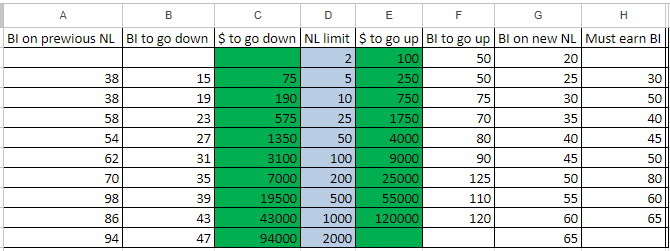
You want to win a lot when you win, but not be too heavily affected by losses. You achieve this by following the 25-buy-in bankroll management rule on the smallest limits. It tells you how big your poker account (bankroll) must be to move up and when you have to pull the ripcord of your shot at the higher limit and move down
The bankroll management for the BSS beginner strategy is as follows:
• You always buy in with a full stack (100 Big Blinds) at the table. 100 Big Blinds are a buy-in.
• You always buy back to 100 Big Blinds as soon as you have lost money at the table and fallen below the 100 Big Blinds.
• If you have 25 buy-ins for the next higher limit, you can move up there.
>For example, you can play with $125 on NL 5 (NL 5 = 2c/5c Blinds)
• If you only have 25 buy-ins for the next lowest limit, you have to go back there.
>For example, if you only have a $50 bankroll left, you have to play NL 2 again (NL 2 = 1c/2c Blinds)
• From NL 10 (=5c/10c Blinds) onwards, you should play with a 30-stack BRM - of course, you can always choose to play with more buy-ins if you want to feel more comfortable.
When do we change the table
This guide is designed to work optimally with a 100 big blind (bb)effective stack size. Effective stack size is the smaller of the stack sizes between the opponents. If you have 200bb and your opponent 100bb, your effective stack size is 100bb and your strategy remains unchanged. As your effective stack size significantly increases, the strategy may work less effectively in certain situations. For example, with a preflop all-in with 150bb+ if we hold AK or QQ. Because the opponents themselves are often only willing to get all in with AA/KK for such large stacks. Postflop All-In situations change too, when it comes to 150bb+.
Everyone has to decide for themselves whether they change a table because they have significantly more than 100bb against one or more players. If the opponents at the table are very bad and you expect to continue making easy wins, then it's better to stay. But if you feel uncomfortable, then you should change tables, regardless of stack size.



 Welcome to the Modern Beginner's guide developed by Paxis and Fallout86, two legends of the German community.