



Greetings all!
First of all, I'm sorry if this is not the place of the post. The example is of HUSnGs, but I think it should be pretty general, since there are no ICM considerations and thus cEV = $EV.
I am an amateur poker player who recently switched from 2NL Zoom Tables to 0.25€ Spin and Goes. As I am starting to have less and less time to study poker, and I want to have a big edge in Spins, I am determined to streamline my learning process. And there is no better way to learn something than to imagine that you are teaching it to other people. Therefore, since I need to learn to construct my own ranges, I'm writing an article on range construction, hoping to start a converation with the community and that the more experience players will help us newbies.
Why range construction?
Well, I have found that there is a huge jump from following someone else's strategy (say Collin Moshman's course in this very own website) to actually developing a strategy. Eventually, one has to make a choice: Do I seek the best possible teacher and learn their strategy, or do I learn to develop my own?
Don't get me wrong, the first is probably the most efficient one, since you take advantage of someone else's work. However, I don't have the money to pay for coaching or the time for stables, so I have to study by myself.
Now, the most critical part of having a solid strategy is having solid and defined ranges, since that allows you to:
- Not have to decide whether you are opening or not nearly as often.
- Identify what spots you can bluff. If you want to bluff, but your range is built such that most of the hands that are in it would be better to bluff, then there might be no sense in bluffing. More on that later.
- Know where you stand in the hand. As we'll see later, to counstruct ranges we need to think about our opponents' ranges as well, as we want to always break even or beat them with out range. Therefore, we will know how different boards affect our opponents' ranges, and we will be able to make more accurate equity calculations, both pot equity and fold equity.
I will try to explain my process for constructing a range with a personal example. I'm still constructing my ranges for the HU portion of Spin and Goes, and thus I'll be building one as we go along.
Constructing a 3-betting (3x) range from the BB for Deep (>14bb) HU play in Spin and Goes
Now to the meat of the article. How does one construct a range? Well, a good range must...
... have a defined opponent range in mind.
That is, we need to know what range we are likely facing in the situation we are planning to use our range to make equity calculations.
In the example, we aim to have a range that is profitable against recreational players in micro-stakes Spins, since recs are the majority of the population at these levels. This is important, since the 3-betting range against a regular is very different.
Now, "recreational player" doesn't tell us much about their range, so let's try to define it in the context of their play in poker. From my limited experience, the vast majorty of the recreational players are loose passive preflop and tight-passive postflop. That means:
- They enter many pots preflop (mostly calling, rarely raising), but
- They fold a lot if they don't hit on one of the streets (which one it is depends on the player, but they usually can be classified as "flop folders" or "river folders").
So, we are actually constructing a "3-betting (3x) range from the BB for Deep (>14bb) HU play against a passive-bad player in Spin and Goes".
With this opponent in mind, we can see how his preflop range looks like from the BB:
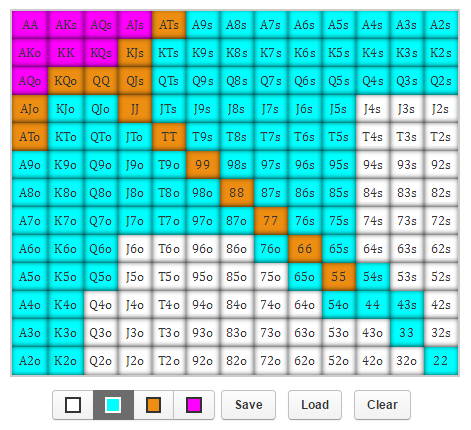
The blue hands mean call (complete the BB), the orange ones represent a minraise and the purple ones represent a shove. Obviously ever player's range will look different, but I think this is a good baseline to start.
It is also vital to imagine what his range would look like after we 3-bet. That is, what hands he continues with.
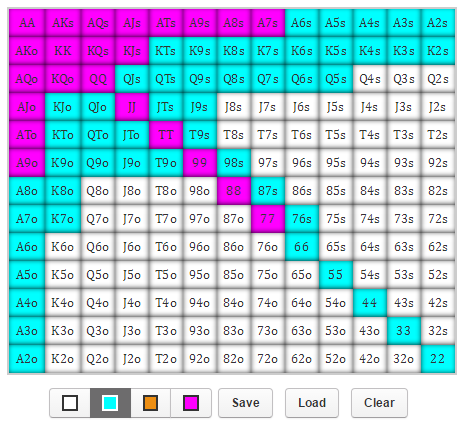
With our opponent defined, we can go to the next section. A good range...
... does not allow autoprofit for the opponent
Autoprofit is what happens when we fold too much to a raise. When the SB minraises, she is risking 1.5BB to win a pot of 1.5BB, so if the BB folds more than 50% of the time, the SB can just minraise every hand and make a profit even if it were to check-fold every hand afterward.
Therefore, there are some hard limits on what our minimum is for defending the BB if we don't want to get exploited by default. That is, vs a minraise we should be at least calling with at least 50% of hands. Here's how the top 50% of hands looks like:
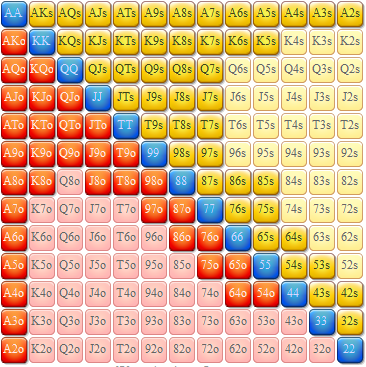
Now, this range does not look pretty at all, and it certainly doesn't look easy to play postflop (look at the 6♠:4♥:, what do you do on an J♥:8♦:4♣: flop?). In addition, we really want to raise some of these hands instead of calling. Therefore, a range...
... needs to take pot odds into account
When the SB open-minraises into the BB, it is giving it 4:1 pot odds (BB needs to risk 1BB in order to win a pot of 3BB). Therefore, we are good to call with hands that have at least 25% equity against the villain's range. So, we play around in Equilab to see what hands have at least 25% equity against the villain's opening range. Unfortunately, a range of 100% has sligthly more than 30% equity over our opponent's raising range, so that is not very helpful in this case.
If we can't look at the pot equity we need to call, we can take a look at what hands we could raise with (for value) profitably. Doing similar calculations, we get that if we are raising 3x the minraise amount we need to risk 5BB to win 3BB, or that we need about 62.5% equity to make the raise purely for value. Some playing around in Equilab later, we arrive at the following range:

Not very promising. However, this assumes that the villain calls with every hand he raises with, which is usually not the case. If we have hope of the villain folding to our raise, we don't need to have full pot equity to raise, since we have what's called fold equity to complement our pot equity, and can incorporate some bluffs to our strategy. Therefore, a range...
... needs to have some bluffs
So far we have seen that we need to at least call with at least 50% of hands, and that we can raise some hands for value. The range we built looks pretty good, maybe somewhat tight:
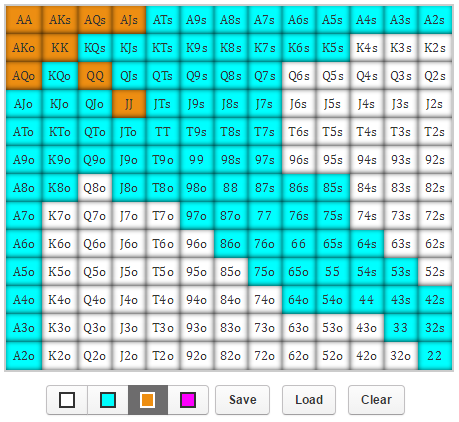
However, we said that we can actually raise some more hands than that, now the question becomes which hands to raise.
Well, according to Mersenneary's free ebook (found un HUSNG.com), the best hands to raise as a bluff (not only preflop, actually) are the ones that:
- Have some equity anyways, and
- Are really hard to play in later streets.
It's easy to see what sort of hands we would like to raise then:
- Hands like K♦:5♦: and J♠:7♥: are hard to play postflop since if you flop a pair with the big card you have a weak kicker, and if you flop a pair with the low card there is a great chance of a bigger pair out there. However, they have some equity because of the high cards. Therefore, it's better to raise these than call.
- Low pocket pairs like 22, 33, 44... have tons of equity preflop, but the flop will mostly come with overcards and we are out of position, not a great position to be in. Therefore, it's better to raise (potentially shove when stacks approximate 14bb) than to call with these hands.
- Hands like J♠:T♠: and Q♣:T♥:, on the other hand, have some conectedness, and the flop is quite hit-or-miss in terms of equity, with mostly big pairs or draws and very few overpairs on the board (mostly  and :Kx:, which he have in our range). Therefore, it's better to call with these since they often have enough equity.
This is how we arrive at the concept of balance in ranges. As Doug Polk said in an AMA in Reddit some time ago, a range shoud actually look like this:
Hand: |---Best Hand ------------------Worst Hand--------|
Action: |--Raise(value)--|--Call--|-Raise(bluff)-|-Fold-|
Or, what's the same: We want to raise the hands that are too bad to call, but have enough equity to continue. This rule applies for every street, but for now we are focusing on preflop play from the BB.
This is where each player's skill comes into play. Which hands is one comfortable playing postflop will mark which hands one bluffs with. In my case, I hate playing low-to-mid pocket pairs and low broadways (K♥:4♦:), so I will incorporate those to my raising range.
If we raise with around 40% equity in our range, we need the viallin to fold at least 12% of the time to make the raise profitable with bluff hands, which is better than the calling range we gave the villain after our 3-bet. Fumbling around in equilab, we add some more value hands and some more bluffs and we arrive to the following range, which has around 40% equity against the villain:
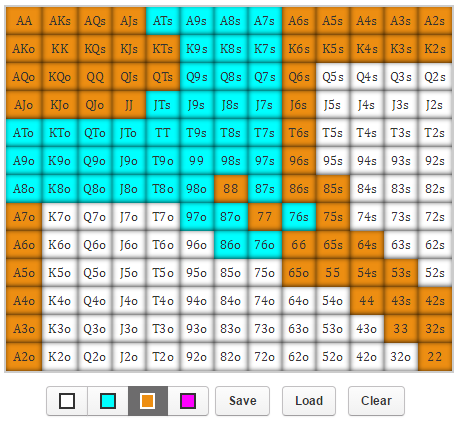
Note that I have taken some particularly hard combos from the bottom of our offsuit range to add them to the bluffing range of suited hands. This is because generally suited hands are easier to play postflop, even if they don't have just as much equity pre.
This looks much better! For now I'll leave it at that, but a couple of notes before I go:
- Note that I didn't include hands AT-A7s or A8o. This is because I don't want to raise with all my aces (even though it could be profitable EV-wise). If I raised with all my aces, when I call and the flop comes A-high I will literally never have top-pair, and that sucks. The same goes for
 and :Qx:.
 - This is only a baseline, assuming that we don't shove. If we considered shoving, we would need to repeat the process for shoving: Imagine a calling range for the villain and calculate the equity necessary, say which hands we'd rather shove than call, etc. For me, it includes low pocket pairs and weak aces mostly, with some strong broadways (AQx, AJx, KQs) for value. Something like this:
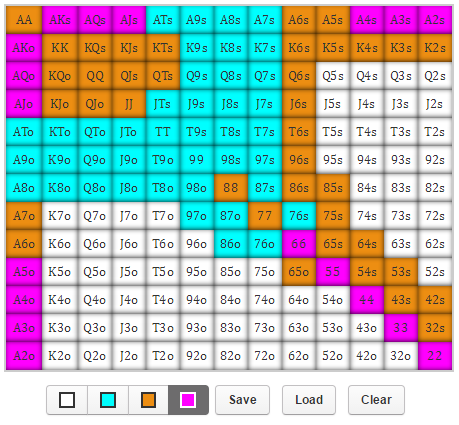
- As the blinds get higher, and the stacks shallower, the ranges change into more of a shove/fold strategy!
Epilogue
And there you have it! I think this is a solid process to construct a preflop range, but please tell me your thoughts, since as I said I'm just learning this stuff!
