Hi,
I've been playing around with the following situation in ICMIZER 3:
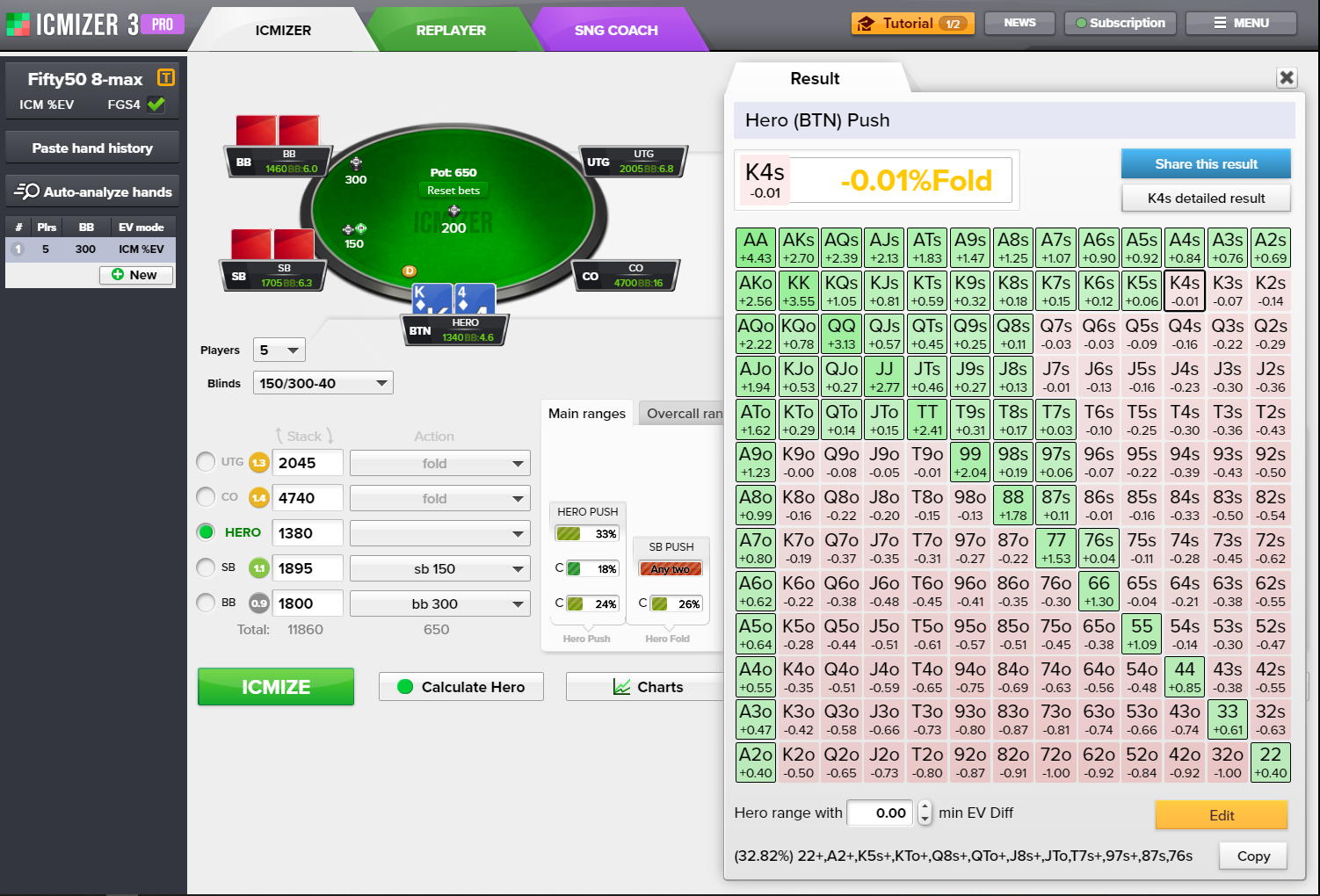
I've noticed that changing the Big Blind's stack size has strange effects on the push EV, so I looked at it more systematically. I've plugged in all values between 1800 and 2000 in 20-chip intervals and computed the push-EV for that case. Here are the results:
1800 -0.01% EV
1820 -0.02% EV
1840 -0.06% EV
1860 -0.07% EV
1880 -0.12% EV
1900 -0.18% EV
1920 -0.16% EV
1940 -0.13% EV
1960 -0.13% EV
1980 -0.14% EV
2000 -0.14% EV
These results are, mildly put, perplexing. I would have expected a monotonically decreasing function, probably one that's convex. Instead, we have... a local minimum at 1900 
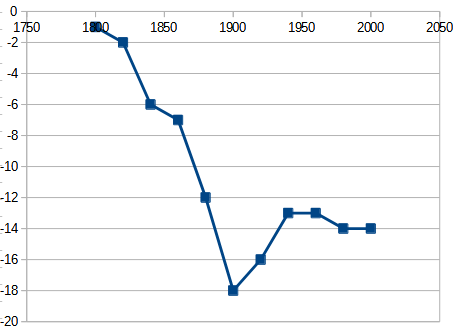
Does anyone understand what's going on here, on a high level? Is there something in the math that effectively amounts to noise, so that you should have error bars around every result? Does the tool track discrete effects from surviving the ante one turn longer or something? Or is there a principled reason why push-EV-as-a-function-of-the-BBs-stack-size has a local minimum? Or something else?