Skip to forum
For the sake of arg...
 
Notifications
Clear all

[Closed] For the sake of argument - Moving UP to recoup losses

48 Posts
27 Users
0 Reactions
4,775 Views
Gerovit
Joined: 16.01.2011

Actually this theory was proven wrong in "Doob's optional stopping theorem"
unless you are immortal.
Anyway it's good to talk about it so players can avoid it.
Here is the link if anyone is interested;
http://en.wikipedia.org/wiki/Optional_stopping_theorem.

Cheers


Coach
w34z3l
Joined: 03.08.2009

I'm just pleased that I have an infinite bankroll.


so this is that secret Isildur1 strategy


By the way, even assuming we have infinite bankroll and betting has no limit, we still may need to perform experiment infinite times to get profit. U mad now?


Coach
w34z3l
Joined: 03.08.2009

I bet you double that you don't lose infinite times in a row.


Interesting thread, some nice reads :)


AlCaTrAzzALZ
Joined: 06.05.2008

just to throw a bit of math out there, using game theory, we can see that if we take x flips (assuming roulette is a flip, obv it isn't bit the math is alot simpler if we assume this), then the average winning streak of a certain colour will be log2(x) - if we take into account non co-operative game theory we would actually need to calculate the streak vs various run variables but lets forget that as well...

so, assume we're going to pick red 100 times, lets do some math ;)

log2(1) = 0
log2(2) = 1
log2(3) = 1.584962500721156
log2(4) = 2
log2(5) = 2.321928094887362
log2(6) = 2.584962500721156
log2(7) = 2.807354922057604
log2(8) = 3
log2(9) = 3.169925001442312
log2(10) = 3.321928094887362

Note that log2(x) is defined for any x greater than zero. If you have a calculator than computes the natural logarithm (often denoted ln), then you can calculate log2(x) = ln(x)/ln(2). The same thing works with log base 10, i.e. log2(x) = log10(x)/log10(2).

log2(100) is about 6.643856.

For curiousity, if you wanted to write a algorithm to 'guess' a number from 1-100 using a divisor strategy, the average number of guesses required is log2(100) if you use a halving strategy to bracket the answer.

for the graph lovers, a basic log2 giraphe
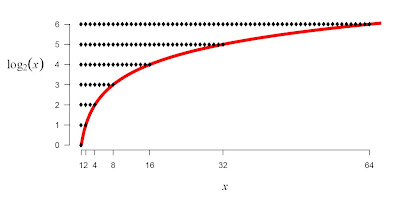
so for 100 spins of roulette, we can see that a run of 7 black in a row would be well within standard deviation. assuming a $1 base unit bet on a standard martingale system with no bias, we can see that a run where we are down 7 martingale betting units (MBU) would be standard (which is -$64, and needs a bet of $129 for the 8th MBU).

we can actually use the log2(x) to determine the average large bet which will be required to operate the martingale system as well, using MBU = 2^(y-1), where y = log2(x) and x is the expected number of bets.

so, lets say u wanted to go pro at roulette. you work an 8 hour day, during which time i'm guessing we could expect 50 spins an hour (assuming only you on the table, it's a simple bet to pay, also assuming there is no house limit on the max bet, the formula above actually lets u work out what tables u can 'profitably' play using martingale with the number of spins you wish to play as your input variable)

so were going to see 400 spins/day, and log2(400) is approx 8.64 so lets round that up to 9. we can see that using martingale aproach, we can expect to have 9 spin losing streaks as an average, or 256 MBU.therefore, assuming a $1 base bet, as long as the table max was less than this, you could argue that a martingale system would be 'profitable' on this table. however, i've never seen a roulette table where the table max was 256x the table min (it's almost like the casino's have sat down and done the math as well ;) )

anyway, it's hot, i'm going to get a soda,

alc out


arisko
Joined: 23.09.2009

Guys, think about it. IF you are immortal with infinite bankroll, will you be sitting at a casino trying to win money??? you have an INFINITE BANKROLL, and you're trying to win more money?

I think I made my point!


AlCaTrAzzALZ made the exact post I was going to do when everyone was slating martingale. It doesnt work, but not because of this infinty v infinity thing but because of the limits put on by casinos.

My 2pennies worth.


Hlynkinn
Joined: 14.06.2008

Originally posted by arisko
Guys, think about it. IF you are immortal with infinite bankroll, will you be sitting at a casino trying to win money??? you have an INFINITE BANKROLL, and you're trying to win more money?

I think I made my point!

your obviously not greedy enough...


gadget51
Joined: 23.06.2008

Infinite BR winning $1 = infinite BR. Lol.
Cut through the crap and don't play roullete, it's just silly gambling.
End of.


Originally posted by Termi8r
I have found a fool prove method to win with roulette...

STEP 1: Open a casino...

Post of the Month!


Variance is a constant?

Amazing.


Coach
w34z3l
Joined: 03.08.2009

No no, roulette is NOT gambling. It's EXTREMELY useful should you ever require a quick -EV flip

It just costs a sklansky buck or two.


AlCaTrAzzALZ
Joined: 06.05.2008

Originally posted by StoneJ
Variance is a constant?

Amazing.

from a math point of view, variance not only is a constant, but can be calculated ;)

having said that, calculating the variance in a 'flip' is ALOT simplier than trying to calculate variance for a game such as poker (which has hundreds of more input variables per hand, or even per decision point)


Ave27
Joined: 14.01.2007

Originally posted by Termi8r
I have found a fool prove method to win with roulette...

...

...

...

...

...

...

...

...

STEP 1: Open a casino...

thats pretty solid. ur ahead of the game.


Also roulette tables have maximums in place for this reason, once you hit the max you can't double any more and the house wins long term. If it was that simple casinos would be broke and gamblers would all be rich.

The same problem exists in poker. Eventually you hit the site maximum, and can;t double anymore, assuming that is that you can afford to endlessly double your buy in when you get beat. Plus the players you'd encounter at the higher stakes would be better and you'd have paid rake/entry fees all the way, which would probably add up to higher than the amount you've won, as after doubling and doubling and finally winning one you would only be up by the initial buy in from the first tourney, less the fees.

It is not a system that works.


GraemeDR there is a floor with your post, poker is not a game of chance its a skill game with some luck thrown in

Poker Players dont hit the maximum limit unless they are called Ivey, Negreanu, Dwan, Antonius ect ect

Games of chance are for idiots even if you take the math into account each spin of the roullette wheel is independent of the last there is no physical reason why it couldn't spin black 100 times in a row

In poker the best players will always rise to the top in the long run not because of luck because they are the best


our intuition suggests that the
probability of obtaining a head on a single toss of a coin is 1/2. To have the
computer toss a coin, we can ask it to pick a random real number in the interval
[0; 1] and test to see if this number is less than 1/2. If so, we shall call the outcome
heads; if not we call it tails. Another way to proceed would be to ask the computer
to pick a random integer from the set f0; 1g. The program CoinTosses carries
out the experiment of tossing a coin n times. Running this program, with n = 20,
resulted in:
THTTTHTTTTHTTTTTHHTT.
Note that in 20 tosses, we obtained 5 heads and 15 tails. Let us toss a coin n
times, where n is much larger than 20, and see if we obtain a proportion of heads
closer to our intuitive guess of 1/2. The program CoinTosses keeps track of the
number of heads. When we ran this program with n = 1000, we obtained 494 heads.
When we ran it with n = 10000, we obtained 5039 heads.


AlCaTrAzzALZ
Joined: 06.05.2008

Originally posted by carexfish
our intuition suggests that the
probability of obtaining a head on a single toss of a coin is 1/2. To have the
computer toss a coin, we can ask it to pick a random real number in the interval
[0; 1] and test to see if this number is less than 1/2. If so, we shall call the outcome
heads; if not we call it tails. Another way to proceed would be to ask the computer
to pick a random integer from the set f0; 1g. The program CoinTosses carries
out the experiment of tossing a coin n times. Running this program, with n = 20,
resulted in:
THTTTHTTTTHTTTTTHHTT.
Note that in 20 tosses, we obtained 5 heads and 15 tails. Let us toss a coin n
times, where n is much larger than 20, and see if we obtain a proportion of heads
closer to our intuitive guess of 1/2. The program CoinTosses keeps track of the
number of heads. When we ran this program with n = 1000, we obtained 494 heads.
When we ran it with n = 10000, we obtained 5039 heads.

pretty much exactly what i said, except i had a graph in my post ;)