Skip to forum
Notifications
Clear all

Discussion Thread: Chip Value

27 Posts
21 Users
2 Reactions
44.6 K Views
Boomer2k10
Joined: 22.09.2010

Chip value

In this module you will see...
• ...what is the real value of chips in SNGs
• ...what is the ICM and how it may help you to evaluate your stack
• ...how to use the ICM when it comes to evaluating decisions
• ...what is the risk premium concept and how to use it

Lesson The principle of diminishing chip value

Article
Quiz
Video

Lesson The Fundamentals of the Independent Chip Model

Article
Quiz
Video

Lesson Application of the ICM

Article
Quiz
Video

Lesson The Risk Premium Concept

Article
Quiz
Video


Reply
Quote
26 replies
GregorKocur
Joined: 30.10.2007

rly nice , thanks for this one! it help alot to understand the chips


Reply
Quote

You're very welcome, feel free to ask any questions you might have :)


Reply
Quote
r1sk4v3rs10n
Joined: 26.02.2011

Whoever is behind those videos in tradimo.com and here in pokerstrategy is very good, very didactic.


Reply
Quote

Does anyone knows if a similar program as ICM explorer exist on poker tracker 4?

Regards,

Jaquare


Reply
Quote

In the example from "Chip Value (3): Application of the ICM" where Hero is in SB with 32o:
Folding is a mistake costing Hero $1.42. Who are these "dead money" being leaked to? I would make sense to me if it was spread out over the remaining players around the table, but if so, is it spread evenly or does stack stack size equity again come into play here?

Thank you for a great read.


Reply
Quote
Super Moderator
VorpalF2F
Joined: 02.09.2010

Originally posted by BArGaInChem
In the example from "Chip Value (3): Application of the ICM" where Hero is in SB with 32o:
Folding is a mistake costing Hero $1.42. Who are these "dead money" being leaked to? I would make sense to me if it was spread out over the remaining players around the table, but if so, is it spread evenly or does stack stack size equity again come into play here?

Thank you for a great read.

Hi, BArGaInChem...
Welcome to PokerStrategy.com !

To answer the bolded question:
The $1.42 he "loses" if he folds, does not get lost immediately.
In the scenario given, he misses the opportunity to win it.

The ICM (Independent Chip Model) assigns a $ value to each chip in your stack based on your overall probability of winning. By not pushing, he lowers his overall probability of winning by $1.42 according to the calculations in the article.

If you like you could put that another way and say that the probability of the other players winning increased by that same amount.

May I suggest that you take a moment to introduce yourself. Other members may be interested in who you are, where you're from, what games & limits you play.

Best of luck,
--VS


Reply
Quote

Thank you for the answer. What I was looking for it what you say about the probability of winning for the other players will rise. Sorry for not introducing myself, I will do that shortly in the thread you link to.

Best
BArGaInChem


Reply
Quote

Ok


Reply
Quote

It seems that the closer one is to the bubble the more $EV is geared towards stack size dynamics. I find this very intuitive and I feel that most thinking players are already working within the conclusions of ICM without necessarily knowing about the mathematical model.

Is risk premium generally higher the further away one is from the bubble, especially in long handed games? It's reasonable to think that the gap between cEV and $EV is bigger when one's probability of placing higher is not increased significantly by an action. Would this concept possibly become bloated in the early stages of MTTs?

I am sure cEV and common sense are better guides during the early to mid stages of MTTs, but I am very curious.


Reply
Quote
ggeshov
Joined: 25.12.2010

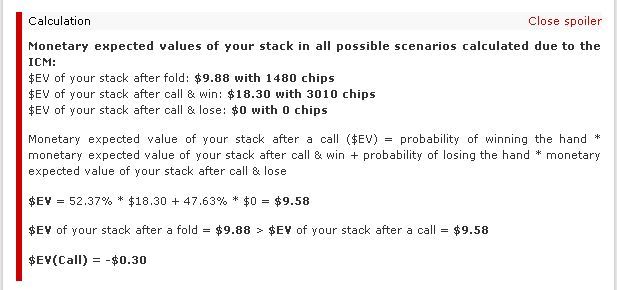
Can someone please help me understand something? Its about the lesson about the risk premium concept in the QQ call or fold example. In the equation of $EV(call) you multiply $18.30 * 52.37% because you are going to win 52.37% of the time. But then you add - $9.88 when you lose, but shouldn't it be like -9.88$ * 47.63% because you are going to lose only 47.63% of the time? Why is it that when you win you only take into account the % of time when you are going to win and when you lose you don't take into account the % of time you are going to lose? The same question goes for the equation for cEV(call). Any clarification would be much appreciated. =)


Reply
Quote
Moderator
SDK1987
Joined: 12.11.2008

I expect is about this calculation:

I’m not sure what you mean with the $9,88 here, because this is you’re chip value if you fold the hand. If you win than you’re stack has value of $18,30 and if you lose it’s nothing.
You win 52,37% of the time $18,30 and that’s $9,58. If you lose you get nothing. So that’s 0.
So a call has a value of $9,58+0=$9,58.

So folding is in this example the best option, because you’re stack value is higher when you fold the hand.

Hopefully it’s now a little more clear for you. If that’s not the case don’t hesitate to ask it.

Best regards,
SDK1987


Reply
Quote
ContenderNR7
Joined: 21.01.2011

how chip value differs in MTT's cause i think the numbers should be really different there ?


Reply
Quote
Moderator
SDK1987
Joined: 12.11.2008

Indeed, but it depends already on with SNG you’re playing. Every prize pool is different and has consequents how you need to play based on $ev.
On MTT’s you play pretty much based on Cev until the last 2 tables and than $ev kicks in.
Most of the time it’s also a top heavy paid out structure. So than you play for top 3 or better most of the time.

Hopefully helps this a little bit, but if you have more questions don’t hesitate to ask them.

Best regards,
SDK1987


Reply
Quote

good advise


Reply
Quote

Hey all,

I'm reviewing SnG strategy articles and there is a doubt regarding "The principle of diminishing chip value" that is:

Monetary expected value ($EV) the value of your stack if won (prize) = 20$. How do I reach this number for STT SnG, because, in the example, as Double or Nothing against villains he will earn the premium, but, in 50/30/20 structure how calculate it?

Thanks

The next article explains how to calculate it!


Reply
Quote
tuananh1601
Joined: 15.11.2018

thank you


Reply
Quote
Mezouzax
Joined: 06.01.2019

thanks you


Reply
Quote
Cypross
Joined: 14.07.2019

Is there any ICM -Software for free? Or just a free trial?

Thanks for your reply :-)


Reply
Quote
ilostmysoul
Joined: 28.12.2014

This is way too confusing, I don't understand anything.

So what exactly am I supposed to do with the ICM training software? I don't know the prize pool I have no idea about any ranges, I have no idea why sometimes I can push with any 2 against a small blind and sometimes I can't. In all the examples on the articles and videos you specify the range for the opponent as well as the prize pool, but on the software itself how can I draw any conclusions? It would be pretty helpful to actually have a video explaining how you are supposed to "train" this or actually apply it. None of the videos do actually show you how to use the software. Exactly what are you thinking about when using the training software? And what are you thinking about in the poker table? How do you know the % of the time you get to 1st or 2nd or whatever place based on your stack?

I'm going crazy over this because I get pretty frustrated when I don't understand something and this is honestly upsetting me. I've spent 2 hours trying to figure out any sort of pattern on the software and I can't.


Reply
Quote