Here's an interesting hand that came up during the coaching which generated a lot of discussion. Mainly, we were deciding about whether or not to peel the flop on this board texture.
Villain seems TAG, but I have just ~15 hands on him at this point and no notes.
$0.25/$0.5 Fixed-Limit Hold'em (4 handed)
Preflop: Hero is BB with 4:d, A:d.
2 folds, SB raises, Hero calls.
Our opponent seems TAG, but I have very few hands on him. On average I sort of expect to see a ~40% hand range like this:
Spoiler
22+, A2s+, K2s+, Q5s+, J7s+, T7s+, 97s+, 87s, 76s, A2o+, K5o+, Q9o+, J9o+, T9o
Flop: (4 SB) 5:h, 8:s, Q:s (2 players)
SB bets, Hero calls.
- So the flop comes down pretty coordinated. 97s, 76s, JT, J9... These hands all have straight draws with decent equity. There is also a flush draw and roughly 6% of his hand range is made up of flush draws.
- Against the range I've given him I have 35% equity. I think this makes it a marginal fold. This player seems somewhat tight. If we were up against a more loose opponent it gets closer to a call. I would want closer to 38% equity to call in position with weak SD value, but I'm curious to see what people think.
- Now, our discussion during the coaching actually had a lot to do with making mistakes. Particularly, mistakes that are likely to come up when bad turn and river cards fall.
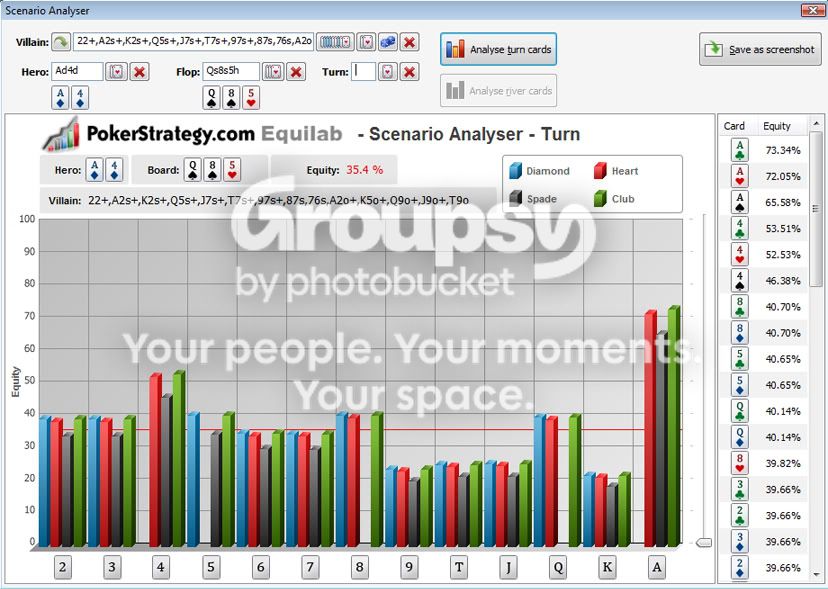
- Below I've included a turn card analysis output from Equilab. What we can see is that actually 22/47 remaining cards give us 35% equity or higher. We'll be getting 5:2 to call down from the turn which means that if our opponent were to barrel 100% then 2/7=~30% equity is enough to justify calling the turn to show down UI on river cards that give us the correct equity and occasionally playing for value if we improve enough to justify a raise.
- Now, he won't always barrel the turn & river. When he gives up that saves us money and we are getting a slight overlay on our turn call if we continue with 35% equity. We do need to be careful though. If I am giving up by the river too often then our initial investment on the flop may not turn out to be profitable. I think we can call the flop with more equity and against an opponent we know well - which again suggests that folding the flop in my case was best.
- On the same token, many of the turn cards which are bad for us are clearly bad, like any 9-K, especially the
 s. We're not likely to make a mistake and call on these cards. Further, our opponent might not always bet the turn on these card. If we do call on the turn incorrectly in other spots we can make a mistake, but if we do make a mistake its significantly smaller on average.
 - When we compare these small losses to the money we can make by improving to a 4♥/:club:, any remaining Ace, or a back door straight we can actually induce mistakes from our opponent and get some value. This value can make up for those small mistakes (which we can of course work hard to avoid making).
tl;dr
We may have a marginal fold on the flop here because I suspect our opponent is tight. If we know our opponent better and he's slightly more loose then we can peel the flop. There are many difficult turn cards, but if we make good decisions we can continue profitably. Using the Equilab Scenario Analyzer its relatively straight forward to evaluate when we should probably continue and when we should probably fold.