Skip to forum
Notifications
Clear all

PLO50 QQTTds SRP postflop line?

16 Posts
4 Users
4 Reactions
1,405 Views
ghaleon
Joined: 17.10.2007

Villain is reggy looking fairly aggro postflop but small sample.

I was planning to check flop as getting x-r would be awkward. Villain though donk bets and call is imo best.

Turn is bit tricky as A5 and 56 get there. At same time I thought villain could value bet for this half pot some 8457 type two pair or set with straight blocker for value plus some semibluffs. But reason I think its bit nasty spot is that there is basically no river where I would be happy to face third barrel. Especially big one. Anyway if villain bet big on turn I would not mind folding.

Well I did call turn and we do hit flush on the river. But I started to wonder if villain is calling that much with less than flush (not spot where I will have lot of bluffs) and if he has enough of weak flushes to call. I can see fair amount of A and K high flushes with hands like A35x, A567, K653 etc. Lot of those combos are strong enough to go for x-r or donk bet. But not really much of J high flushes. Likely some small flushes with set, two pair, straight or straight blockers are there. For those reasons I decided to check river. No reads if villain would have balls for x-r bluffs though. I suppose like half pot-fold would be good option as well. If I had hit Q high bd fd I would be happy to bet even pot size.

So few questions this spot made me ask:

- Cbet flop versus check? I dont see bet-fold being good idea though.
- Bet river for value? Fold versus x-r as default?
- If villain pots river should we call?

Scenario where villain pot river is also interesting. In solver we probably dont fold but what sort of hands villain is likely to bluff? It would likely be of course A♥: or K♥: blocker with less than set or top two. I would imagine set or straight to go for check. So point being for villain to have enough bluffs he really need to have low equity blocker hands in his triple barrel range. E.g. hand like A♥:8♦:6♦:6♣: or K♥:8♦:6♦:9♣:

I just think most players donk bet ranges are too equity heavy for them to have that much natural bluffs for river.

Game #1751462574: Table €50 PL - 0.25/0.50 - Pot Limit Omaha - 17:52:46 2022/10/13
Seated players
Seat 1: Ketusa (€127.01)
Seat 2: Annieeee (€104.40)
Seat 3: MissesDT (€0) (sitting out)
Seat 4: Clepsy8 (€0) (sitting out)
Seat 5: Confuchsia (€79)
Blinds and button
Ketusa has the button
Annieeee posts small blind €0.25
Confuchsia posts big blind €0.50
Hole cards
Dealt to Ketusa Q♠:Q♥:T♠:T♥:
Preflop
Ketusa raises €1.75 to €1.75
Annieeee folds
Confuchsia calls €1.25
Flop 2♥:8♣:4♥: (3.75€)
Confuchsia bets €2.25
Ketusa calls €2.25
Turn 3♣: (8,25€)
Confuchsia bets €4.50
Ketusa calls €4.50
River 7♥: (17.25€)
Confuchsia checks
Ketusa checks


Reply
Quote
15 replies
Mascherano95
Joined: 09.10.2010

This hand is strong enough to call a check-raise and I think too strong to play a 2-streets game only. 5 outs to a clean overset has quite some value and the QQxx overpair aswell against top-pair and 2pair-stuff. With low nuttiness I would also think about raising the flop donk but it kinda depends on his donking range to call or to raise. This is a really important question considering the rest of the hand to get more value out of it than with same handstrength categories on different more heavier boards (the flop is extremely light and overpairs and high flushdraws increase in value).

I agree with your thoughts about turn and river. with all those wheel combos that are semi-bluffing he indeed might have a nutflush otr. But we are quite likely to hold it myself, hard to estimate though if villain is aware of our perceived range. I think 3rd nutflush is generally too strong to check-back I go for 3 streets with, I start checking back with 4th nutflush depending on villains tendencies. Also the fact we could get check-raised otr should not stop us from betting anyways as long it is more likely to get called by a weaker hand. I think villain is likely to call a lower flush but since as you said beside K and A flush there are only low flushes from the Axxx and Kxxx wheel side cards I would bet rather small to get value from those like 1/3 pot thin-value and probably a straight would come along here aswell.

Against the raise I think folding and calling both is somewhat fine because it´s not the most likely scenario and we would need some information to know what to do. I am pretty sure if we let solver overtake this situation with ranges involved it is likely to bet-call but since bet-folding is EV zero I think that´s fine too. The thing with bet-folding is that it is more a exploitative move against too heavily nut-weighted river check-raises (most people do not bluff the way you should). It also does not change the quality of our bet in the first place, against a typical check-calling range which is more likely than an exploitative check-raising range the bet does not get bad because of the check-raise. So bet-call against an unknown check-raise since we have to call some more flush than the nutflush to stay balanced is fine. 3rd nutflush is already on the edge but I surely call 2nutflush against an unknown to stay balanced.

- Cbet flop versus check? I dont see bet-fold being good idea though.
- Bet river for value? Fold versus x-r as default?
- If villain pots river should we call?

- C-bet & call (protection, increased value due to the light texture, implied odds with clean nut-outs)
- Yes and No. Bet small for thin value and call the raise selectively, do not make it an auto-fold spot.
- Yes. 2nd and 3rd nutflushes are my default bluff-catchers in a 3streets game until proven that villain nut-peddles otr.


Reply
Quote
ghaleon
Joined: 17.10.2007

I think our hand is actually one of those that look better than it is. Its raw equity is ok and to be honest if we choose to cbet flop and face x-r it might even make most sense to just 3bet (actually too deep for that, might make sense 100bb deep). Reasoning being there really is not that many good turns making hand visibility really bad after call. Yeah four cards are good giving us nuts with top set but otherwise... Lot of awkward spots. Thing is we are probably sort of forced to continue on lot of turns versus bet but with not that many nut outs its ugly on river.

Turns we would need to continue after cbet-call on flop would be 2, 4, 8, 9, T, J, Q and K. Straight completing ones are imo worst as we might be drawing dead. Pairing cards not great and likely depends lot on villain sizing if he bets but in general we should be quite sticky with double pairs havng showdown value and those 4 practical nut outs. But that said hand flop equity is not good enough I would be happy to stack off either.

For facing river third barrel (after calling flop) I feel like this is in real life very heavily under bluffed spot. Majority of players going for donk bet flop, bet turn just doesnt come up with enough air on river to have any decent balance. They might have some busted club draw with pair/straight blocker but those likely wont follow that often through when front door flush hits and our range is likely going to have lot of those.

Well I think its interesting hand :)

PS: Also note stack depth that is 160bb. So if villain x-r flop 3/4 pot it would make pot around 20€ for turn. If he pots turn we will still have close to pot size behind on river. So if we make third nuts with flush on river and face shove... :spit:


Reply
Quote
Mascherano95
Joined: 09.10.2010

I feel like the whole discussion is becoming confusing.

A. The relative Strength of our hand.

I think our hand is actually one of those that look better than it is.

I think it is the other way round, the hand is better than it looks. Why?

1. Because of villains´ range is capped when flat-calling. BB did not 3bet preflop, this reduces basically all AAxx and most KKxx, so we have basically best overpair. It is also more unlikely, villain is flopping strong with multiple components at the same time, like having Nutflushdraw and overpair or 2pair at the same time, or having set with 2 backdoors etc...

2. The board is light, it is not that wet despite the flushdraw because the possible wheel draws plus the 7/6/5 combos are actually 9-wraps that do not belong to the most frequent and strongest straightdraws around, we block the flushdraw with our own fd. 22xx and 44xx belongs to the pocketpairs around played most infrequently, also among bad players.. same lesser degree to 88´s. So both player have a hard time flopping good which opens room for meta-game a place where player are likely to make mistakes when deviating too much from what to be considered GToptimum. Ah and the likelyhood of 2pairs is also lower, 84, 82, 42 are less often played, obv. Without those made hand discounted overpairs, the next best category, goes up in value.

B. Facing the donk-bet. We were talking about a c-bet scenario that actually did not occur because villain donk-betted. I already said it is quite player depandant how to play here because Villain should be checking the flop 90%. So against unknown calling is fine, we would invest this bet here otf anyways. And no need to raise against an undefined gray-area range.

C. Villain checks, C-bet or check-back? If villain checks, as he is supposed to do, we try to approach playing a GTO style against him, an unknown, as good as we can. And so our hand because of its value on this texture is a clear bet. Check-back with overpair+flushdraw on such a light flop is just complete out of line. The hand is not suitable to balance out our check-back range, lack of having nuttiness and reverse blockers. Besides against most player I do not worry that much about balancing because nobody will exploit us with turn-probes at PLO50. So the C-bet is a clear thing imo.

D. We C-bet, facing a check-raise. Now our nightmare of getting check-raised has realized. But I repeat, the possibility of getting check-raised is no reaon to actually not bet at all in the first place. Solver is cbetting around 50% frequency in this situation despite "he knows" he will be facing a 75% pot-sized check-raise frequency of 16%(!). AAAND we call that raise at a frequency of 32% whereas we prefer hands that can improve like having a good old Q♥:-high flushdraw! xD

E. We called the check-raise and head to the turn. With the cards you listed, we evaluate what is good and what is bad. We continue on good hands and fold against bad hands, we won´t get punished for this behaviour following board events. Getting more information was a reason to call at the first place, when facing the flop raise we do not have the information yet what the turn card there is going to be. Facing more difficult situations and try solving them correctly will generate additional EV for us. We kinda have to decide in advance how far we wanna go with certain handstrengths against certain player. But we don´t know if the flop check-raise is nutted like NFD+ and SET only or if it is out of line so we try to follow GTO.

F. River-plays, our deep stack at risk. So when this hand is so strong theoretically, why we still feel so uncomfortable about it when pots become bigger? Proably because it´s not nuts. Maybe also because here can be made arguments for both plays. And both plays might be correct, It´s something that also can happen at GTO_solutions at NLHE but there this is not such a problem since the spots are easier to identify and can be simplified way easier into an actual applicable strategy. At PLO arriving on the river the amount of possiblities already exploded far from what we can grasp with randomizers, removals etc.. and GTO play is so complex that we do not know how to replicate. Kinda feels bad to invest stacks when we feel like not knowing what to do. So how to evaluate at all? Call or fold against a big river bet?

1. Fold. The thing, that make those hands looking bad when money goes in are those nut-orientated player tendencies nearly everyone had when started out at PLO trying to survive not being stacked all the time with some inferior good-looking hands. So we turn into nut-peddlers and have to relaern proper play by trying to establish reading handranges and -categories which is hard. Lots of player do not finish that skill-set. They stick to nuts cause they feel safe and it feels good like we wanna never crawl out of that beaver and in the end we still can make profits, we still can win against some total idiots that even after a thousands of hands cannot understand we actually never bluff that big for stacks. Some people understand this nut-peddling is wrong and try to evolve, so there are shades of this cord clamping. Like some player will play really wide otf, continue most of it ott and then suddenly play nut otr only. Some player have that gap earlier ott and some indeed are very selective otf already. That´s why we always feel like we are running into nuts otr because when it´s time to come clean at the showdown nobody wants to show mediocre stuff. Considering facing river bet I agree that it is underbluffed. GTO is folding here 50% of the Q-flushes and calling around 50% following a mixed strategy. But that play is against a 10% donking range that is perfectly balanced and veery well defined to removals, blockers etc..

2. Call. Another thing is, player start making more unusual moves when being deep playing for bigger pots because they become greedy and out of their habitual stack depths they feel like they can go for it outside of their usual "SPR environments" .. don´t know how to say it, for example at GG with those occasional cashdrops, there are 10 additional bb deadmoney and people go crazy shoving around really trashy hands just because the SPR is a little different, it´s the same when they are deep on rush tables starting off extraordinarily tight but inwilling to fold anything once they get to the river. But as I said folding otr is completely fine. It´s not like we will be exploited by that single river shove.

G. Summarizing it up from a GTO perspective. It´s a tricky thing that when the EV edges become smaller, the actual pot-sizes including the monetary outcomes they bring are so much impactful for a $net-result orientated player. Kinda feels bad investing so much blinds in a technical drawing dead spot. I guess that´s the variance part of the game. There is not much we can do once we have a flush otr at SPR1. The EV-question has evolved earlier on at the flop, which flushdraws we do call, where mistakes are either overfolding and calling hands we should not call at all. In the end we just do not know how much this unknown will bluff it all along, that´s why he is unknown. So when GTO is playing mixed, we probably should try to reproduce that with randomizers. Since you like me aren´t that advanced in our studies yet, we are kinda making those plays how we "feel" like, then post it here. I would say it is not that important what we do otr in this specific instance because of the maringal EV differences and we actually do not know the "real EV". So we can call here sometimes, fold here sometimes, depandant on notes, histories, table dynamics, timing tells etc. But what is important and what I do know is, we have to call here at least sometimes in those ugly dubious dead end spots and we are supposed to lose here from time to time since it´s part of an overall superior strategy.

Spoiler

That was some Ultra-brainfart. I´d be happy indeed if someone actually reads this, even more if somebody could take away something from it. Cheers! :f_drink:


Reply
Quote
ghaleon
Joined: 17.10.2007

Well the main points why I still personally prefer check are:

- Lack nut potential (4 nut outs is not much when pot start to get big)
- Dont block x-r range (no interaction with flop outside of mid flush draw). But mid fd rarely should x-r anyway.
- Have hand on turn to call almost always
- Hand lacks solid turn barrel spots

As I mentioned earlier if we face flop x-r and turn barrel there are decent amount of turns we kind of have to continue. But important point is do we want to open possibility for this scenario? Calling that turn barrel with hand that has little nut equity is not nice spot at all. But ok x-r is not most common possibility. Issue though is we are not super thrilled to barrel that many turns either as ultimately our hand made hand strength is most of time mediocre. We definitely dont want to face turn x-r even if getting good turn like lets say J♦: giving gs.

You mention we dont get exploited with aggression after flop check but I think that is one of easiest spot to find for aggression. Compared to light flop x-r or balanced donk bet range. Simply because population so rarely protect that check range. So I find it somewhat curious if assumption is people dont find this sort of spot but would have balanced enough range after taking donk bet, bet, bet line or flop x-r. bet, bet.


Reply
Quote
Mascherano95
Joined: 09.10.2010

- Lack nut potential (4 nut outs is not much when pot start to get big)
- Dont block x-r range (no interaction with flop outside of mid flush draw). But mid fd rarely should x-r anyway.
- Have hand on turn to call almost always
- Hand lacks solid turn barrel spots

1. Yes our calling ranges are rarely nutted because it´s the nature of a defensive calling range to be capped. We bet with range advantage but once villain raises, the initiative switches also the composition of ranges. We change into a defense mode where we are not supposed to be aggressive anymore on later streets. If we would be polarized, we would be incentivized to make the aggressive moves ourself (ofc there are exceptions like we are having strong equity and poor playbility where equity denial is superior). And we cannot bet this flop with nuts and nutdraws only, that would not bring us the required betting frequency.

2. If the flop is light, not only the hits are more infrequent, also blocker effects are more infrequent. We cannot always rely on blockers, their use is highly situational depandant.

3. Well, this is somewhat a point indeed. But we would face the same problem if turn is a flush card and villain double barrel pots. And the mentioned straight cards would be bad. We are already protecting our check-back range with less equity like naked oesd and naked lower flushdraws. PLO-Vision is drawing somewhat a line between 3rd and 4th nutflushes I would say. So it´s okay to check-back the Q- flushdraws but due to the overpairs and clean set-redraws for my taste this hand is too strong.

4. We can check-back turn. Solver is taking the bet-check-bet line as often as the bet-bet-check line. It´s because villain can more often bluff credibly on texture shifts compared to NLHE. GTO is following up 45% ott, so we find enough other hands to 2-barrel. And we surely 2-barrel if we hit a set.

I´ll illustrate you this concept of making a stand with a non-nutted hand on the river against loose ranges on 2 similar SRP hands with a player involved having his dead money altering the SPR lightly. We both times face an unknown with reggish tendencies haven´t shown any out of line play so far. Due to texture switch we are switching into a defensive call mode and facing big pot spots with non-nutted hands:

GG Poker - $1 PL Hi (6 max) - Omaha Hi - 4 players
Hand converted by Holdem Manager 3

CO: $129.87 (129.9 bb)
BTN: $118.47 (118.5 bb)
SB: $297.45 (297.5 bb)
Hero (BB): $100.00 (100 bb)

SB posts $0.50, Hero posts BB $1.00

Pre Flop: (pot: $1.50) Hero has 3♠: A♠: J♦: Q♣:
fold, BTN raises to $3.00, SB calls $2.50, Hero calls $2.00

Flop: ($9.00, 3 players) A♥: 2♦: J♠:
SB checks, Hero bets $6.75, fold, SB calls $6.75

Turn: ($22.50, 2 players) 7♥:
SB checks, Hero bets $22.50, SB calls $22.50

River: ($67.50, 2 players) T♦:
SB bets $67.50, Hero calls $67.50

Results: $202.50 pot ($2.00 rake)
Final Board: A♥: 2♦: J♠: 7♥: T♦:

SB shows 9♦: T♥: K♠: Q♠:: (Straight, Ace High)
(Pre 47%, Flop 34%, Turn 30%)

Hero shows 3♠: A♠: J♦: Q♣:: (Two Pair, Aces and Jacks)
(Pre 53%, Flop 66%, Turn 70%)

SB wins $199.50

Our hand is not nutted yet and the situation is far ahead far behind to the dry texture. I haven´t solved turn stack-off situations yet but I guess this is somewhat marginal and might be better an exploitative fold against most human players since real players just usually do not bluffshove here. For a turn it´s marginal I´d say but once we get to the river it´s a little difference since we have to discount villains turn-raising range. On the river I do not have a strong hand anymore. Even top-2pair against his straightdraw-heavy range is just a bluffcatcher, but for this situation I use my Q♣: blocker to make the call. I am supposed to lose here frequently but I am still very happy with my play and monker solver is calling the river with :Ax::Qx::Jx: a 100% aswell.

GG Poker - $1 PL Hi (6 max) - Omaha Hi - 4 players
Hand converted by Holdem Manager 3

Hero (SB): $105.47 (105.4 bb)
BB: $100.00 (100 bb)
CO: $8.50 (8.5 bb)
BTN: $138.13 (138.1 bb)

Hero posts SB $0.50, BB posts $1.00

Pre Flop: (pot: $3.00) Hero has 7♥: K♦: T♣: J♦:
CO calls $1.00, fold, Hero calls $0.50, BB raises to $4.00, CO calls $3.00, Hero calls $3.00

Flop: ($12.00, 3 players) K♥: 9♦: 7♠:
Hero bets $9.00, BB calls $9.00, CO calls $4.50 and is all-in

Turn: ($34.50, 3 players) 4♦:
Hero bets $34.50, BB calls $34.50

River: ($103.50, 3 players) 6♠:
Hero checks, BB bets $52.50 and is all-in, Hero calls $52.50

Results: $208.50 pot ($3.99 rake)
Final Board: K♥: 9♦: 7♠: 4♦: 6♠:

BB shows 9♠: 7♦: A♦: 5♣:: (Two Pair, Nines and Sevens)
(Pre 39%, Flop 23%, Turn 33%)

CO shows J♥: Q♥: 3♥: 2♣:: (High Card, King)
(Pre 29%, Flop 14%, Turn 6%)

Hero shows 7♥: K♦: T♣: J♦:: (Two Pair, Kings and Sevens)
(Pre 31%, Flop 62%, Turn 61%)

Hero wins $208.50

Same story, again mediocre hand, not suitable for value-shoving but for check-calling. There are lots of straights and sets possible also having flushdraw blocker is bad blocking villains bluffing range but a strategy check-folding without nuts is just weak. This time the T♣: blocker is useful for blocking the nutstraight.


Reply
Quote
ghaleon
Joined: 17.10.2007

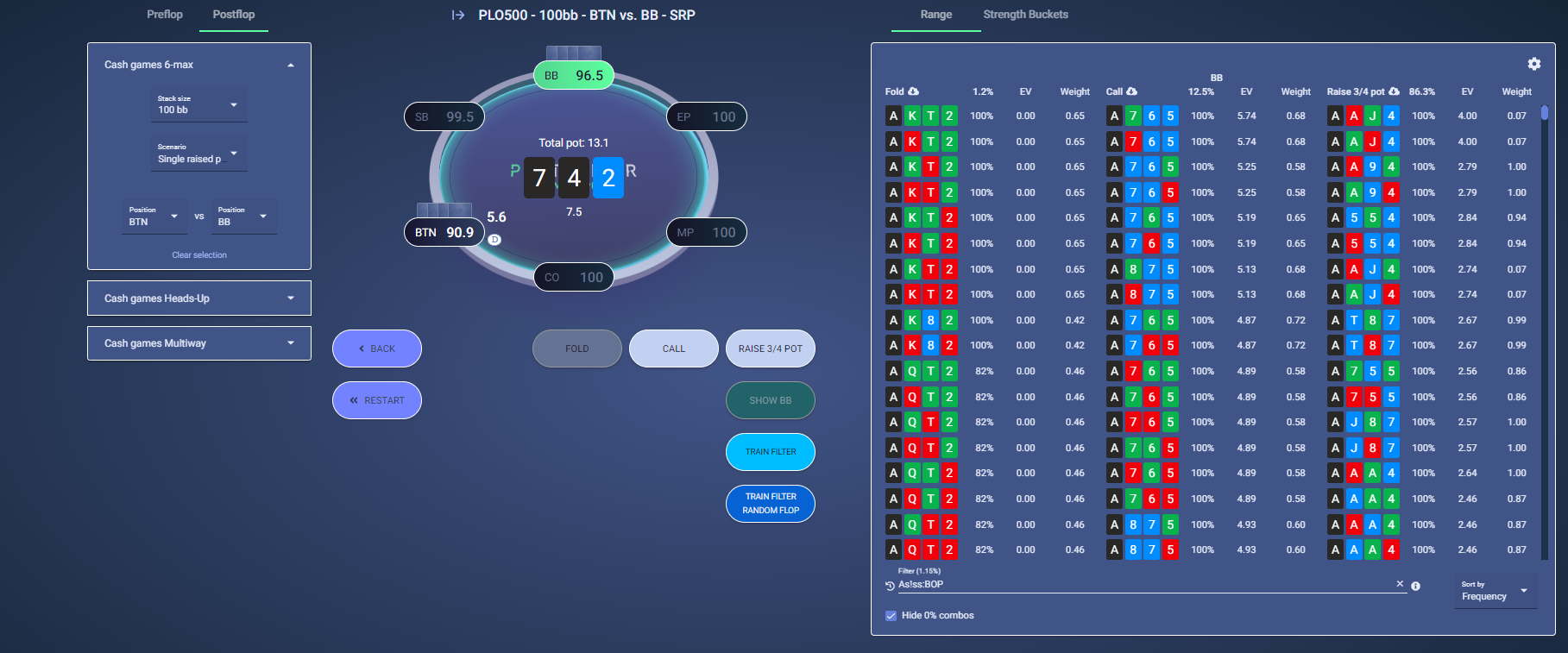
I checked 742 flop versus cbet possibility from trainer view and EV were very very close. Like 0.04bb difference. If we had KKTTss or AATTss difference would get clearly bigger. But yeah like one point I also checked from villain side if facing cbet is that As blocker with any board pair is supposed to x-r almost always. That is something I really dont see happening from anyone in this player pool:

Spoiler

Overall from villain x-r range around 40% should be folding versus 3bet so there are quite a lot of non value hands. Stuff like pocket pair+board pair+small flush draw:

Spoiler

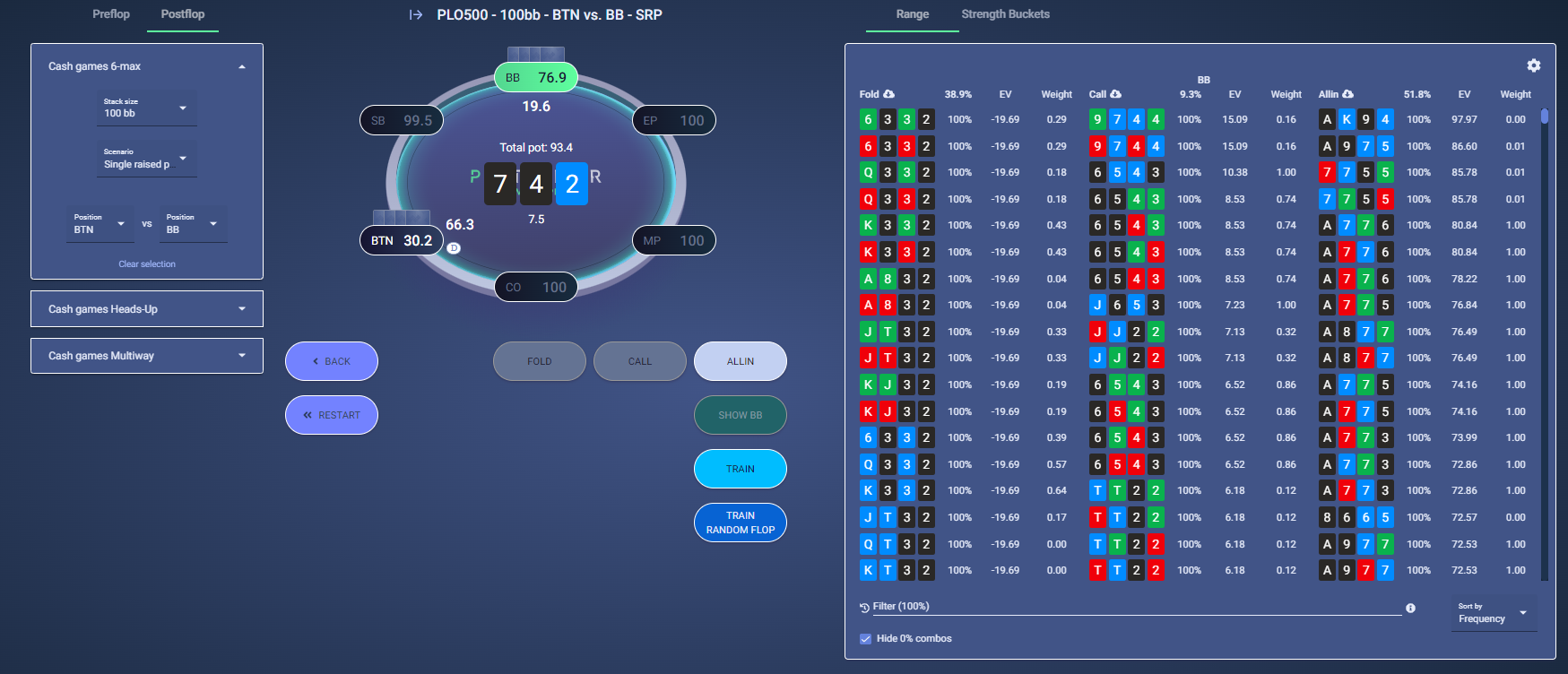
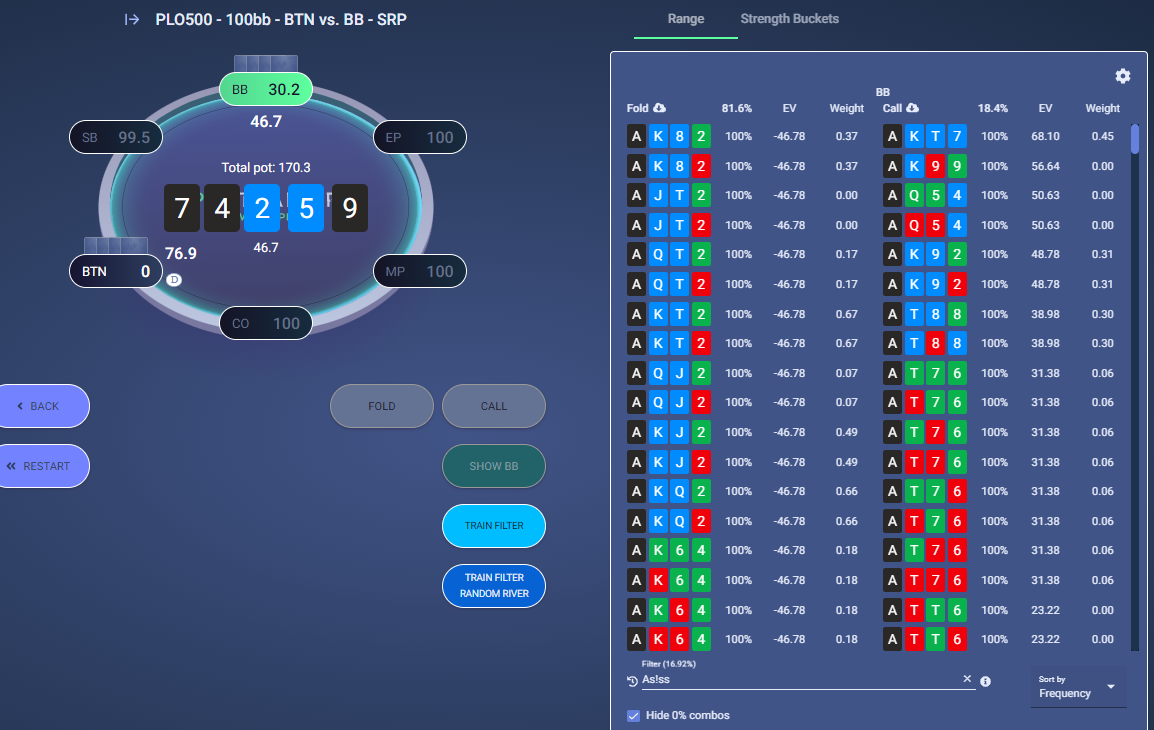
I also checked spot where villain donk 3/4 pot flop, 3/4 pot turn, pot river and faces allin:

Spoiler

So key question being what sort of hands solver finds as bluff there. So there are fair amount of these AK64 with nut flush blocker. Plus also some really weird stuff with low flush blockers. So if we decide to call river pot we kind of should expect villain to find some of these bluffs (or other bluffs) as most (at least reggy type) are not going to pot with weaker for value. This is something that is imo dangerous if we attempt to follow GTO too eagerly. Some spots require these low equity blocker plays to show up with enough bluffs and I just doubt pool is creative enough to have those.

If this hand flop goes checked, flush complete on turn and villain goes for pot turn, pot river its just so much easier for villain to have high flush blocker in his range. After all his whole preflop range has come to turn. So situation is very different from one where villain x-r flop and then barrels or donk bets three streets. Also spot is easier as we face way smaller bets and there might also be case where we beat portion of villain value range.


Reply
Quote
Coach
Kyyberi
Joined: 09.07.2010

Lots of text, I didn't have time to read through it all. But I want to remind that when we start to think solver strategy as our default strategy, in reality our average opponent might play very differently.

Like the board in original hand, solver does donk over 10% of times. And check-raises over 15% of times. And the cbet strategy is based on those numbers. Now when donking goes down, cbet frequency goes down. I am quite sure that PLO50 Unibet player pool has lower donk% than solver. Also most likely the check-raise is lower too, in my databases for small stakes the average check-raise flop was always under 10%.

That's why it's also important to think about our cbetting strategy in relation to the player pool tendencies.


Reply
Quote
Mascherano95
Joined: 09.10.2010

Originally posted by Kyyberi
Lots of text, I didn't have time to read through it all. But I want to remind that when we start to think solver strategy as our default strategy, in reality our average opponent might play very differently.

Like the board in original hand, solver does donk over 10% of times. And check-raises over 15% of times. And the cbet strategy is based on those numbers. Now when donking goes down, cbet frequency goes down. I am quite sure that PLO50 Unibet player pool has lower donk% than solver. Also most likely the check-raise is lower too, in my databases for small stakes the average check-raise flop was always under 10%.

That's why it's also important to think about our cbetting strategy in relation to the player pool tendencies.

Originally posted by Mascherano95
B. ...quite player depandant how to play here because Villain should be checking the flop 90%...

D. ... will be facing a 75% pot-sized check-raise frequency of 16%(!) ...

Got you covered Sir.


Reply
Quote
Mascherano95
Joined: 09.10.2010

Originally posted by ghaleon
...But yeah like one point I also checked from villain side if facing cbet is that As blocker with any board pair is supposed to x-r almost always. That is something I really dont see happening from anyone in this player pool:

Spoiler

Erm but this tendency is actually a point for us to bet it, since a x/r is punishing bets?

Overall from villain x-r range around 40% should be folding versus 3bet so there are quite a lot of non value hands. Stuff like pocket pair+board pair+small flush draw:

Spoiler

I also checked spot where villain donk 3/4 pot flop, 3/4 pot turn, pot river and faces allin:

Spoiler

This is something that is imo dangerous if we attempt to follow GTO too eagerly. Some spots require these low equity blocker plays to show up with enough bluffs and I just doubt pool is creative enough to have those.

If this hand flop goes checked, flush complete on turn and villain goes for pot turn, pot river its just so much easier for villain to have high flush blocker in his range. After all his whole preflop range has come to turn. So situation is very different from one where villain x-r flop and then barrels or donk bets three streets. Also spot is easier as we face way smaller bets and there might also be case where we beat portion of villain value range.

Another thing I may add is that once we see a certain line with a hand we can kinda discount it from the other line since villain is unlikely to balance that well. I find that donk-bet-bet line more suitable as a comparison to our hand since the pools raising range rarely match GTO when it comes to the bluffing part.

We know that rarely anyone would check-raise-fold exactly 40%, but I did not advocate for 3-betting but calling the check-raise actually?

When it comes to the bluffing part we just do not know. Lag can have all sort of blocker-type air but that´s why we relate to GTO. It´s not like GTO is checking back because it could be check-raised and it´s not like GTO is folding because the bluffing part of the range is not clear.


Reply
Quote
Coach
Kyyberi
Joined: 09.07.2010

One thing to consider is also how opponent continues on the turn and on the river. Lets say we know he donks flop often with semi-weak hands. Do we want to raise more to punish that or call more if he likes to barrel too much? If his turn bet range is weighted heavily to really strong hands, does our EV increase with call or raise?

Of course all of above requires reads from opponents or player pool. But it shows that the real situation is often very different than what solver assumes, so checking solver EV's for different lines is VERY rough way to think how good/bad the line in reality is. But at the same time a good starting point, as we need to have one. Just don't get too fixated to what solver likes to do.


Reply
Quote
ghaleon
Joined: 17.10.2007

Originally posted by Mascherano95

Originally posted by ghaleon
...But yeah like one point I also checked from villain side if facing cbet is that As blocker with any board pair is supposed to x-r almost always. That is something I really dont see happening from anyone in this player pool:

Spoiler

Erm but this tendency is actually a point for us to bet it, since a x/r is punishing bets?

It also means that when we face x-r we are facing more equity driven range. So we can cbet more stuff that would like to get protection but has not that nice playability after checking or go for thinner value. Key point having plan to fold to raise. Hand I had can turn some straight draws, can turn flush, can turn top set and most importantly can call most turns versus big bet. But if it gets raised it will be in tough situation especially versus that strong range. We are not ahead of any made hand raising and our visibility with most of flushing cards in unclear. Visibility is very important factor for hands we do decide to cbet and start building pot unless our plan is to fold to raise. But as said I definitely would not cbet-fold. I would also say when our stack gets deeper it becomes even more vital that we are drawing for nutty outs with currently mediocre holding. Otherwise we open the door to be in big bluff catching spots with danger of facing too value heavy range.

One of core principles in cbetting from position is efficiency and polarized approach. So we avoid situations where we would cbet and have to fold to raise considerable equity and/or playbility. Good example in general is nfd hands. E.g. in 742ss flop solver is cbetting 83% of nfd combos. If we remove bdfd, overpair+, board pairs and straight draws that frequency comes down to 40% and those betting will mainly continue versus raise by having good chance to turn straight outs or have some future straight or bdfd blockers etc. One common theme is that hand with three suits or four suits are bet-folding as EV of check is lower and fe will increase from blocking fd.

In reality how people create their cbet range and well any postflop (non river) aggression ranges really tend to be very equity driven. That means they tend to lack bluffs in board changing scenarios. When I check solver approach in these spots I have to ask if ranges in reality are likely to be similar on aspect of value:bluff ratio. I would say that in most cases people and I are underbluffing compared to solver. Potentially also not value betting thin enough which can help. Some exceptions where overbluffing by some players could be common are perhaps straight and monotone flops. Some might look at pocket blocking straight as "I cbet and follow through on blank runout". Same might happen on monotone flop with nf blocker. So when decision to start aggression has started it might not be slowed down often enough.

But in this spot when opponent donk bets or x-r flop is it more likely villain is more value heavy than solver? When I check what type of hands solver is using that are folding to raise (or 3bet) I just have to accept that its likely. This will become crucial when board changes on river and villain would need to find those bluffs. I think its easier for villain to show up on river with reasonable x-r bluff candidate. E.g. hand like set, two pair or straight with nut blocker that tries to get to showdown. But then the question is if villain would turn those hands into bluff if facing river bet. Its ballsy line to take as if BU bets river he says to have medium/high flush.


Reply
Quote
ghaleon
Joined: 17.10.2007

Originally posted by Kyyberi
One thing to consider is also how opponent continues on the turn and on the river. Lets say we know he donks flop often with semi-weak hands. Do we want to raise more to punish that or call more if he likes to barrel too much? If his turn bet range is weighted heavily to really strong hands, does our EV increase with call or raise?

With read like that I would not mind to raise more often with blocker type hands that have easy fold if facing 3bet. Assuming villain is capable of folding. With our hand type raise make some sense if villain also overplay enough of those weak hands. But I think this would be quite special scenario considering deep stack situation. My hand has still too much potential to ever be better as raise-fold over call imo.


Reply
Quote
ghaleon
Joined: 17.10.2007

Originally posted by Mascherano95
We know that rarely anyone would check-raise-fold exactly 40%, but I did not advocate for 3-betting but calling the check-raise actually?

Its nice way to see what kind of hands solver uses as non value hands in x-r range. Well to be exact there are sometimes some two pairs that go for x-r as value or sort of bluff but then are in too bad shape versus 3bet range and fold. But as I commented moment ago in long post if villain is lacking these lighter x-r hands then EV of our call will decrease as well.


Reply
Quote
ghaleon
Joined: 17.10.2007

On river check is indeed too nitty approach. My in game thinking for check was that I block T high flush which is that tiny bit weaker hand I would want villain to have. Now in this case I dont think it matters that much as villain is unlikely to have those mid high flushes that much and also when turn open second fd there is higher chance to get called by weaker. Also positions made ranges wide. If river was club (and I had flush) I would have definitely bet as chance of bd flush is simply lower for both players.

Well this time villain had

Spoiler

A♥:5♥:3♠:7♣:
This hand can really go either way with lead or x-r. So got lucky with nitty play and villain was probably annoyed.


Reply
Quote
YXKCOBRA
Joined: 20.09.2008

QQTTds is a strong hand: double chance for SET @ the Flop & Overpair in this sample... :f_cool: (And Flush on the River.) :f_love:


Reply
Quote