Skip to forum
Notifications
Clear all

PLO25 KJTTss BB vs SB 3b?

14 Posts
3 Users
6 Reactions
1,506 Views
PakerFace
Joined: 19.09.2010

Villain is a LAG.

Is this a 3b vs SB?

Thoughts?

Hand Information
Pot Limit Omaha, 0.25 BB (5 handed).
Hand History converter courtesy of pokerhandreplays.com

Table Information
Seat: 1 iceooks ($12.5)
Seat: 2 jurgent ($45.16)
Seat: 3 waitforit2 ($47.9) Dealer
Seat: 4 berbatov_9 ($36.74) Small Blind
Seat: 6 wordler ($28.93) Big Blind

Dealt to wordler
K♥J♣T♣T♦

Preflop (Pot:0.35)
iceooks    FOLD
jurgent    FOLD
waitforit2    FOLD
berbatov_9    RAISE $0.75
wordler    RAISE $2.25
berbatov_9    CALL $1.5

Flop(Pot: $4.85)
J♦6♦Q♦

berbatov_9    CHECK
wordler    CHECK

Turn(Pot: $4.85)
J♦6♦Q♦4♠

berbatov_9    BET $2.25
wordler    FOLD
berbatov_9    RETURN $4
Showdown:
berbatov_9 MUCKS


Reply
Quote
13 replies
ghaleon
Joined: 17.10.2007

My approach would be to just call pre. I think hand is bit too weak to 3bet. DS I would not mind 3betting or if we had like AJTT with nut suit. I doubt this is 3bet even as K high suit.

On flop would go for 1/3 pot cbet. Reason being our showdown value is on weak side and we have reasonable blockers to villain continuing range with all of our cards really. I think on such high card monotone flop we are probably expected to cbet quite a lot like 70-80% of our range with 1/3 pot cbet in trainer. As played turn fold is perhaps bit weak but I would probably fold also and not try any float play as default. Problem is lack of showdown value and somewhat improvement potential when we get to this turn spot after flop check. Hand like QJT8 with flush blocker would be good to check and then we could call turn and evaluate river. Actually having some outs to very strong hand.

I will check now from solver view:
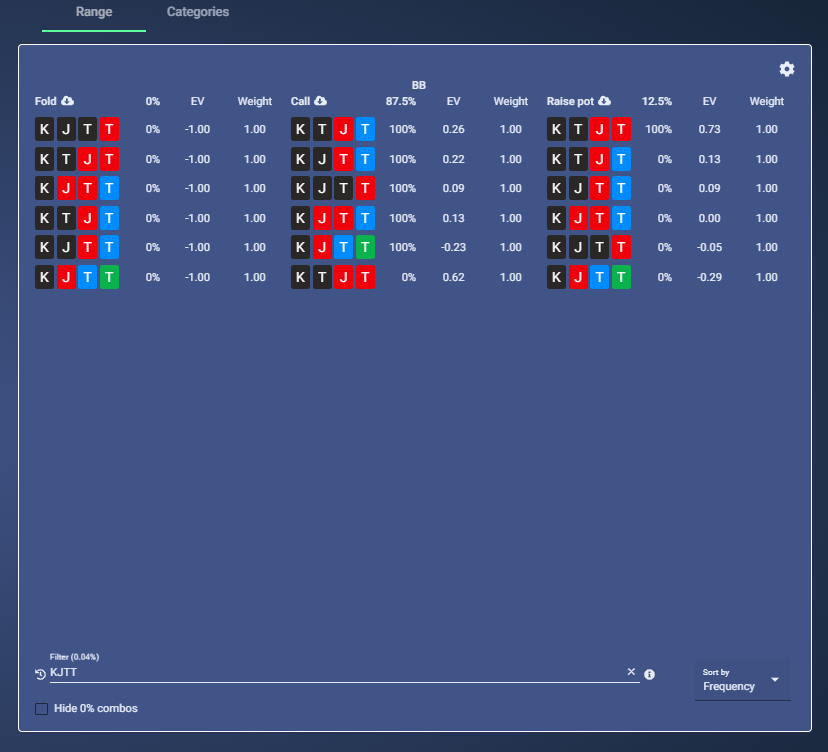
In solver plo50 rake SB open raises 36% and fold to 3bet 43% of time. 4bets 15% of time. What I would expect to happen in real life is more like call 60-80%, 4bet bit less often and then fold 10-30%.

Then on flop our range would look like this (closest to QJ6 flop I found from trainer):
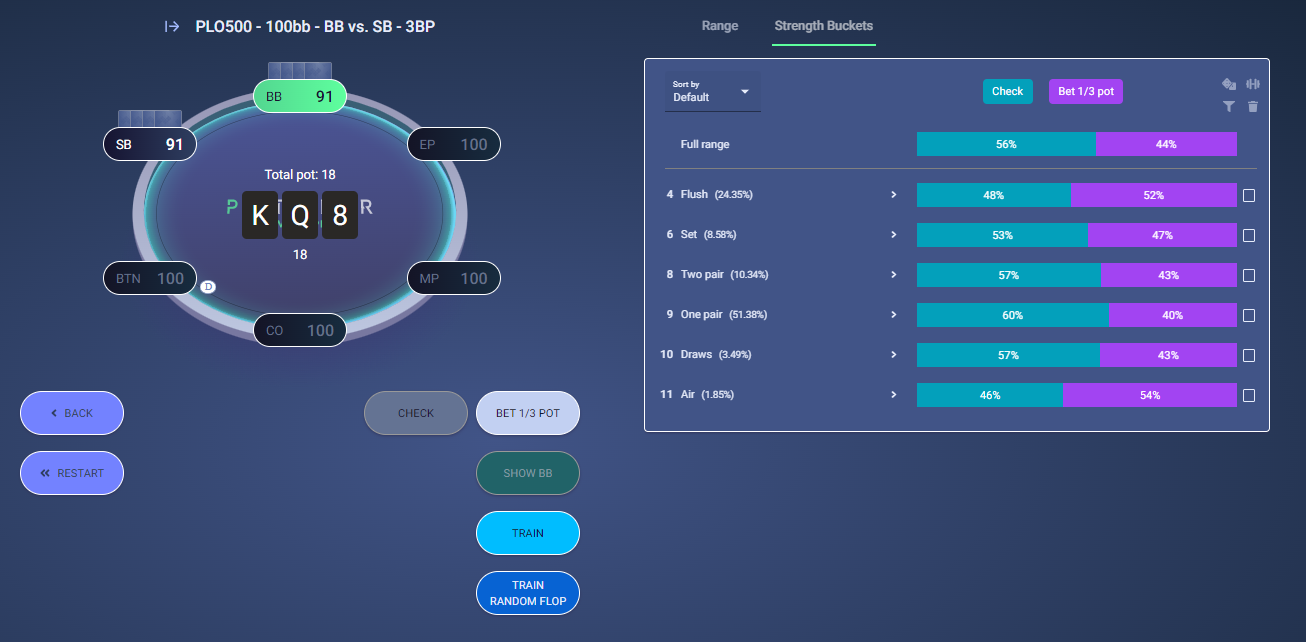
Ok so my assumption on cbet frequency was off. I did actually check BBvsBU spot on same flop where it was over 70% but in that scenario BU is going to have wider range and of course when we are in position we have option to take free turn so that also tighten cbet frequency. Anyway if we look similar hand like lets say QJTT with T♦:
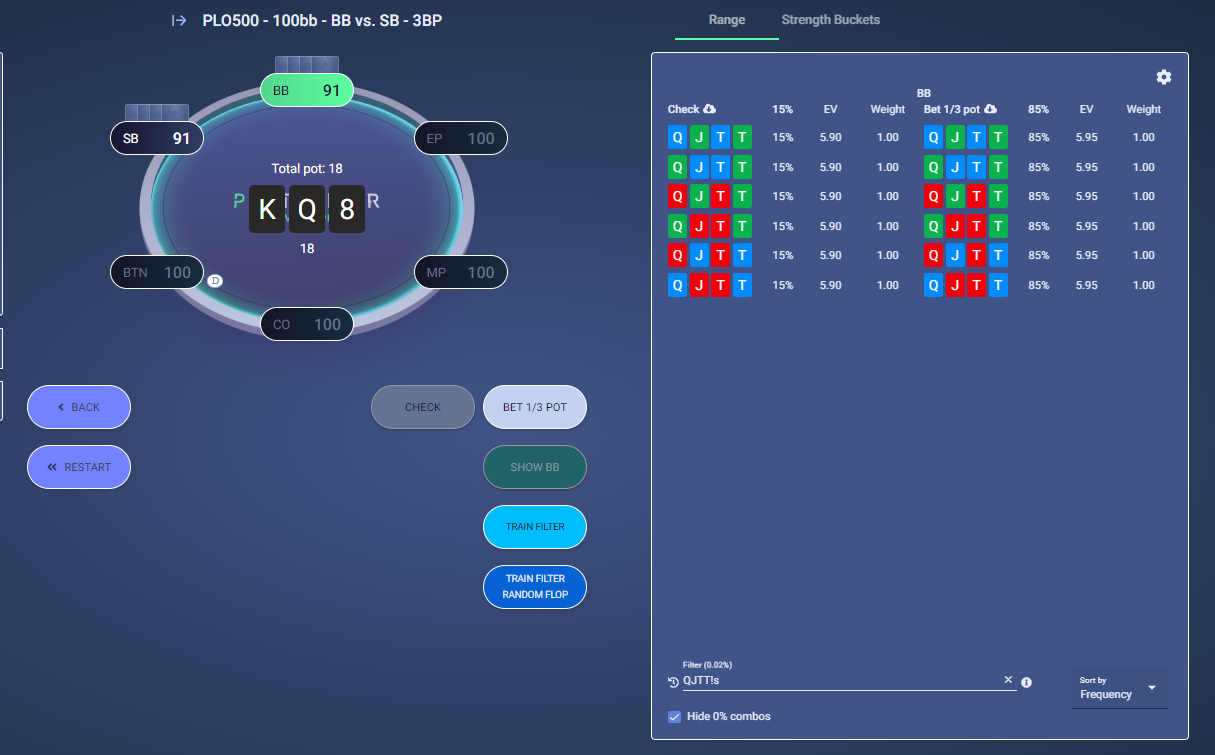
Except solver is not going to have QJTTss in its range. Actually kind of tough to check QJT with one spade that would not have wrap or two pair as those are pretty much not in range. But when we almost purely bet hand like QJTT without any spade for small size then one with spade is definitely higher EV bet blocking flushes. Also make more potential bluff or call hand on later streets when we hold that spade.

Also SB is supposed to continue pretty wide versus small cbet:
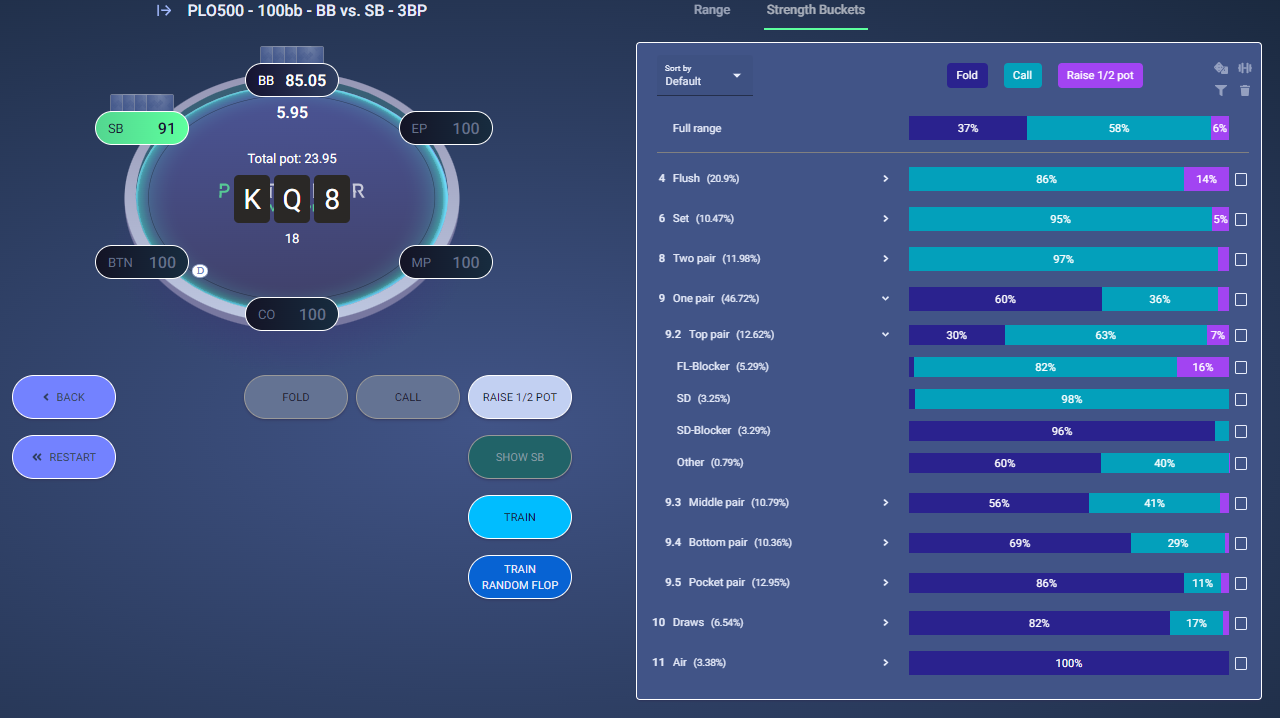
So I would not expect SB to fold two pair or better most of time but we will definitely get stuff like one pair+flush blocker and probably some straight draws to fold more often. Meaning EV of flop bet increase.


Reply
Quote
ghaleon
Joined: 17.10.2007

Even if SB is open raising potentially more than he should is there really point in 3betting this kind of hand? Not really in my opinion because issue of this hand is that it doesnt flop in smooth way so that we can often continue putting aggression on villain postflop plus its tough to be in position to dominate his range on flop. Even if he open raises too wide there is very slim chance he would fold 40% to 3bet. So just make clearly profitable call pre and play deep stacked in position.


Reply
Quote
Mascherano95
Joined: 09.10.2010

I call this hand aswell but I against a loose player I might be tempted to 3-bet this aswell, you have quite good connectivity and it plays well in 3bp. But calling is fine for sure.

I agree with the 1/3 pot-sized c-bet because

Originally posted by ghaleon
we have reasonable blockers to villain continuing range with all of our cards

. Solver is c-betting here with some frequency and we have to select some suitable hands to apply that strategy in some manner. I agree with the conclusion that we have an increased FE with the cbet due to the player tendencies.

As played I would fold turn aswell since our blockers are decreased in value due to bad equity of just 1 more street and another thing is we have not good SDV. At first sight I would just say it is somewhat marginal but you do not have to make a stand if you think villain is capable of firing another river bluff but rather wait for a situation where you do have a small flush or sth. Having some reads from showdowns will help you a lot to make more elaborated decisions against tendencies on high-frequency boards since different players play those texures quite different.


Reply
Quote
PakerFace
Joined: 19.09.2010

Thanks for the detailed answer, very helpful.


Reply
Quote
Mascherano95
Joined: 09.10.2010

Originally posted by ghaleon
Even if SB is open raising potentially more than he should is there really point in 3betting this kind of hand? Not really in my opinion because issue of this hand is that it doesnt flop in smooth way so that we can often continue putting aggression on villain postflop plus its tough to be in position to dominate his range on flop. Even if he open raises too wide there is very slim chance he would fold 40% to 3bet. So just make clearly profitable call pre and play deep stacked in position.

Ugh I do not really agree with this. We do dominate a loose RFI range. SB is expected to have a loose range and we are surely in the top-tier of a typical SB RFI range. We dominate all medium high, semi-conntected staff with the pair of tens. The Jack-suit is somewhat okayish too in loose matchups. We primarily fear an :Ax: without broadway card or a dynamic board texture in the high or low region but we can do fine on most boards with our SDV by checking ip or hitting quite nutted straightdraws .

Reply
Quote
PakerFace
Joined: 19.09.2010

I 3bet him after seeing what sort of hands he was showing up at showdowns despite his SB RFI range being obviously weak.

He would play any 4ds cards and that's was the reason why I didn't cbet in this spot.

It might not be correct gto wise but that's just the read I had and decided to give it up.


Reply
Quote
Mascherano95
Joined: 09.10.2010

Yes, this is a strong hand and I would advocate for the 3-bet as soon as you think you can dominate a big part of his range. To get a better awareness you would have to study preflop ranges and what part of that range make up which x% portion of a range. HU being oop hand ranking becomes more important than playability and against the typical TTxx part of his range we are crushing. We would not go too far with a bare pair of TTxx on dryish light boards and AA-QQ mostly are 4betting (some QQ-JJ should be folding). It is another huge (but common) leak by his side if he starts calling KKxx, QQxx and JJxx against 3-bets oop. So basically our hand is a good candidate to 3-bet.

You still should go with the c-bet and just give up if he calls or reraise. A 1/3 psb is not expensive and reveals a lot of either his handstrength or tendencies after flop. Once you hit the jackpot with a good flush you can mimick that play stacking him off on a fancy turn or river play. It´s hard for anyone to continue on monotone boards without even a pair or to play big pots without a flush later on so the bet accomplishes the part of FE pretty easily.


Reply
Quote
PakerFace
Joined: 19.09.2010

If I cbet monotone boards I usually bet 1/2. Is there a major difference between 1/3 and 1/2 ?


Reply
Quote
ghaleon
Joined: 17.10.2007

I would still recommend to not 3bet hand like this. Number of flops you are happy to stack off are pretty rare. Out of curiosity I checked if our hand is 3bet in HU game (2 handed table) and its marginally 3bet there versus 85% open raising range. There one advantage will also be lowering SPR being OOP. When we are in position lowering SPR is not that beneficial.

1/2 pot on monotone flops in single raised pots or in general high SPR spots is fine. But usually in 3bet pots SPR is so low that we can easily leverage our whole stack even if starting with small cbet. With 1/3 we get quite a bit cheaper cbet and I would say there is not much difference how often people continue whatever we use 1/3 or 1/2.


Reply
Quote
PakerFace
Joined: 19.09.2010

Well, I think both of you are right. I think in general we should play gto against good thinking opponents and exploitatively vs weak ones. In this spot the villain was extremely lose and this play made sense to me and my range was crushing his.

BTW playing gto vs players who don't play gto is somewhat counterproductive isn't?
I think you can get more value out of exploiting certain opponents and their tendencies rather than to be solver approved.


Reply
Quote
ghaleon
Joined: 17.10.2007

Sure we can widen versus wider range but I would prefer different type of hands that flop more smooth.


Reply
Quote
Mascherano95
Joined: 09.10.2010

Originally posted by ghaleon
I would still recommend to not 3bet hand like this. Number of flops you are happy to stack off are pretty rare. Out of curiosity I checked if our hand is 3bet in HU game (2 handed table) and its marginally 3bet there versus 85% open raising range. There one advantage will also be lowering SPR being OOP. When we are in position lowering SPR is not that beneficial.

1/2 pot on monotone flops in single raised pots or in general high SPR spots is fine. But usually in 3bet pots SPR is so low that we can easily leverage our whole stack even if starting with small cbet. With 1/3 we get quite a bit cheaper cbet and I would say there is not much difference how often people continue whatever we use 1/3 or 1/2.

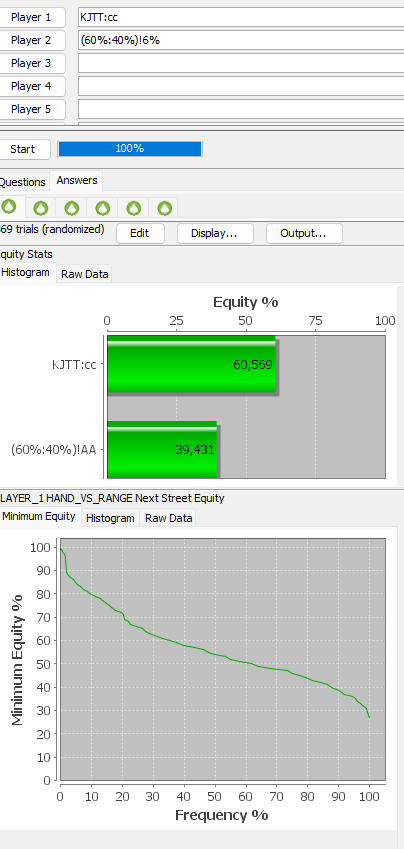
It is highly depending on SB RFI. Our hand is more strong in terms of ranking and raw equity than nuttiness so we can push Equity. Against a 60% range we have like 56% which is a equity advantage of 12%. In PLO that is quite nice already. Against a 40% range it drops to 53% and I would not 3-bet this anymore for sure. If we assume villain to 4-bet a range of 6% we´d have a significant 60% preflop equity advantage.

At the same time Equity-distribution of the hand is very smooth and therefore suitable to ramble several flops in 3bp´s. We hit 40% Equity+ in more than 90% of the flops if villain defends like 2/3 of an initialy 60% opening range and 4-betting 6%. If villain is like 4-betting AAxx-only it gets even better (common leak that player do not widen their 4-bet range which would be a counter against loose 3-bets, ofc skyrocketing variance even more). If we keep it to 3bp´s Villain will still be quite positionally disadvantaged especially when defending too wide. Creating room for villain to make mistakes is a potential source of profits.

Overall I do not think it makes sense to give static advisory for marginal hands how to play it as they are so often situational depandant also on tilt etc.. which influences postflop looseness of villain and at SPR4 we do not need to hit nuts to stack-off if villain fights back oop (which is still difficult with a weaker defending range supposed he is not 4-bet adjusting). We have to play back against aggressive players regularly without getting emotionally involved. If villain is decribed as a LAG why not punish this? We will not be paid off with the nuts in a SRP more often against such player type when the pot is smaller so we gotta look for edges in areas that may increase variance.

I agree that 1/3psb is better on locked textures like monotone. We risk less money and still preserve our FE on texture that are hard to play for villains without big parts of a range that has no visibility.


Reply
Quote
Mascherano95
Joined: 09.10.2010

Originally posted by PakerFace
Well, I think both of you are right. I think in general we should play gto against good thinking opponents and exploitatively vs weak ones. In this spot the villain was extremely lose and this play made sense to me and my range was crushing his.

BTW playing gto vs players who don't play gto is somewhat counterproductive isn't?
I think you can get more value out of exploiting certain opponents and their tendencies rather than to be solver approved.

Yes it is counterproductive. We want to boost our winrate by playing exploitatively without giving too much room for counteradjustments. And we also do not want Villain to get note of it so we have to do it gradually by mixing in some plays occasionally rather than start doing it several times a session.

The first problem is, if we have no big example on villain so he could just have a good run of cards (which happens more frequently than we would expect since our brain is not suited to process randomness very well). We would start adjusting into something that does not exist because we were biased at the first place.

The second thing is, Villain could have certain tendencies but play differently against us or adjust against us in a different way that would also make a wrong picture. Our perceived table image is somewhat quite impactful and we have to be aware not overdoing thing and just lean towards exploits when the image and the dynamics fits the current situation.

The latter one being highly difficult to observe when playing more than 2 tables player try to compensate this with GTo at the same time cutting their winrate.
I would say a mix of both is fine to maintain a flexible skill-set. So I personally mix some more short multi or rush table session to improve my skill-level and training of GTO application but then also have some sessions with well-known players in regular sessions where the meat comes from. I found that improving my GTO skills very much improved my skill at the regular tables.


Reply
Quote