
Skip to forum
When/what to x-r on...
 
Notifications
Clear all

When/what to x-r on turn after cbetting flop?

5 Posts
2 Users
2 Reactions
1,296 Views
ghaleon
Joined: 17.10.2007

So I had this hand today which bring very common situation. CO was very high VPIP guy calling all the time preflop and overall passive. BU was unknown.

If we look flop from solver perspective we would pretty much check range as players in position should have fairly tight ranges and both players have plenty of KK in their range with 100bb stacks. In this case CO probably shouldnt even have any calling range with 40bb and average player on BU is going to overcall much wider than solvers less than 10%. Also especially multiway people tend to stab less on average I would say. So I dont mind to cbet my hand as default. We also have bdfd which help on playability.

But key point is now in turn. I would say 8 is fairly dangerous card as BU range can definitely have rundowns like 89TQ+fd that he calls flop in position. Turn SPR is around 2.5 so if we pot there would be bit over SPR 0.5 for river. Which is awkward in a way that 4, 5, 6, 9, T, J and non pairing spade will change the nuts. My hand doesnt really interact in those cases where nuts change (in form of blockers) so it makes kind of bad bluff catcher from that view. Of course some cards like 4 and 5 are fairly blanks as 65 and 69 should be very rare combos for villain.

So this bring us to reason I went with check. If villain bet we can end the hand on turn by x-r pot. With miniscule amount potentially left on river it doesnt really matter what river comes.

Game #1767059921: Table €50 PL - 0.25/0.50 - Pot Limit Omaha - 17:08:14 2022/11/10
Seated players
Seat 1: RubberDucky2 (€51.14)
Seat 2: Polasa (€48.96)
Seat 3: jebou2 (€19.36)
Seat 4: varstubacken (€46.57)
Seat 5: brokestudent (€50)
Blinds and button
varstubacken has the button
brokestudent posts small blind €0.25
RubberDucky2 posts big blind €0.50
Hole cards
Dealt to Polasa Q♦:K♦:A♥:K♥:
Preflop
Polasa raises €1.75 to €1.75
jebou2 calls €1.75
varstubacken calls €1.75
brokestudent folds
RubberDucky2 folds
Flop 7♠:2♥:K♠: (6€)
Polasa bets €4.50
jebou2 folds
varstubacken calls €4.50
Turn 8♦: (15€)
Polasa checks
varstubacken bets €7.50
Polasa raises €37.50 to €37.50
varstubacken calls €30
River 7♥: (90€)
Polasa bets €5.21, and is all-in
varstubacken folds
Uncalled bet returned to Polasa: €5.21
Polasa wins €87
Summary
Total pot €90 Rake €3

So I would say that at least in my pool when MP checks on blank turn after flop cbet his range tend to be very capped. There are fair amount of top pair/overpair hands and potentially some K2 or K7 but I would say pool on average doesnt check even these mediocre two pair hands. Reason is look for protection. Board is drawy, we have likely best hand with K2+ so lets pot! Happy to get pot down or make villain call. But that bring some issues:

- Our range doesnt do that well on board changing river when getting called
- Our turn check range become very weak and attackable as we very rarely have hands to x-r or even x-c that happily
- Weak range can also hurt our river playability. E.g. on this pairing river it can prove very nice to be able to show up with KK if we check or bet river and face aggression

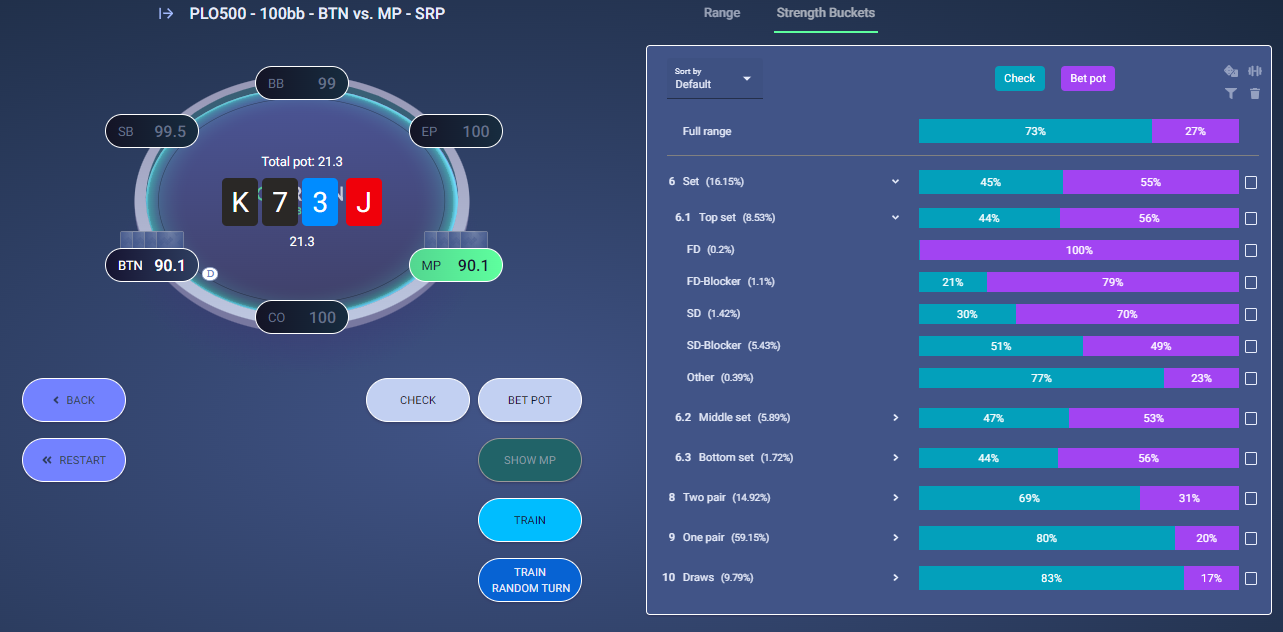
Solver wise we are more happy to cbet when we have back up. So lets say in my case I had KKT9, KK+fd. Like if turn was 8♥: I would second barrel all day long.

Here is image of MPvsBU HU pot where we cbet flop and turn bring potential straight draws on. We can see lot of barreling with top set when having support:
Now of course downside of checking is possibility of giving villain free river. That can be viewed though both good and bad. If we get super bad river after turn goes checked its much better than if we potted turn. But as always in poker there is "it depends". Like when MP pot on this solver case on K73J BU is supposed to fold fair amount of draws:
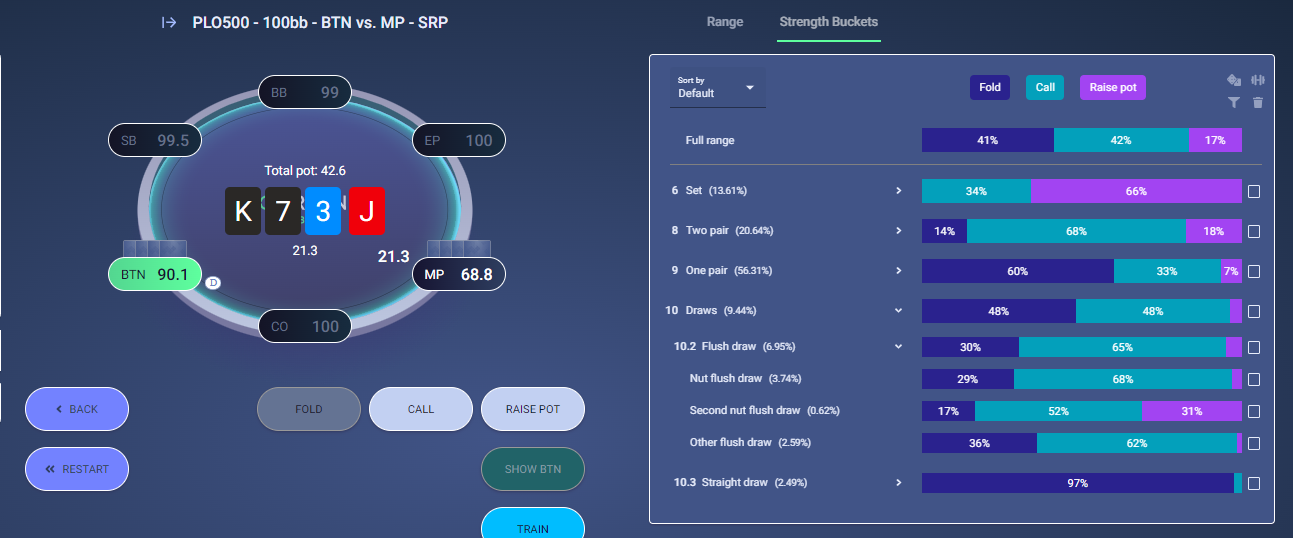
For example nfd without decent support should just fold. But as we know people often does call too wide with draws so reads are important. More passive or more call happy villain is more we should lean toward straightforward potting. Also passiveness can lead into easier decisions on river. But if villain is more creative and has already put you into tough spots when you check turn... Try throwing in some x-r to make it less attracting to stab versus check.

Also point versus solid player is that we make it fairly easy decision for most of his range when we pot. If villain makes call with appropriate type of draws we are not really making that much profit.

This same kind of logic can be also applied in 3bet pots when OOP. Like for example when we are COvsBU, flop goes checked and we have decision to lead or check on turn. Ton of players are heavily lacking delayed turn x-r range and are actually very honest with their hand strength. Betting most strong hands and checking weak to mediocre ones. Which can make very aggressive delayed cbetting ton of money as you simply dont get punished for it. On those spots similar concept apply that if board is drawy we should lead more with strong hands that have support. Then weaker combos prefer going for x-r which is again close to shove so we dont care about river decisions anymore.


Reply
Quote
4 replies
Coach
Kyyberi
Joined: 09.07.2010

To simplify the situation, we check-raise turn after cbet to protect our turn checking range. If we don't, our turn check range is fairly weak and opponent can exploit us if he picks it up. So the first question is if the opponent is

A) capable to realize if you turn range is weak
B) Aggressive and good enough to attack it

That is if we don't add strong hands to our check range on draw heavy boards. If the answer to either A or B is no, I would just cbet with strong hands as it doesn't backfire. But once we face better opponents who can exploit if we are heavily unbalance, we need to put more balance to your ranges. I don't think we need to aim for perfect balance, as often it is enough that opponent sees few times that we take the line bet, check-raise for him to realize that we are not capped with turn check. How much we want to do it is based then more to opponents aggression and whether he adjusts or not.

Versus unknowns in most player pools I would just barrel top set there. Majority of players are often just checking the turn to see the river, and our plan fails. Also to make low SPR on the turn often means that opponent's turn call is -EV even with the implied odds. If our cbet is +EV in the long run, I would take it unless I am sure checking is more +EV. And for that I would need some notes/reads.


Reply
Quote
ghaleon
Joined: 17.10.2007

Yeah I am not trying to get to gto frequencies by any means but I think understanding concepts behind the lines solver takes is very valuable. Like in this case we dont want to check our top sets that has good back up but use weaker ones. What I have noticed in pool I have played is that in PLO50-100 (compared to plo25) there is definitely lot more people taking stabs in position versus missed flop cbet. Which is often effective as most players dont approach spot from balanced view and check range is too capped. But yeah likely pool will not be that stab happy in missed turn barrel spots. That said we can still throw some of these weaker top sets in as check.

Its in good amount of spots also about making your life easier in a way. Like if our approach is to go for thin value with kind of merged range it will bring more nasty spots on later street with pot being bigger as well. Common spot could be e.g. BUvsBB single raised pot, flop J♠:T♥:6♥: and we have dry top two pair like AJT5 with no spades or hearts. Majority of players will just cbet that 100% and I would do it more often than not as well. But when you think about scenarios that can happen check start to make good amount of sense:

- Are you happy to face x-r on flop?
- How often turn and river will not change nuts? We are not thrilled to see A, K, Q, 9, 8, 7, heart or even 6. Also turn like 4♠: open ton more awkward river cards.

So to check flop in this case with top two is not only or primarily about protecting check range (which is plus) but also to look forward and see issues in visibility of the hand.


Reply
Quote
Coach
Kyyberi
Joined: 09.07.2010

I also think that a lot of players put themselves in nasty spots with cbetting hands that don't really improve on boards where equities shift a lot on later streets (=draws get there often).

It makes sense to use dry top sets to c-raise, as it doesn't block opp semibluffing range and is happy to get the money in and realize full equity.

In more reg-heavy and aggressive pools there are always players who stab vs check. Like at Party FF pool I have notes on several players that they stab very often vs turn check, and some of them even float flops with almost nothing (and in bad spots imo). It might be somewhat profitable strategy, as most of the pool over folds after turn check. Not sure though if it's profitable to blindly attack those checks. Versus those players I think it's very important to make sure you are the one who is exploiting and not the other way. Once I adjust and start to exploit their aggression vs turn checks, I pay attention to how they react. Some might shut down stabs once you c-raise them few times, which means that I need to adjust again.

Once we start to check-raise turns in these situations, we need to start thinking about balancing that check-raise range. Here's something to think about:

At 100bb game, we can often commit our stack with raise. Is it a problem, if our check-raise range is always for value?


Reply
Quote
ghaleon
Joined: 17.10.2007

Well in dynamic boards we can also include hands that has reasonable amount of equity in x-r range. I have noticed solver rarely seems to use draws without showdown value. Like on that K73J board hand like AKQT with fd is very viable hand to x-r but hand like AQT9 is usually either barreling or taking x-c line at least versus pot size bet from in position player. So even those x-r hands are sort for value. On some more static boards there might be space more for low equity x-r-f lines as sizings are often smaller and SPR bit higher on turn. But like on dynamic boards its kind of spot where small x-r sizing doesnt make much sense for overall range.

On some even dynamic boards versus stab happy players it can also make sense to x-c some overkill type hands that are happy to continue on most rivers but also block villain stack off range. But I think in these you really want to know your opponent so that we dont lose too much value if in fact villain is bet-calling too wide. Often even if IP player is stabbing with high frequency he might not do it in polarized enough fashion leading into spots where player feels committed to continue with mediocre made hand that solver wise would work better as check back.


Reply
Quote