


GTO Poker Theories: Gambler's Ruin
Barry Carter with advice on how to avoid going broke in games with many iterations.

One of the real gifts poker has given me is that it has been a great jumping off point to learn things from other disciplines like economics, AI, psychology and Game Theory. So I am starting a series of articles where I bring some of the most interesting things I have learned from other subjects outside of poker which are applicable in this game we know and love.
I begin today with some Game Theory, and how to play when the odds are against you.
'Gambler’s Ruin' is a statistical concept which explains why somebody playing negative expected value games will eventually go broke, or if somebody with finite wealth plays a fair game with somebody with infinite wealth, they will also go broke. The more iterations you play in a game with no edge, the more likely you will be to lose it all.
For example if a roulette player takes $100 to the table and makes $1 bets on red or black, because the house has an edge (the zero which is neither red or black) that player will eventually go broke. In the second example if you continually flipped a coin for $1 a time with Warren Buffett, you also would also eventually go broke because even though it’s a game with no edge either way, eventually you would go on a downswing which would see you deplete your net worth, whereas Buffett is so rich he could keep going against you forever.
Go big or go home
This is not exactly new information for poker players, but it gets interesting when you consider the best option you have if for some reason you have to gamble with the odds against you. Let’s say you have $100 again and you for some reason have to run it up to $250 playing red or black. Your best approach would be to take what is called a ‘Bold Game’ strategy which would be to put the whole $100 on red or black, then if you win the first game, putting $25 on red or black (then if you lose that, putting $37.50 on the next square, and so on).
Basically, the correct approach would be to wager either the whole amount, or no more than necessary, to get to the target in the minimum number of bets.
The reason for this is that with the odds against you like in the first two examples, the more iterations, the easier it is for the party with the edge to realise their advantage. If you are putting $5 bets on red or black trying to get to $250, it is much more likely the house edge will wipe you out before you go on a heater. But with the ‘Bold Game’ strategy, winning two spins on the bounce is pure chance, but could easily happen.
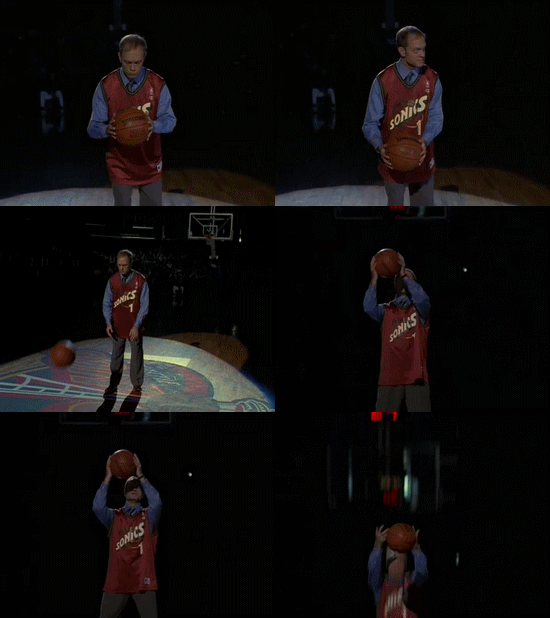
If you had to play LeBron James at basketball and he allowed you to start with the ball and pick the number of baskets to decide the winner, you should always choose a single basket as the target. The chances of you even putting two past him is incredibly unlikely, but anyone has it in them to fluke a basket if they throw it hard over their head the second the game starts.
Reduce iterations when you're the underdog
So how does all this relate to poker? I think the ‘Bold Game’ strategy is useful to think about when you find yourself in a game where you are outclassed at the table. Let’s say you have satellited into an EPT event as an amateur and everyone at your table is a notable High Roller or bracelet winner. If you are a serious player wanting to test yourself, by all means take it to the big boys, but if you are an out of your depth amateur wanting to survive, the Bold Game is your best shot.
This doesn’t mean going all-in every hand and trying to end a five day EPT tournament there and then. In this respect I am referring more on how to avoid ‘Gambler’s Ruin’. Instead of trying to end the game as quickly as possible, reduce the number of opportunities for the players with a significant edge to bust you. This is why the starting advice for new players is to only play premium hands and it applies here, it’s much harder to get crushed by better players when you only have strong hands when you do play.
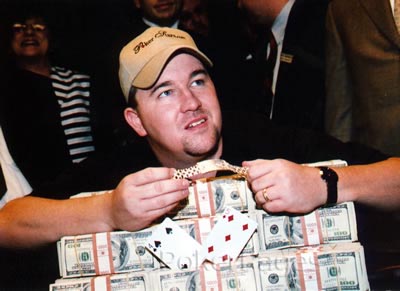
On the occasion that you are going to enter the pot with a strong hand, the other way to make Gambler’s Ruin less likely is to make the pots bigger. Playing smallball against a superior player is like trying to beat the house by making smaller bets or playing first to 11 with LeBron. The poker equivalent of the Bold Game approach would be to make the bet large amounts when you do play a hand, so there is less room for a better player to outmanoeuvre you. Obviously this is a much more volatile way to play and could see you exit sooner, but if we are to make the assumption that the odds were stacked against you anyway, it does give you a puncher’s chance of being on the right side of variance and doing well. Chris Moneymaker’s victory in the 2003 Main Event is a classic example of the Bold Game strategy against vastly superior opposition, he played aggressively and got lucky, making history in the process. If it doesn’t work out, at least you can say you went out swinging.
What theories from outside of poker have really helped you with your game? Let us know in the comments:
Related
- The Matthew Principle in poker
- Why you have to let weaker players win
- The Tragedy of the Commons and poker
- Why AI beating poker players is important
