


GTO Poker Theories: Flow (or how to get in the Zone)
It seems random but playing at your peak is a lot more predictable than you would think, once you understand the 'Flow Channel'.
One of the real gifts poker has given me is that it has been a great jumping off point to learn things from other disciplines like economics, AI, psychology and Game Theory. So here is a series of articles where I bring some of the most interesting things I have learned from other subjects outside of poker which are applicable in this game we know and love.
We all know what it’s like to play on tilt, but we all have also had those rare moments where poker seems effortless. You instantly make the right decisions, you are honed in on all the action, you get completely lost in the moment and before you know it hours have passed. We call this being in 'the Zone', but it is probably better referred to as a state of Flow.
This term 'Flow' was coined by psychologist Mihály Csíkszentmihályi and refers to those moments where we are really playing our A-game. We have all experienced it, perhaps in our work, a hobby and especially video games (more of that in a moment).
Csíkszentmihályi has a large body of work and a book explaining why flow happens and how to create it, but I think the best way to understand it and make it happen more often is using the image below:
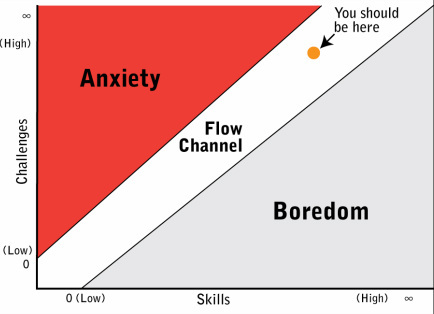
A flow state happens when you can find a sweet spot between being challenged and being competent at what you are doing. If something is too easy, you would get bored and it would be hard to summon the energy to perform well. If something is too hard then you will feel overwhelmed, deflated and low in confidence, again not ideal for performance. But if something pushes you to the edge of your capabilities, but you can keep up, then a flow state is more likely.
I mentioned video games because not only is it a likely place most of our audience will have experienced a flow state, the games themselves are designed to illicit flow. Most video games are easy to pick up (so you will have the competence to perform them) but gradually get harder as you progress, so you will be constantly tested to the edges of your current capacity. This is why it is easy to get lost in (and hooked by) video games.
Game selection

Poker is a skill game so it makes perfect sense that you will experience flow a lot of the time, just as you can experience flow at the gym or at work. The specific reason I wanted to call out poker is because the way we approach it can hinder or help flow. Your game selection skills likely play a big factor in how often you are in the zone.
The common mantra in poker is to find the softest games you can, the easiest opposition, and print money that way. This is indeed a vital skill in poker which should not be overlooked. But if you never challenge yourself in tougher games, you might never perform to your potential.
Phil Galfond and Doug Polk are two players who made a point of seeking out the toughest heads-up matches they could online early in their careers, rather than ‘bum hunt’. They purposely put themselves in tough spots they could easily avoid which must have hurt like hell, but it resulted in them both being considered the best cash game players for a while in their respective games.
Losing should hurt

My friend Dara O’Kearney recently blogged about how he felt he needed to feel a bit of fear in his game, so he has started taking a few shots at High Roller tournaments:
The last few years have been undeniably comfortable. I've reached a point in my career where money can no longer be the only motivation. A new challenge is needed. I need to play games again where losing hurts, just to see what that feels like. I need to challenge myself to learn more so I can compete with the very best.
Of course you can take this to extremes and the downside of that should be obvious. Play too many games that are beyond your current ability and you will go broke, or before that you will get so demotivated that you give up playing.
The lesson here is simply that taking occasional (safe, affordable) shots at tougher games is a good thing. Just like pushing yourself at the gym, trying to get over your fear of public speaking, applying for a promotion, or trying to get the phone number of the guy or gal who is a bit out of your league. Life would get boring fast if we all just stuck to what we knew and never took risks.
But obviously if there is a really profitable game happening right now still jump in it, just try and solve a rubik's cube or do some push-ups during it to make it tougher.
What theories from outside of poker have helped your game? Let us know in the comments.
Related
- The Matthew Principle
- The Tragedy of the Commons
- Gambler's Ruin
- The Pareto Principle
- The Ultimatum Game
- The Survivor Bias
- The Cobra Effect
- Black Swan events
- Prospect Theory
- Marginal Utility
- Illusion of Control
- The Bike Shed Effect
- The Peter Principle
- Commitment Devices
