


Why New Years resolutions fail
Jared Tendler says you are working too much on your A-Game and that is why your plans for 2024 might derail.

The start of a new year is often a time when you feel energized about your goals and optimistic about your ambitions. You envision the year ahead, imagining the progress you’ll make and the success you’ll have.
My job isn’t to decide what you or my clients aspire to this year. My job is to help you get there. So out of the gate, I want to remind you about The Inchworm Concept, because it can help you understand how to make progress this year without the usual big ups and downs. For those of you whose goals are really more like New Year’s Resolutions that are easily derailed once the inspiration fire has burned out, this is especially relevant.
If you’re going to have success this year it’ll be because you’ve successfully leveraged, or improved, your strengths, while also protecting yourself from, and improving upon, your weaknesses. The Inchworm Concept helps you to be honest and practical about your current skills, including both your strong and weak points.
For many of you the latter is most important. It is our weaknesses that have the power to trip us up and hold us back. They undermine our efforts and keep us trapped in a cycle of underperformance that can wear on our confidence, kill our motivation, and fray our nerves.
You’re not going to allow that to happen this year.
No, this year is different.
This year you’re going to do the dirty work. You’re going to dig into your weak points and unlock your potential. This isn’t rocket science, it just takes the willingness to look at aspects of yourself and your performance that can be hard and uncomfortable. Fortunately, The Inchworm Concept makes that work easier to do.
Inchworm & The Bell Curve
For those of you who are unfamiliar with the The Inchworm Concept, it’s literally based on the inchworm, a caterpillar that moves in a distinct way. If you’ve never seen the way an inchworm moves, the graphic below shows how it stretches its body straight, anchors the front, bends from the middle, and then moves the backend forward in order to allow the next step forward.
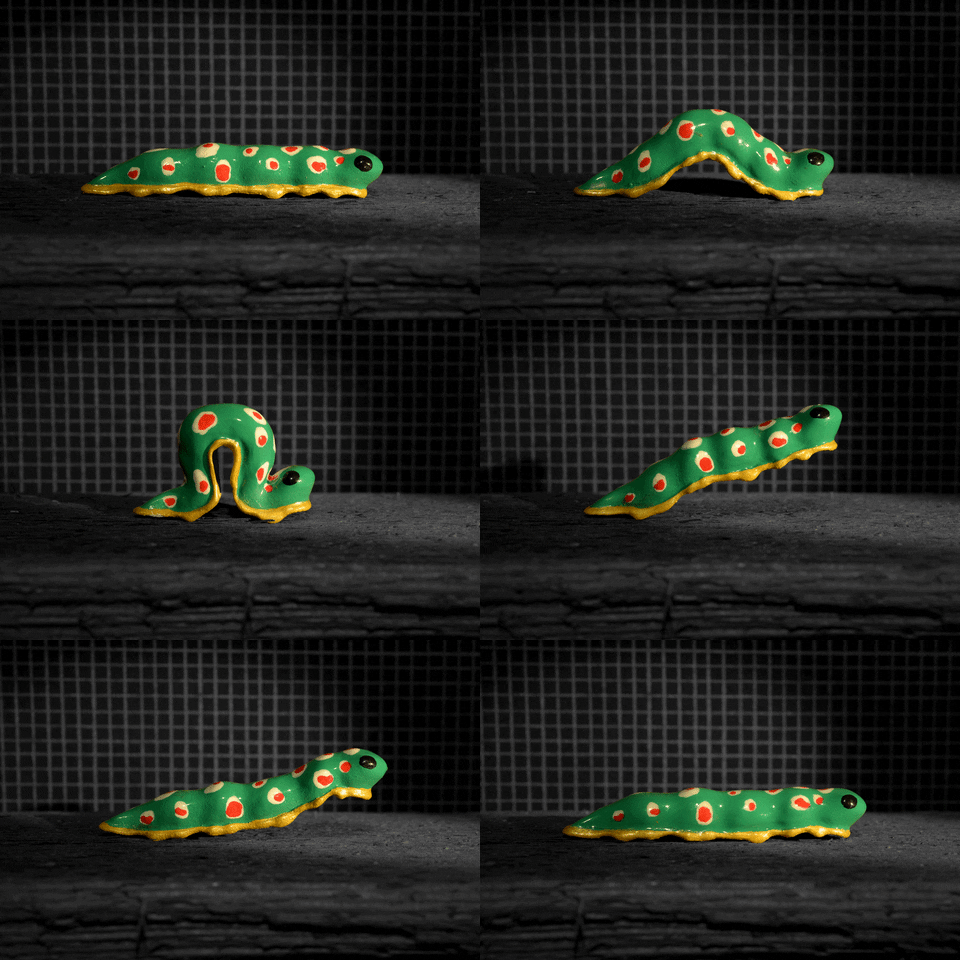
An inchworm looks like a bell curve that moves.
Your bell curve is the variation in your performance from best to worst, and everything in between. All the knowledge and skills that you’re currently learning exist within that range. Every day you show up to play poker you’re bound by your range. There’s a limit to how bad you can be, and there’s a cap on how good you can be as well.
Moving Your Bell Curve Forward

The bell curve is a static snapshot of your current range. Improvement, on the other hand, is the forward movement of a bell curve over time — something an actual inchworm illustrates perfectly in the way it moves.
Consistent improvement happens by taking one step forward from the front of your bell curve, where your A-game becomes even better, followed by another step forward from the back, where your C-game becomes less terrible.
Over time, that improvement from both sides of your range moves your entire bell curve forward: Progress in motion.
What trips you up is your C game. That’s why New Year’s resolutions fail, you’re not accounting for your back-end weaknesses.
Inspiration can ignite your A-game, allowing you to reach new heights or sustain new habits for a short time. But you can’t escape your C-game that easily. It’s like gravity and eventually you’ll fall back down to earth.
In practical terms, you may be inspired to work harder, have better focus, avoid your common trading, poker or golf mistakes, but when momentum starts to fade, your C-game habits, such as procrastination, distractibility, and tilt, pop back up and derail you.
To truly move your C game forward, you have to get at the root of what’s causing your issues, and/or have a plan in place to apply corrections when inspiration fades and progress is tougher to sustain.
The Inchworm Concept helps to keep you more accountable, ensuring that you produce C-game progress, not just improvements to your A-game. Because if you focus only on frontend improvement, as many mistakenly do, your range gets wider, and that causes a host of problems to develop:
- Wild swings in execution
- Inconsistent performance
- Plateauing
- Burnout
- Emotional ups and downs
Contrary to what many believe, your backend doesn’t automatically move forward because the frontend did. To counter this, you must consistently focus on backend improvement, especially when you reach a new peak in your ability.
Putting Inchworm into Practice

When looking more closely at your performance, for better or worse, it’s important to be honest about the reality of the range that exists – not what you wish the reality was, but what it actually is.
Think for a moment about the quality of your performance at your absolute best vs. at your absolute worst. In other words, how good does it really get when you’re doing great, and how bad does it really get when you’re doing poorly?
Everyone wants to be at their best more often and improve faster. Inchworm is an easy way to remember that improvement happens from two sides: improving weakness and improving your best.
As you kick off this new year, use The Inchworm Concept to keep you focused on improvement everyday, so you can look back at the end of the year and be proud of what you accomplished.
What weaknesses do you want to improve this year? Let us know in the comments:
