


Poker and Chess with Jennifer Shahade
We talk about what poker players can learn from chess, and vice versa, with expert in both Jennifer Shahade.
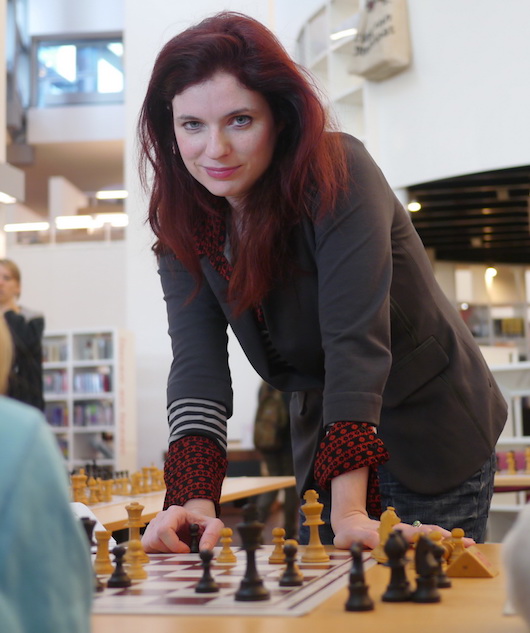
What has poker helped your chess game?
Jennifer Shahade: Chess is a beautiful game that attracts many artistic, perfectionist types. Poker teaches chess players to be more pragmatic—it’s more about winning than in finding the perfect moves.
What has chess helped your poker game?
Jennifer Shahade: I don’t care too much about getting unlucky and have few superstitions…except that clubs are the best suit and deuces are better as live kickers than treys in OFC.
The money in chess is different
.jpg)
How does the presence of money change your motivation to play poker compared to chess?
Jennifer Shahade: I look for both creative and money making opportunities in everything I do.
What is the money situation like in chess for an aspiring player, compared to poker?
Jennifer Shahade: Surprising to many, there is money in chess! But it is structured very differently than poker. At the elite level, a handful of players make millions. Underneath that, many players do quite well from supplementing tournament wins with coaching and writing.
I really liked your Ted talk because (as someone who knows nothing about chess) I always thought it was more complicated and required more memory than it maybe does. Your video showed me that chess players thinking in terms of decision trees is a lot like thinking in ranges in poker. Is that an accurate analogy?
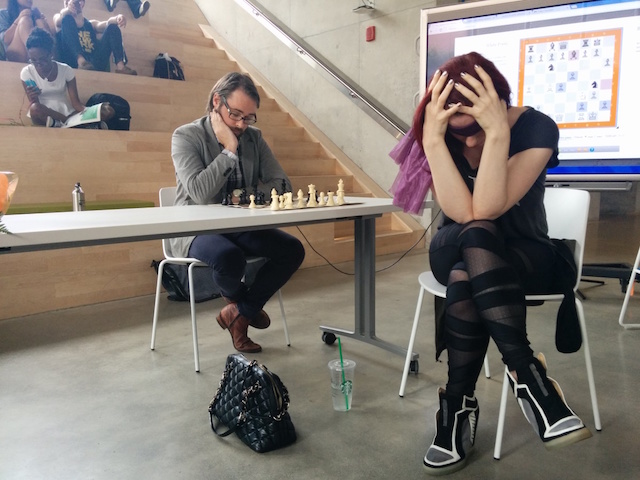
Jennifer Shahade: Yes, chess players rely on instinct far more than people think. Memory is not just about specific moves but also general patterns. I recently played in a blindfold exhibition in Toronto (while there to play the World Championship of Online Poker). That required a lot more focus and memory than usual. I was trying to create a visual image in my head of the chess board and shut everything else out. Unfortunately for me, jackhammers went off just as the game began. I couldn’t help but laugh. The concept of the event went beyond blindfold chess. An artist, Aaron Tucker, created an algorithm to turn chess games into poems. You can read more about it here.
"Hard work beats talent"

As an ambassador for both games, are chess players more interested in poker, or vice versa?
Jennifer Shahade: Chess players are interested in the glamour and money in poker, and poker players are interested in chess because they think you have to be smart to master it. Joke is on them there. In Dublin, Dmitry Urbanovich got Heads-up in our EPT Side event that combined chess and poker, behind David Murray, who is a chess master. Urbanovich went on to win first place in the Main. Of course, I enjoyed seeing that as a MindSports Ambassador.
Chess is often used to discuss the role of nature vs nurture in mastery. You have an interesting perspective because you are from a chess playing family, which could be proof of nature (The Shahade gene) or nurture (the amount of practice you've been exposed to) – where do you stand on the talent vs hard work debate?
Jennifer Shahade: I feel talent and hard work are important, but I stand more on the side of hard work. When I first started playing chess, I was not very promising, compared to my brother who shot up very quickly and confidently. A few years later, I fell in love with the game itself, mostly due to my discovery of chess problem-solving. That’s a branch of the game that is about creating beautiful studies. It appealed to my artistic side and I started studying chess all the time. Of course, I suddenly became a talented player.
"We have not solved chess yet"

Artificial Intelligence has played a huge part in chess, and now it seems the same research is going into poker. Is poker solvable in this regard? Do you think AI is good or bad, in general?
Jennifer Shahade: As my good friend Bill Chen likes to say, “Solvable” is a word that gets thrown around very lightly. There’s a distinction between getting good enough at a certain game/format to beat the best human players and “solving the game.” We have solved tic tac toe, we have not solved chess. We have no idea what the best first move is, though we can be sure it’s not 1.f3.
As for poker, I have mixed feelings. I think the poker culture and the many brilliant minds in both the industry and on the felt will do a good job at adjusting if we need to tweak certain aspects of play to avoid cheating based on AI.
On a positive side, I think using AI to train is kind of cool, because it rewards hard work. It makes being part of a specific poker clique somewhat less important. For instance, you can use programs as a substitute for a group of poker friends to study certain spots. Of course there will always be a lot of value in cliques sharing population tendencies and liquidity. But as one gets better at using these programs, you see how incredibly powerful they may be in the hands of someone with no connections but a lot of time and drive. Matthew Janda said something similar in his very dense book, where he addressed the concern that writing it would somehow kill poker.
You see the same thing in so many other subcultures, including chess. Before chess programs, databases, AI and online play, most of the top players came from geographic hotbeds. Now you have talents popping up all over the World. Examples include the rising star Grandmaster Kayden Troff of Utah, or on the largest stage, our current World Champion Magnus Carlsen of Norway.

Another thing you see in both chess and poker is that AI can actually make people worse if misused. For instance, AI may say this move, or this bet size is good or bad, but if you don’t understand why that’s the case or under what parameters, it could be totally worthless and even damage your thought process.
Obvious final question but if you had to choose chess or poker and couldn't play the other, which one would it be?
Jennifer Shahade: I’d play poker and then get my chess fix in with compositions, where you have to find mate in the quickest number of moves. That would satisfy my love for the game. For instance, here’s one (Left) that I commissioned Grandmaster and composer Pal Benko to make- it’s a mate in two in the shape of a poker spade.
Thanks Jennifer, good luck with both games.
