WSOP $1 Million Buy-In Event - Good or Bad for Poker?
News of a $1 million buy-in event for the 2012 WSOP has polarised opinion amongst poker aficionados. In this column, we delve deeper into the pros and cons of such an event.
In early June, Cirque Du Soleil founder Guy Laliberte announced a $1 million buy-in event for the 2012 WSOP, with 11.1% of each buy-in going towards the ONE DROP charity foundation. Entrepreneur, philanthropist, space travel enthusiast and high stakes cash game player, Guy is influential in almost everything he does. But is his latest creation good for poker's overall image?
Having all committed to play, familiar faces Patrik Antonius, Gus Hansen, Daniel Negreanu, Johnny Chan, Tony G and Tom Dwan seem to think so. Business mogul Andy Beal, who allegedly lost over $16 million to a syndicate of pros including Phil Ivey and Jennifer Harman, has also pledged to participate along with Treasure Island owner Phil Ruffin.
Negreanu championed the event's charitable ambition, stating "A million dollar buy-in seems crazy, and well, it is, but when you factor in a great cause like ONE DROP getting a percentage of the prize pool, all of a sudden it seems like a fantastic idea, and a great way to raise money for charity”.
Tony G echoed Negreanu's sentiments, "One Drop is an extremely intelligent, important charity organization and I'm honored to play a part in giving back. This is a perfect partnership for the WSOP and for poker in general".
Despite backing from some of its participants, the introduction of a $1 million buy-in event is a contentious issue to say the least. Let's take a closer look.
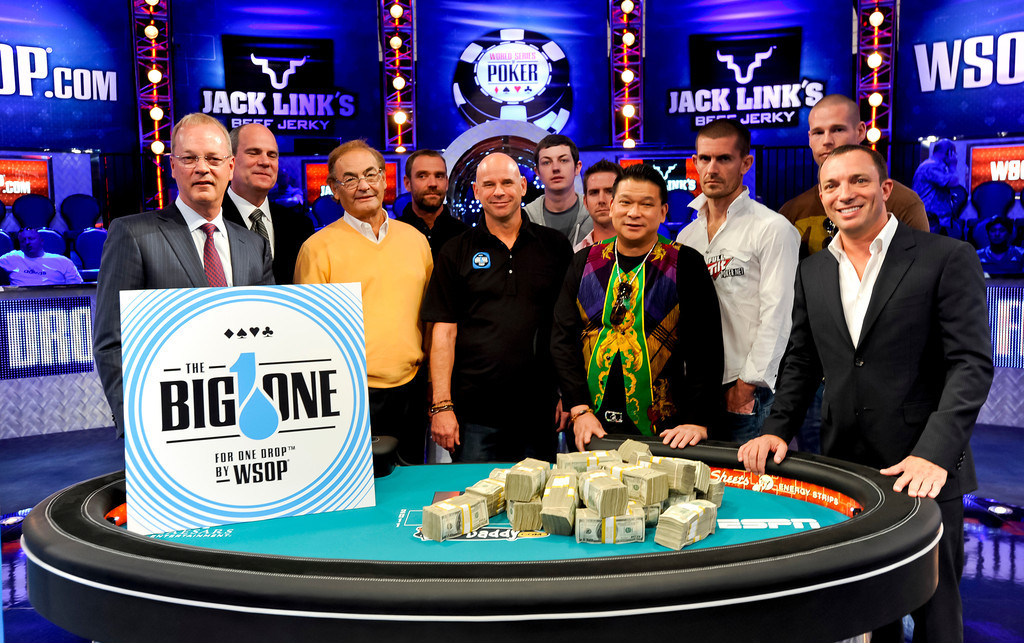 |
| Show of solidarity - big names back $1 million buy-in event |
Brilliant innovation...
With its "Ante Up for Africa" events, the WSOP is no stranger to charitable practice. 15 players have signed up to the $1 million event already, which guarantees $1.5 million going towards the preservation of water around the globe.
The bumper buy-in concept was launched at this year's Aussie Millions, where Erik Seidel claimed victory in the $250k Super High Roller Event.
 |
| Aussie Millions Super High Roller winner Erik Seidel |
The $1 million buy-in event can also be backed from a poker perspective. Some feel that the WSOP's integrity has been damaged by the number of $1k events, which attract a fair proportion of tourists and recreational players.
The WSOP is supposed to be the holy grail of poker festivals, and the addition of $1 million buy-in event may help restore some of the prestige. Many believe that the WSOP has lacked a flagship event for the elite contingent since the removal of the $50k H.O.R.S.E. event.
Many household names refrain from playing the WSOP's smaller events unless lucrative bracelet prop bets are involved. Professionals these days endure million dollar swings, and play as high as $8,000/$16,000 at the Bellagio or in Macau.
Isildur1 lost over $4 million to Brian Hastings in a single session, and still finds himself in the enviable position of sponsored pro at PokerStars. Would $1 million be such a significant dent in the pockets of Tom Dwan and Patrik Antonius, who have earned millions through sponsorship and cash game exploits?
With the countless number of poker "celebrities", scandals and even scantily-clad ladies, it's impossible to escape the fact that poker has become a form of showbiz. The more cynical amongst us attack "showbiz", which traditionally manifests itself in things such as gossip magazines, for being superficial and vacuous. But poker's evolution to "showbiz" status has an obvious plus point, and that's the ability to reel in the masses and get everybody talking.
Bearing in mind the showbiz factor, the $1 million buy-in event is a blessing, given the entertainment it will provide. It was estimated that 415,000 people tuned into ESPN's coverage of the closing stages of 2011 WSOP Main Event. With no obscure names, and truly life changing sums of money on the line, the $1 millon buy-in event could be an even bigger draw.
Or harmful for poker?
Take away the charity component however, and the $1 million buy-in event looks like a far more indecent proposal.
It betrays a fundamental ethos of the game - that is, its accessibility. Such an event sends out contradictory messages to people looking to take up the game. On the one hand, you have the "Moneymaker" road to stardom, and a story which encapsulates the American Dream. Here, a player can satellite all the way from $33, and eventually become Main Event champion. But then you have a $1 million buy-in event, inconceivable for the layman, and instead geared only towards the super rich.
The event is a kick in the teeth for many grinders and MTT specialists who adhere to bankroll management. Can such an event be representative of true poker pedigree when many of the world's most consistent tournament players will be absent?
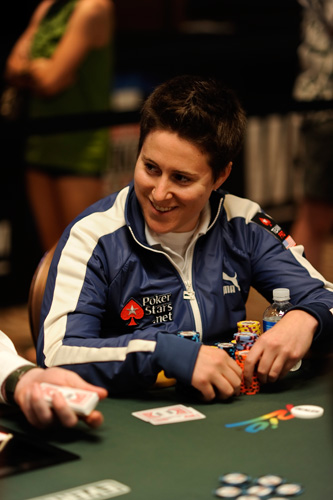 |
| Disapproving of event - Vanessa Selbst |
Pro Jeff Madsen voiced his concerns: "I wanna play it, but I'm not going to be able to because it's a lot of money. I mean the WSOP keeps stepping it up".
Other pros have also spoken out against the event. Vanessa Selbst ranted, "I think it's ridiculous, it completely destroys the sanctity of the bracelets. It completely ruins the idea of poker stats. I think $100k and $250k buy-in tournaments are stupid enough".
Selbst makes a valid point. This event undermines everything that the Epic Poker League's Global Poker Index is trying to achieve. How can we hope for an objective measure of greatness if monster buy-in, "elitist" events are going to skew statistics?
It is a clear sign that the WSOP is running out of ideas on how to keep their tournament interesting. Raising buy-ins to reinvent poker is not a good sign for the game. On reflection, the $1 million buy-in tournament does smell of an audacious, rather cheap publicity stunt.
Perhaps the WSOP is feeling the pressure of the rise of the EPT and the WPT, along with the success of online festivals such as the WCOOP. Regardless, the WSOP should be aiming to attract more recreational players to encourage the game's growth, not ostracise them with hefty buy-ins.
Finally, a $1 million buy-in tournament gives more ammunition to poker's detractors, who frown at the ridiculous sums of money involved.
Your thoughts?
In principal, a $1 million buy-in event seems like a ludicrous concept, and does more harm than good for poker.
But does the involvement of charity make it acceptable? Feel free to share your thoughts and debate in our forum thread.