


Your ROI is greater in larger fields l Strategy with Barry

Continuing my look at the nerdy world of variance in poker. Today I wanted to look at field size. I've always been an advocate for playing smaller fields because they are much easier to manage mentally. You don't go in big swings, and you get much more practise in the endgame spots like bubbles and final tables.
However, if you are a player who is looking to increase your ROI, then increasing your field size is the way to go. As long as you're okay with the variance that comes with it, you will always win more on average over the long term in larger field tournaments.
One of the reasons is simply because of a quote I love from Andrew Brokos. He said that any tournament with 1,000 players will be soft because there aren't 1,000 good players in the world. Anyone who has seen how poker has gotten tougher over the years may disagree with that, but the general sentiment, I think, is absolutely spot on.
More players = more profit
To dive into this further, below are three filtered SharkScope results for the same player. I won't name the player, but he is one of the best online players in the world.
The bottom table is for tournaments with 20 runners or less. The middle table is tournaments with 27 runners to 180 runners. The top table is tournaments with 200 or more runners. As you can see, this player has a large sample for each tournament type.
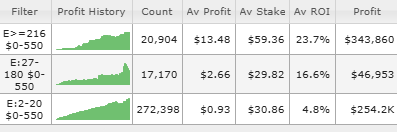
As you can see, the difference in win rates is significant. His ROI is just 4.8% with 20 players or fewer, and it goes as high as 23.7% when the fields get large.
This is obviously partly due to there being a ceiling on how much you can win in any one tournament in the smaller fields. I'd also make the case that the smaller the field, the more likely you are to encounter tough regulars who have specialised in that field.
Thousands of mistakes on hundreds of tables

I would argue the main reason, however, for higher ROIs with larger field tournaments is because of the nature of tournaments themselves. You can benefit in a tournament from hands you didn't play. An obvious example of this is if you are at a final table, you fold, two other stacks collide, one player is eliminated, and you get a pay jump.
But you can also benefit from hands that didn't even take place at your table. Again, the obvious example here is if you are on the bubble of a tournament and the bubble boy is eliminated from another table on the other side of the room.
Every time a player is eliminated in a hand you didn't take part in, you benefit. Therefore, any time a player makes a mistake in a hand you didn't take part in, you benefit too. It stands to reason, therefore, that the larger the field, the more these errors compound. If you're in a 1,000-runner tournament and 600 of the players in that tournament are making mistakes, over the long term you will benefit from those mistakes.
That's why, even though there is an incredible amount of variance in large-field tournaments, if you have the fortitude to withstand that variance, you will eventually benefit from them greatly.
