


Poker tells expert Zach Elwood answers your questions
Verbal Poker Tells author Zach Elwood answers your questions on everything about verbal and physical tells in poker.
"I did seven months of research for this book"
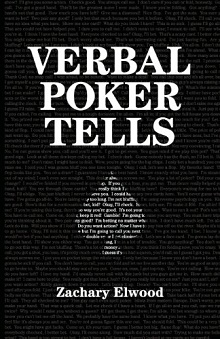 swish29: How have you created this book? Is it based on your experience at the tables from you and people you know that play live poker, and/or did you have skills/were you interested in that area away from the poker tables and did you transfer it to poker?
Zach Elwood: I’ve played poker seriously for more than ten years, three of those years professionally. And I’ve always been interested in the psychological side of poker, even while knowing it’s much less important than the strategic side.
I spent a good seven months or so, pretty much full-time, working on this book. A couple months were dedicated to watching televised poker and taking notes. I focused on televised poker shows and footage that featured more recreational players, as their patterns are more understandable and reliable than the behaviours of experienced players. So a lot of hand histories used in the book come from shows you’ve probably seen: High Stakes Poker, Poker After Dark, Heartland Poker Tour, World Series of Poker, EPT, to name a few.
I also took notes when I played. I took a lot of notes on a bunch of cash games, ranging from $1-2 NLHE to $5-10 NL (mostly $2-5) and also some fixed limit games around $20-40. I also got some trusted poker player friends and acquaintances to send me hand histories.
Every hand history in the book is supposed to represent a real hand that was actually played. And every pattern I describe is supposed to represent my take on what I’ve seen to be fairly reliable indicators of hand strength, at least mainly for the recreational player base.
"I like to ask questions to elicit information"
 sherriffatman: What questions do you find to be the most effective for eliciting responses with verbal-tells inherent?
Zach Elwood: A lot of times, we won’t get much information from verbal behaviour, whether it’s elicited or volunteered. I say in the book that the best readers of poker tells are not trying to read opponents constantly, in every hand; the best way to make use of behavioural patterns is to let them “come to you,” and just try to absorb things as much as possible and hopefully recognise the occasional spot where things align to give you information.
That being said, working on the book has led me to try to probe people more often for information now. I didn’t used to try to elicit information much before, but now I’ll occasionally do it. I don’t recommend burning up a lot of time asking questions and talking, but sometimes, if you’re on the fence about a tough call-or-fold type decision, a little question or probe when you’re thinking can give you a little information that might help you make a better decision.
A few of the more sneaky questions I like to ask people these days are:
“What do you think I have?” Players with strong hands are more likely to say goading things and to assign a weak or unknown hand range to an opponent. Players who are bluffing will sometimes assign an opponent a strong hand range, almost as if to say “I know you have a strong hand and I’m not really worried about it.”
“Will you show if I fold?” While most answers to this aren’t very helpful, just because most people are so used to hearing it, there is sometimes information in how they answer. For example, a player who acts irritated or aggressive in some way is often comfortable; this is because bluffers don’t usually want to irritate an opponent. So if a player says something like, “Hell, no, you never show” then it’s become very unlikely he’s bluffing.
“You’re pretty quiet; makes me think you’re bluffing.” This kind of probe can sometimes make a bluffer uncomfortable and he might say something small in an attempt to feign relaxation. Whereas if a player has a strong hand he’ll be happy that you think he’s weak and be more likely to act even more quiet or uncertain with the situation.
With all probes, you can sometimes pick up nonverbal information about how relaxed a player is, like how much eye contact they make or other things. But most of these kinds of elicited reads will really depend on your experience level, and will mostly be successful versus your worst opponents. Good players will either be stoic and unreadable or will be capable of switching up the normal players. I find these kinds of ways to gain information entertaining but I really hardly ever use them just because if you use them too much you really slow up the game and annoy people.
"False tells are uncommon"
 zeezout: Will a professional player show a tell to make the opponent think he shows a tell to mislead hem, so he makes the wrong decision even when spotting a tell?
Zach Elwood: False tells are relatively uncommon. Most good players don’t waste their mental energy and efforts trying to perform complex verbal or nonverbal deceptions, just because there’s not really that much upside.
But yes, false and misleading behaviours do happen. Some people will act contrarily to what you’d expect them to do; this may be because they’re trying to be tricky, or it may just be because that person generally acts different.
All of this points to the fact that ideally we want to gain player-specific reads before acting on behaviours. You want to know that an opponent is at a specific skill-level and mindset, and that he seems to have the pattern we’re looking for, before basing a decision on that behaviour. With verbal poker tells, this is difficult, just because there’s so many different kinds of verbal behaviour. But at the very least, you can get a sense of “this player isn’t very good and is likely to adhere to the basic verbal patterns that many recreational players have.” As long as you have some sort of information about a player to base a read on, that helps.
And of course, for players who are tricky, it’s not hard to figure out they’re tricky or that they act contradictorily. It only takes seeing someone act in an unexpected way once, and then you can remember that about them. The nice thing about my new book, I think, is that it allows you to set a “baseline” for what “normal” behaviour is from most players. Then, when you see someone not adhere to that pattern, you can start thinking “oh, they are more likely to switch the behaviour in the opposite way” or “they are tricky, I shouldn’t trust my reads about them” or whatever. But I think setting a general behavioural baseline is valuable. It also gives us a way to discuss and describe how someone acts.
But, back to your question, in general you should not be trying to get reads of experienced, good players. Not only is it harder to get reads on them, just because they’re more stoic, it’s also possible they’ll know how to deceive you. So if you think an opponent is better than you, you should be unlikely to base big decisions on their behaviour, unless you’ve already got a good reason to do so.
"Behavioural patterns are more important in cash games"
 barrycarter: Now you have studied verbal and physical tells so much, is it hard to 'turn it off'? Do you find yourself noticing little things when someone is serving you coffee or when you meet them at a party etc?
Zach Elwood: Well, I should say it’s not like I consider myself the “best reader of poker tells” or anything like that in the first place. In the process of writing this book I actually learned a lot, which was cool.
But I’ve always been interested in psychology and verbal behaviour. I used to read a lot of Freud books when I was a kid, including the book The Psychopathology of Everyday Life, which delves into slips in speech and mispronunciations in normal, day-to-day life and what those can mean. Freud’s sometimes a bit over the top, but a lot of his observations about the hidden meaning in people’s interactions are really very interesting and logical.
So I guess I’ve always been interested in studying small behaviours and gestures and wordings. But generally I don’t really “turn it on” unless I’m playing poker or unless I’m getting a bad vibe from someone. But lately most of my best realisations about verbal behaviour happen away from the table.
Later, I’ll think, “Oh that was obvious when you consider such and such.” It is admittedly hard to know exactly what we should be paying attention to in the moment, at the table. But I think that thinking about it more, consciously, can lead to better and better decisions in the moment. I’ve definitely improved at understanding verbal poker behaviour just in the course of writing this book.
mkjmkjmkj: Often you don’t see the opponents hand so how do you confirm a tell?
Zach Elwood: Yes, it can admittedly be hard to formulate a read on someone, considering how few shown-down hands we sometimes see. But for more recreational players, it often happens that we can be very sure in many situations that the player had a strong hand, just due to a bluff being so unlikely. Most big bets from recreational players will be strong hands; that’s a generalisation but a useful one.
Tournaments have a lot less showdowns than do cash games. That’s one reason why behavioural patterns are more important in cash games.
Another reason is that tournament players are just more serious, stoic, and silent than players in cash games. Cash game players are more behaviourally loose and relaxed in general. You’ll hear a lot more talking in cash games. That’s why I say in the Verbal Poker Tells book that it’s mainly useful for cash games. (Having said that, there are a lot of patterns you’ll often see in tournaments.)

