In Ergänzung anbei ein WSJ-Artikel, in dem ihr die Dimensionen des Banns in Zahlen nachvollziehen könnt.
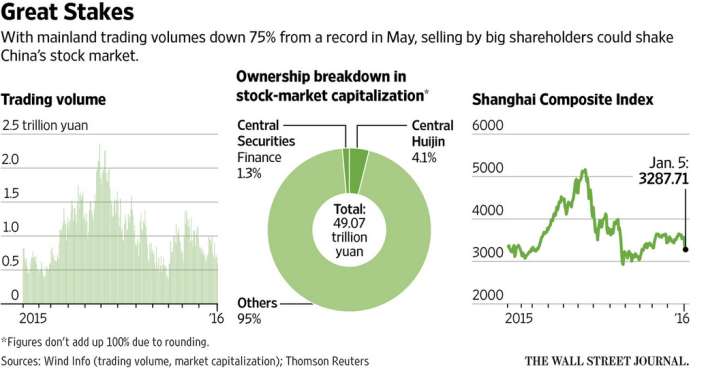
So schätzt GS, dass mit Ablauf des Banns Aktien in Wert von 184 Mrd USD zum Verkauf stehen.
Die beiden Käufer im Auftrag der chin. Regierung sollen zwischen Juni und Nov. 2015 rd. 1.8 Billionen Yuan in Stützungskäufe investiert haben.
Spoiler
Uncertainty About Stock-Selling Ban Clouds China’s Markets
Regulators’ ambiguity exacerbates volatile trading
By Anjani Trivedi and Chao Deng
Jan. 5, 2016 10:44 a.m. ET
Chinese regulators’ murky guidance about whether big stakeholders will be able to resume selling stocks is exacerbating an already volatile week of trading for mainland markets.
The six-month ban was among Beijing’s summer stock-market rescue moves, and lifting it would test whether mainland shares can find their footing after months of government support.
China on Tuesday signaled that the ban could remain in place past its original expiration date later this week, until the securities regulator works out new rules to ensure any selling of stocks will proceed in an orderly way, according to officials close to the agency. In a statement, the regulator said it was assessing how to oversee the selling, but didn’t provide a map or any indication of timing.
The ambiguous announcement has cast uncertainty over the market.
Already this week, fears that the ban would be lifted Friday as initially expected helped send China’s stocks tumbling, triggering a global selloff.
“If you change policy that quickly, that casually, then that will generate uncertainty in the market,” said Hong Kong-based Yuming Ying, a fund manager at China Eagle Asset Management Ltd. “The worry in the market is that they see the Chinese government can change their rule or policy any time.” Goldman Sachs estimates that the ban’s expiration would effectively mean as much as 1.2 trillion yuan ($184 billion) of shares could be put up for sale.
The regulator’s hazy comments made for a skittish day of trading Tuesday, with the Shanghai Composite Index down as much as 3.2% and up as much as 1%, ending the day down 0.3% at 3287.71. That follows a 6.9% drop Monday, which triggered a newly launched circuit breaker that shut the market early.
The original directive, put into effect July 8, banned any shareholders with stakes of 5% or more from selling, but implied they would be free to sell after six months. It applies to institutional and retail investors.
Institutional investors include insurers and company executives, as well as securities companies and their asset-management units. These types of investors held 75% of tradable mainland shares by market value at the end of 2014, according to China’s central bank.
Analysts say the central bank’s definition of institutional investors includes small asset managers that would be considered day traders in developed markets.
Meanwhile, the so-called national team, or government funds tasked with supporting the market, are likely to hold onto their stakes, analysts say. The government’s two main buying vehicles, China Securities Finance Corp. and Central Huijin, spent 1.8 trillion yuan between June and November last year buying shares, according to Goldman Sachs.
Trading volumes in mainland China have plunged 75% since May last year, which means that any selling of large stakes could magnify price swings.
In a report published at the end of December, China International Capital Corp. estimated that 150 billion yuan of shares could be sold in January alone. That compares with the more than 35 billion shares valued at near 500 billion yuan that major shareholders sold during the first half of 2015, according to Wind Information Co.
Yet regulators brushed off expectations of heavy selling, saying Tuesday that estimates stakeholders could unload as much as one trillion yuan are “unrealistic.” They also played down the amount investors would want to sell at once and said that large shareholders tend to sell in blocks, a method often considered less disruptive.
Hao Hong, managing director at Bank of Communications Co., said company executives seeking to cash in after their firms went public would constitute much of the initial selling—a total of about 300 billion yuan in shares, or roughly a third of total locked-up shares. China’s stock regulator requires company management to hold stakes for at least one year after listing.
At least 30 Chinese companies, mostly technology and startup firms, have issued statements in recent months on plans of their shareholders to reduce stakes.
After Monday’s plunge, however, at least 20 listed firms, mostly listed in Shenzhen, released statements saying their controlling shareholders wouldn’t sell shares, with pledges to hold shares ranging from the next six months to one year.
None of the companies specified whether the announcements were a reaction to the stock regulator’s latest statement
Hinweis: an den Kursstürzen ( 3 Yuan-Abwertungen als Auslöser ) vom Black Monday ( 24.August ) und den Tagen zuvor war diese Gruppe der Großinvestoren nicht beteiligt, da der Bann im Juli verhängt worden ist.







 Heutiges Low im Futures ( Feb ) liegt bereits bei 29.28.





 ).
).


 )
) ( eine Glattstellung einer short Posi erfolgt durch einen Long= Kauf )