Skip to forum
Notifications
Clear all

Standard 3barrel Spots

34 Posts
6 Users
12 Reactions
20.2 K Views
Coach
w34z3l
Joined: 03.08.2009

Hey guys,

The following is a somewhat simple hand, but it's good to include it here since 3barrel bluffs are entirely missing from the games of most low limit players. And you might say this is for a reason - we don't have good fold-equity at the lower limits and should be bluffing less.

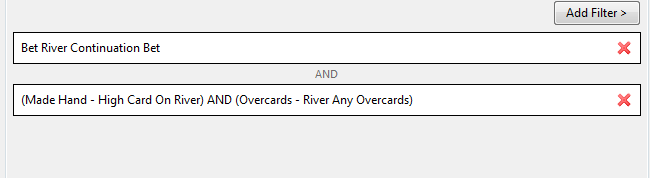
This would certainly seem a reasonable assumption. If you fall in to this category I recommend that you run a filter in your tracking software for 3-barrel=TRUE. Look closely at your non-showdown winnings. Alternatively, let me do it for you with one of my lower limit databases.
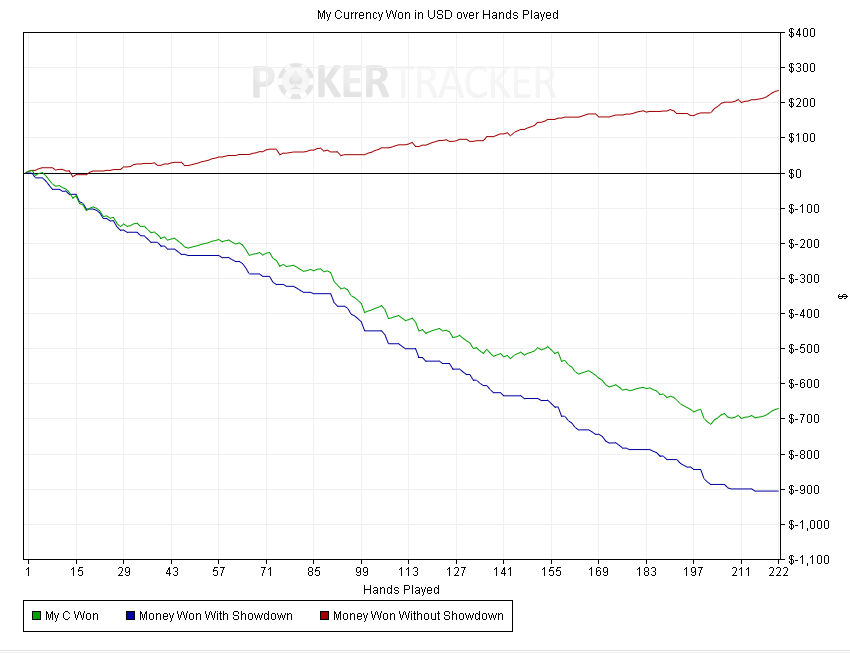
Does the above graph ring true with our assumptions that 3-barreling at lower limit with suicidal. On the contrary, think of all those times you have 3-barrelled top-set at lower limits only to not get paid off. It's common for players to feel their value hands never get paid off with a 3-barrel, yet at the same time they'd never 3-barrel bluff because they feel they don't get any folds. Can you see the contradiction here?

Now we have some empirical evidence to show that 3-barreling as a bluff can be a nice way to boost winrate and red-line even at lower limits. The following is an example.

$0.02/$0.05 No Limit Holdem
Winamax
3 Players

Stacks:
BTN ($49.8BB) 50bb
SB Hero ($145.4BB) 145bb
BB ($100BB) 100bb

Pre-Flop: (1.4BB, 3 players) Hero is SB J:diamond: Q:heart:
BTN calls 1BB, Hero calls 0.6BB, BB checks

Flop: 6:heart: K:spade: 10:spade: ($3BB, 3 players)
Hero bets 2.4BB, BB calls 2.4BB, BTN folds

Turn: 4:heart: ($7.8BB, 2)
Hero bets 5.6BB, BB calls 5.6BB

River: 2:diamond: ($19BB, 2)
Hero bets 13.6BB,

Firstly this is a 3-handed table and should be played more aggressively than a standard 6-max table.

Preflop

We have QJo which is likely strong enough to iso-raise 3-handed. It's not a big deal to occasionally complete also, especially if BTN does not have a full stack.

Flop and Turn

On the flop we take the betting lead. This is pretty standard in a limped pot where no-one has the initiative. There is no point attempting to check to the PFR because there is no PFR in this hand.

On the turn we continue barreling since we still have reasonable pot-equity with our OESD and likely have some fold-equity also.

River

This is the part where many players would give up at lower limits. Especially on a blank 2:d. Is this really a bad card for us though? Not necessarily since our opponent has a number of busted draws that could have bricked. Pretty much any straight or flush draw which missed on the river will be folding to our third barrel. It's true that we actually beat a decent amount of these holdings, but checking will generally not be a great option because it's so easy for our opponent to bluff us here. We have no shot at being able to check/call with QJ.

We are also even potentially folding out Tx and Kx hands. It's a little bit harder to fold out a Kx given the limped pot preflop, but generally speaking most regs will not feel comfortable with any top pair facing a three barrel at the lower limits.

We should definitely go ahead and fire the third-barrel. Remember that it's not a big deal if we get called. The objective of a river bluff is not to get our opponents to fold every time. If we make roughly 2/3rds pot on the river our bluff only needs to work 40% of the time. This means our bluff could even fail the majority of the time and we still manage to make long-run profit on the river. So it's important not to make the mistake of getting discouraged and become passive after a run of situations where we get called.

Ok now for the rest of the hand......

BB calls 13.6BB

Final Pot: $46.2BB
Hero shows High card : King
J:diamond: Q:heart:
BB shows One pair : Kings
5:spade: K:diamond:

BB wins $43.2BB (net +$20.6BB)

Hero lost $22.6BB


Reply
Quote
33 replies
GoOnCal1
Joined: 22.01.2015

Originally posted by w34z3l
Hey guys,


Now we have some empirical evidence to show that 3-barreling as a bluff can be a nice way to boost winrate and red-line even at lower limits.

I can't get my head around why this graph supports 3barrel bluff profitability. Showdown hands are slightly higher than non showdown hands. Wouldn't this seem to indicate that slight -EV given we never have a hand at showdown?


Reply
Quote
Coach
w34z3l
Joined: 03.08.2009

It's a fair point, and essentially increasing our red-line through 3barreling will have a negative effect on the blue-line.

However, notice that there are more flat sections on the blue-line than the red-line. (Red line appears to be more of a fluid curve where the blue-line has more "corners".) This generally means that most of these hands didn't reach showdown. In other words our fold-equity should outweigh the cards we are holding at any point.

The only effect our cards will have on a non-showdown situation is blocker effect etc. Not to mention if we 3barrel bluff every time then some players may decide to call us down wider. But essentially it seems that 3barreling will increase our red line more than it makes our blue line decrease, resulting in overall positive effect on green-line. If our initial assumptions are correct we would not expect to see the red-line positive at all.

Notice also that this graph does not automatically convey that 3barreling any 2 cards is profitable in the long run. Naturally this graph does not show any situation where we attempt to 3barrel and perhaps get raised on the flop and turn. But it does show us that assuming we reach the river with air, firing will be more profitable than checking in the long term. This is actually also in harmony with GTO principles to an extent. It's usually correct for the caller to slightly over-fold the river since he has an inherent range disadvantage. (It's common to see fold to river cbet stat of significantly above 40%, which is not incorrect from a GTO point of view). It's one of those situations that we should always make auto-profit vs a decent opponent. He defends against this not by calling wider but by making sure he 3barrels with an appropriate frequency in a similar situation where we give him auto-profit. So if we have strong 3-barrel fundamentals and our opponent doesn't, we should show long-run profit.


Reply
Quote
GoOnCal1
Joined: 22.01.2015

I follow your concepts, but I don't see "empirical evidence"


Reply
Quote
ruastinraata
Joined: 25.01.2015

This might be a dumb question, but as I don't use tracking software, could you explain the meaning of those different lines?


Reply
Quote
GoOnCal1
Joined: 22.01.2015

Green = Profit
Red = uncontested pots
Blue = showdown pots


Reply
Quote
Coach
w34z3l
Joined: 03.08.2009

Originally posted by GoOnCal1
I follow your concepts, but I don't see "empirical evidence"

Feel free to dig deeper and use a graph with larger sample.

You could also use notecaddy or player-aliases to calculate average fold-to-river-cbet stat. If it's noticeably above 40 then that's more evidence to suggest auto-profit with 2/3rds pot size bet on river.


Reply
Quote
GingerKid
Joined: 05.08.2007

Hi Adam,

I think that looking at red/blue line for determining how successful is 3 barrel bluff can be missleading. As I understood, you filtered hands where hero did 3 barrel, and the graph came out as a result? Can we expect in that case, red line to be negative? Lets say villians calls too often, 80% vs 3 barrel in average. When they call, it will go to blue line, when they fold it will increase our red line. The only way that hero's red line will decrease, is when hero bets and villain raises and hero folds. There will be also cases where hero bets, villian raises, hero reraises, and villian folds which increases also hero's red line. Since raises on river are in general very rare, I think it is obvious that red line will be very positive.
In your case, blue and red line are somehow similar. What does it mean? It can mean so many things (e.g. villians mostly call and hero is bluffing too often so blue line is not great, and since villians rarely fold red line is similar as blue). My point is, looking at blue and red line for 3 barrel spots (and most other spots) is not helping us to conclude how successful is our line.

Imo, more accurare approach would be to make a filter for 3 barrel, and set hand category to high card or weak pair (which are almost allways bluffs in 3 barrel spots, could also add mid pairs, but it doesnt matter much). Then we can look at stat "cbet river success", which shows how often is our 3 barrel bluff successful.
Then if we can look the same for value hands by negating filter for "bluff hand category". This way, you can see for any line, how successful is bluff and how good is value hand. If you want to go in more details, you can add filter for board category type, and e.g. see how often is bluff good on draw heavy board which is the case for this board.

Regarding the JQo hand, theoretically not a good bluff candidate since it blocks busted draws and has showdown, also it blocks KJ, KQ, but it is the question if it is in limped range, and it also blocks TJ, QT, JJ, QQ which will villian fold.
It totally depends what is % of busted draws in villian's range, and if he folds Tx, JJ, QQ or even Kx. So I would make decision here purely on river cbet success vs population, (or vs villian if enough sample), and from my experience, population on micro limits (even NL4) is overfolding flop, overcalling turn and folding around 40-45% river, so I wouldnt bluff this hand especially because it has showdown value (if you thin value bet Kx and cc river on such board, villians are perhaps not going to bluff you that often, and if anyway they bet most of their bluffs, you can start cr bluff since they really dont rep much besides busted draws when they bet river). I would bluff only lowest busted fd, since they block least fold range in villian range. I would decrease my bet size to 50% on river, to make a bluff +EV. if villians are not bluff raising and induced, then to 33%.


Reply
Quote
Coach
LemOn36
Joined: 07.02.2009

This?
EDIT: doesn't apply to limped pots tho - cbet stat is only when you raise PF I'm guessing.

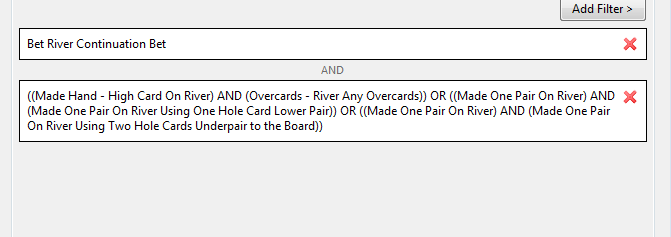
Need to add made pair one pair is bottom pair I guess too - I bluff blockers a lot, turn bottom of range into a bluff later


What does this say tho
because if I check
The graph will show what I lost last 2 streets as well so can't compare to EV=0 and can't do what I do e.g. in BB when looking at -EV calls as -100bb/100 being 0EV

So I guess put this in just doing this and then going to cbet success

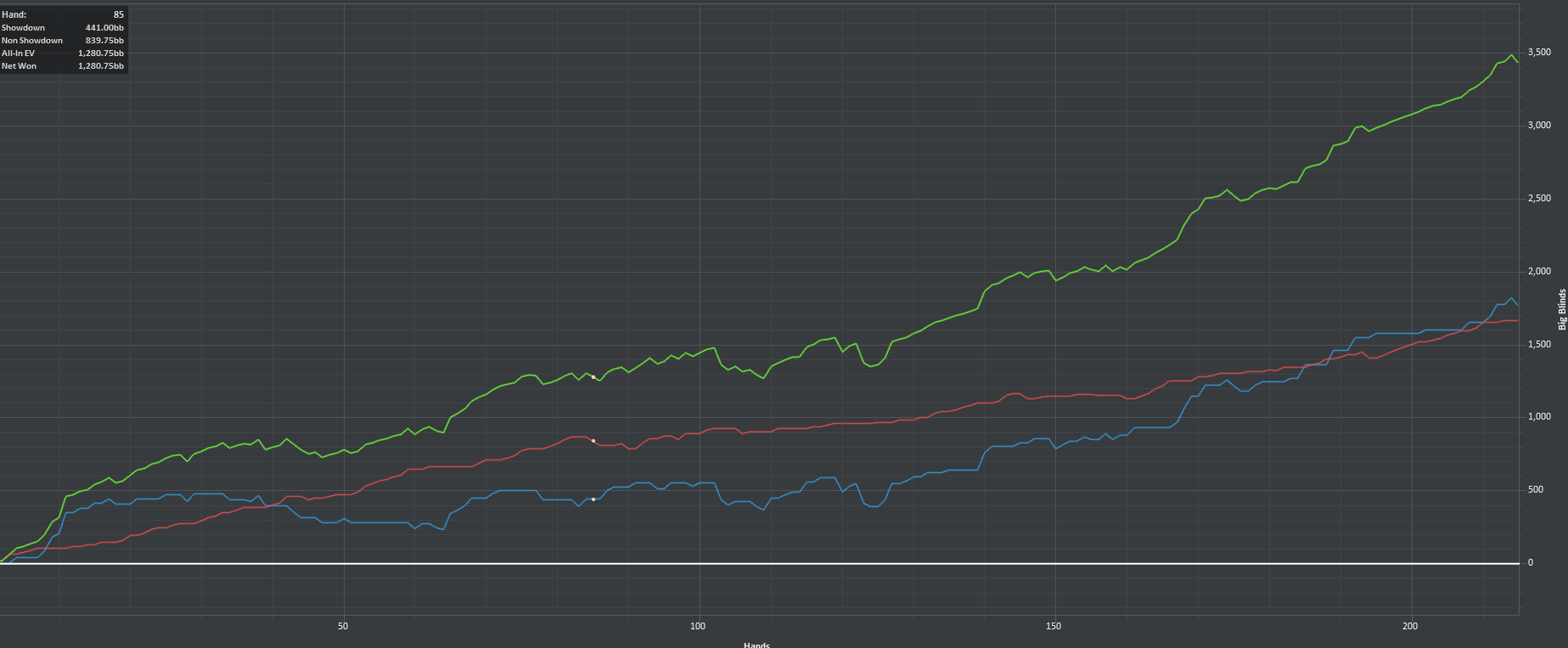
EDIT: 49.55%
So I am the master grandmaster river bettor champ - average sizing will be like 65%
So yeah I should look to barrel my air balls more often thanks w34z3l and GingerKid!


Reply
Quote
Coach
LemOn36
Joined: 07.02.2009

Okay added more stuffs

with blockers and under pairs (combined with previous)
it comes up to 51.34% R cbet success 261 hands

Should really bluff more

Blocker lower pairs work more often than high cards (not surprising + small sample tho)

1.1 million hands database btw guys
Keep these coming I will give my input
Since My PC is slower than Dwan playing live I might need to do a purge soon :]


Reply
Quote
Coach
LemOn36
Joined: 07.02.2009

As to this hand, whatever, people will overcall bullshit draws especially limpers so we can bet regardless of blocking QJ imo - this is a limped pot at a limit where people overcall FDs especially to small dollar amount, so low flush blockers do play indeed vs limping/completing ranges (not getting a boner over the Qh tho :p) . Like Ginger Kid's half pot or less to get the bad boys fold those and just let them call their Kx Tx - Sometimes you get called by Tx anyways by limpers at NL5 when you bet like this, happens quite a bit actually.


Reply
Quote
Coach
LemOn36
Joined: 07.02.2009

Originally posted by w34z3l
It's usually correct for the caller to slightly over-fold the river since he has an inherent range disadvantage. (It's common to see fold to river cbet stat of significantly above 40%, which is not incorrect from a GTO point of view). It's one of those situations that we should always make auto-profit vs a decent opponent. He defends against this not by calling wider but by making sure he 3barrels with an appropriate frequency in a similar situation where we give him auto-profit. So if we have strong 3-barrel fundamentals and our opponent doesn't, we should show long-run profit.

Great quote
The 1-A poker simplicity was fun while it lasted :P


Reply
Quote
GoOnCal1
Joined: 22.01.2015

Thinking more about bluff spots, has made me smile more this week.
Thinking about developing empirical data has had me distracted.
:club:
Bluff experiment
Bot profile A does not bluff with no hand on the river
Bot profile B does, else both players range and decision trees are identical.
Both players play a significant number of hands in the same arena
Compare results


Reply
Quote
GingerKid
Joined: 05.08.2007

Originally posted by GoOnCal1
Thinking more about bluff spots, has made me smile more this week.
Thinking about developing empirical data has had me distracted.
:club:
Bluff experiment
Bot profile A does not bluff with no hand on the river
Bot profile B does, else both players range and decision trees are identical.
Both players play a significant number of hands in the same arena
Compare results

Wouldnt regs overfold vs bot A since they would notice he is value heavy :) ?


Reply
Quote
GingerKid
Joined: 05.08.2007

Originally posted by LemOn36
Okay added more stuffs

with blockers and under pairs (combined with previous)
it comes up to 51.34% R cbet success 261 hands

Should really bluff more

Blocker lower pairs work more often than high cards (not surprising + small sample tho)

1.1 million hands database btw guys
Keep these coming I will give my input
Since My PC is slower than Dwan playing live I might need to do a purge soon :]

Your filter is good, I am using the same. And yes, you should bluff more :) keep in mind, it can be that regs overfold vs you because they noticed your low river cbet frequency, or your low bluff river frequency, which can change if you suddenly start bluffing. If you want to use a version of pt4 bluffing frequency, you can download custom stat "river bluff frequency", which is a great stat to have, can put it in your HUD.


Reply
Quote
Coach
LemOn36
Joined: 07.02.2009
GingerKid
Joined: 05.08.2007

https://www.pokertracker.com/custom/stats

There are a lot of nice custom stats. It will slow down your hud since custom stats are not well optimized as default stats, but it is ok. I never tried it with huge databases.

By the way, since you have big data sample, did you filter bluff river success, on dry board, wet board, paired board, A high, K high, low board? It would be also very interesting, because some spots are very bad for 3 barrel, and some are not. Depends a lot on population, e.g. on Axx many regs will fold very little vs 3 barrel on lower limits, and on e.g. Nl50, Nl100 it could be that they overfold.


Reply
Quote
GoOnCal1
Joined: 22.01.2015

Originally posted by GingerKid

Originally posted by GoOnCal1
Thinking more about bluff spots, has made me smile more this week.
Thinking about developing empirical data has had me distracted.
:club:
Bluff experiment
Bot profile A does not bluff with no hand on the river
Bot profile B does, else both players range and decision trees are identical.
Both players play a significant number of hands in the same arena
Compare results

Wouldnt regs overfold vs bot A since they would notice he is value heavy :) ?

Sorry I'm just being pedantic about the term "empirical evidence" and suggesting that clinical trials of a proposed hypothesis is what this term means,
as opposed to the rationalistic perspective (or argument) backed up by data mining, which aint "proof".


Reply
Quote
GingerKid
Joined: 05.08.2007

Originally posted by GoOnCal1

Originally posted by GingerKid

Originally posted by GoOnCal1
Thinking more about bluff spots, has made me smile more this week.
Thinking about developing empirical data has had me distracted.
:club:
Bluff experiment
Bot profile A does not bluff with no hand on the river
Bot profile B does, else both players range and decision trees are identical.
Both players play a significant number of hands in the same arena
Compare results

Wouldnt regs overfold vs bot A since they would notice he is value heavy :) ?

Sorry I'm just being pedantic about the term "empirical evidence" and suggesting that clinical trials of a proposed hypothesis is what this term means,
as opposed to the rationalistic perspective (or argument) backed up by data mining, which aint "proof".

Yes, such experiment would be the best estimation of how good is bluff 3 barrel, but still it is not a proof, unless they would somehow play identical hands, and villains play identical vs both bots. Since in reality it is not possible vs real players, then such experiment is not going to show us much, since real players are going to play differently vs bot who never bluffs compared to the bot who does bluff. Also data mining can be misleading, but imo it is the best we have in the real world


Reply
Quote
GoOnCal1
Joined: 22.01.2015

I quite disagree
:)
Paired trials, in real environment's, provides

Originally posted by GingerKid

Originally posted by GoOnCal1

Originally posted by GingerKid

Originally posted by GoOnCal1
Thinking more about bluff spots, has made me smile more this week.
Thinking about developing empirical data has had me distracted.
:club:
Bluff experiment
Bot profile A does not bluff with no hand on the river
Bot profile B does, else both players range and decision trees are identical.
Both players play a significant number of hands in the same arena
Compare results

Wouldnt regs overfold vs bot A since they would notice he is value heavy :) ?

Sorry I'm just being pedantic about the term "empirical evidence" and suggesting that clinical trials of a proposed hypothesis is what this term means,
as opposed to the rationalistic perspective (or argument) backed up by data mining, which aint "proof".

Yes, such experiment would be the best estimation of how good is bluff 3 barrel, but still it is not a proof, unless they would somehow play identical hands, and villains play identical vs both bots. Since in reality it is not possible vs real players, then such experiment is not going to show us much, since real players are going to play differently vs bot who never bluffs compared to the bot who does bluff. Also data mining can be misleading, but imo it is the best we have in the real world

I quite disagree
Paired T tests in a real environment provides a solid empirical evidence.
You could quite easily run a model with identical hands as well :)
Perhaps on snowie or other similar tool
:)

Later adds...
Don't get me wrong, I don't disagree with the OP's premise.
I have been bluffing all week, so I can provide observational and anecdotal evidence :)
In the real world lots of people are building better bots and the best way to improve them is testing in the real world.


Reply
Quote