Skip to forum
Having a Raising ra...
 
Notifications
Clear all

Having a Raising range ond dry/static flops

15 Posts
8 Users
3 Reactions
1,469 Views
Gr1ff1th
Joined: 24.09.2017

Hi.

I've been working with a GTO solver lately, and i'm pretty confused with the solutions.

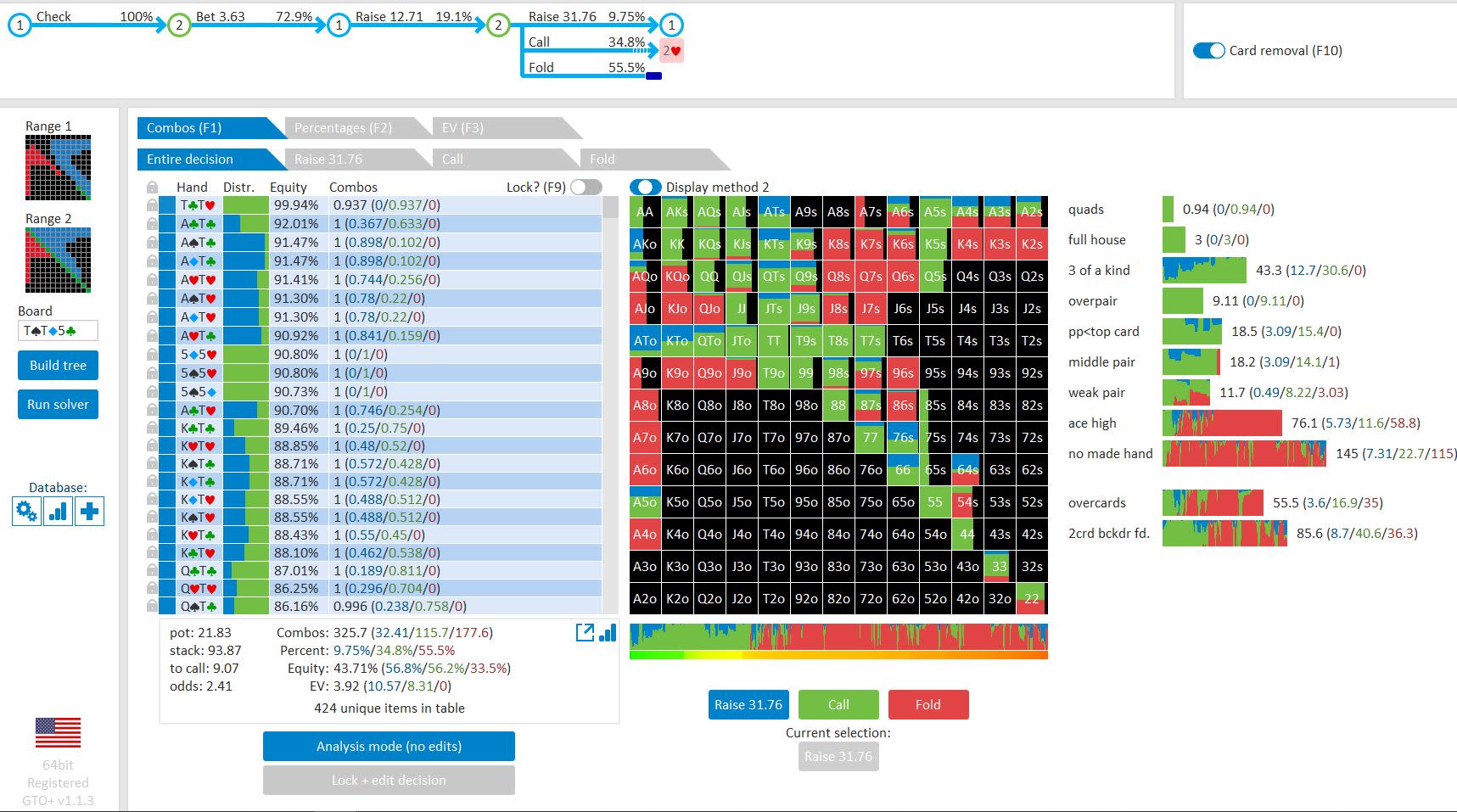
I've always been told that having a raising range on dry/static flops was wrong, but on some dry/static flops solver raises like crazy (20% or so).

In the spot below (BB CC vs BU OR 2.5bb) --> BU bets 66%psb 77% of the time and BB check-raises 19%:
*Pre-Flop ranges for BB and BU are from Pokersnowie PreFlop Advisor

I always tought having a raising range against regs was wrong because you become capped if you raise your strongest hands, but it seems it's not a problem.

What you think guys? Is possible having a raising range on dry flops ?


Reply
Quote
14 replies
Tomaloc
Joined: 17.01.2011

of course it's possible, though it's hard to implement good ranges in practice. in this example you still have enough calling Tx that can calldown a stack


Reply
Quote
la55i
Joined: 27.01.2013

Yea it is possible but as Tomaloc said it would be more difficult at the tables. Check raising hands like 44 or 33 doesn't immediately come to my mind in this kind of situstions so if I would raise there, my range would probably be too value heavy.

And then, what do we want to accomplish with the raise here? If we are playing against microstakes regs, how would they react to a check raise on this kind of a board? I would say many of them would overfold a lot. In that case it might be a decent option to start check raising more crappy hands but not raise our value hands.


Reply
Quote
Pokamon
Joined: 15.04.2006

Originally posted by la55i
I would say many of them would overfold a lot.

they dont.
some do, but its the minority.

in my experience the response is very individual. some even 3-bet a lot, arguing that we are not repping much.

the most frequent occurrence is obviously a CALL. you could have guessed that, we are talking microstakes.


Reply
Quote
CptJokerFish
Joined: 06.06.2017

Originally posted by Gr1ff1th
I always tought having a raising range against regs was wrong because you become capped if you raise your strongest hands, but it seems it's not a problem.

What you think guys? Is possible having a raising range on dry flops ?

You have also strong hands in your calling range and yes you should have also a raising range on dry flops. You could also set a node-lock so that there are hands in that range that corresponds to your limit that you play. Then just checkout the new raising range.


Reply
Quote
la55i
Joined: 27.01.2013

Originally posted by Pokamon

Originally posted by la55i
I would say many of them would overfold a lot.

they dont.
some do, but its the minority.

in my experience the response is very individual. some even 3-bet a lot, arguing that we are not repping much.

the most frequent occurrence is obviously a CALL. you could have guessed that, we are talking microstakes.

Do you mean they don't overfold vs raises in general or on this kind of dry and paired boards?
Sure when someone raise on a board like that they don't rep much, but also there are not many good bluffing hands. If the board is drawy, you might assume villain has some draws and so on in his raising range. But now do we expect villain to raise us with total air here? Or do we believe his raising range is more value heavy?
If you face a raise on that kind of a board, what hands would you defend? If they don't happen to have JJ-AA here, playing further streets could get quite uncomfortable for them.

For me it is difficult to see normal regs calling a lot vs check raises on this kind of boards. And I think 3betting as a bluff would be quite rare. But of course that is just my subjective opinion. And we could be playing in a player pool that plays very differently.


Reply
Quote
Gr1ff1th
Joined: 24.09.2017

Originally posted by CptJokerFish

Originally posted by Gr1ff1th
I always tought having a raising range against regs was wrong because you become capped if you raise your strongest hands, but it seems it's not a problem.

What you think guys? Is possible having a raising range on dry flops ?

You have also strong hands in your calling range and yes you should have also a raising range on dry flops. You could also set a node-lock so that there are hands in that range that corresponds to your limit that you play. Then just checkout the new raising range.

I'm using node-locking to give me an exploitative strategy against population, but the result is pretty close to the above results. I'll have to work a lot more with the software before utilizing in game.

Yes, we have strong hands, but mainly bluffcatchers like T6s,T7s and T8s. Hands like nut and second nut trips are 100% raises. It's thought provoking to see how solver "thinks" about the game.


Reply
Quote
Gr1ff1th
Joined: 24.09.2017

Originally posted by Pokamon

Originally posted by la55i
I would say many of them would overfold a lot.

they dont.
some do, but its the minority.

in my experience the response is very individual. some even 3-bet a lot, arguing that we are not repping much.

the most frequent occurrence is obviously a CALL. you could have guessed that, we are talking microstakes.

I think people still overfold even if they defend sometimes its not enough, if you see the response to check-raise, i don't think people are defending all this range.


Reply
Quote
CptJokerFish
Joined: 06.06.2017

I think the most people would not defend so much like a solver would do. Its not bad if they fold more as the solver would do because especially on microstakes no one is using GTO raising frequencies. In general you can raise with a wider range as the solver would do because the people overfold.
But you have to think about if call or raise is better with the specific hand.
Take also these things into account:
Does the hand need protection?
Can you improve your hand on later streets?


Reply
Quote
Coach
LemOn36
Joined: 07.02.2009

Two things
1) TT5 is good for the caller when it comes to nutted part of his range,he will actually have the same or more Tx than bu open because it should call more Tx on the low end
2) bu has a lot more good made hands in all 99+ snowie mixes in or 3bets completely
Edit: and yeah more ATs, Kts qts kts but that's it for the Tx
3) so I can see a strategy where both bu cbet a lot because of 2)
And bb c/r a lot because of 1) pretty straightforward

You have to check raise a lot here because but will realize way too much equity with cbet, I'm pretty sure if you nodelock only c/c for bb tye cbet would go close to 100%
And because you just can because the ttx gives you plenty of nutted hands to do it with, there are boards you can do nothing about and even solver sill almost never raise like A6xr after calling a 3bet

Why this is possible is
-Mixing in combos where you can cc and cr and keep both ranges reasonable people just aren't used to doing that
- Solver doesn't care about complexity you create as it works the whole tree
Which isn't easy in practice


Reply
Quote
sdf256
Joined: 21.07.2016

.


Reply
Quote
sdf256
Joined: 21.07.2016

Originally posted by Gr1ff1th

I always tought having a raising range against regs was wrong because you become capped if you raise your strongest hands, but it seems it's not a problem.

What you think guys? Is possible having a raising range on dry flops ?

There are definitely flops where people from late positions do overfold vs an x/raise so yes I think it can be a good exploitative bluffing opportunity. You just gotta put in the work to find out what board textures they overfold on. For example if the board is 922 I believe it is one where they overfold.

Just look how his range hits this flop. For the sake of simplicity I assumed he would be cbetting 100% of his range. But even if he wouldn't.. the crazy amount of offsuited air will be oerfolding vs your x/raise I believe.


Reply
Quote
Coach
LemOn36
Joined: 07.02.2009

yeah I've never used this one
In fact I never used any Pio/MonkerGTOrb myself
You can actually make friends with people easily if you either run the sims for them yourself or you help them to interpret them for people that are running them
I've seen and analyzed a ton of GTOrb and Pio scenarios without ever installing the software heh.

So yeah keep it up, you'll get good responses to these threads even though I'm not sure how good this one is personally, most people use Pio/Monker these days


Reply
Quote
Coach
LemOn36
Joined: 07.02.2009

And I looked at the C/R range
just look at the amount of Tx we have
And then it mixes in good backdoor hands like 76s 98s (those will be the ones with the suit with the card on board that can barrel the 9 extra turn outs) - and J9s with some added pair outs that seems very straightforward to me

The underpairs especially (22-44) especially might feel counter-intuitive, 5x little less so
But the reason why you see this is that they will
1) struggle to realize equity when the c/c
so folding out other hands and denying them equity has great value for them
2) Still have ev in the C/R+ Check down line where the raiser bet + calls some of his better A high

This was like my first wtf moment with solvers years ago, a very common spot where you'd 3bet and go bet check+jam with a crappy top pair on the turn that's medium-connected because it'll be hard for you to realize your equity as you have to go check/call turn to check/fold on a lot of river cards

So instead you jam, and deny you opponent's equity with his mediocre hands that can both connect or bluff the river, and sometimes get it in good vs rare good draws, pair+draw. That was the day I knew the bluff/value thinking is just dead and you need to think more fluidly in terms of equity and the rest of the tree in the hand.

And the weak pairs here check/raising are a similar concept


Reply
Quote
MyFloXyBabY
Joined: 15.02.2010

Originally posted by Gr1ff1th

I always tought having a raising range against regs was wrong because you become capped if you raise your strongest hands, but it seems it's not a problem.

What you think guys? Is possible having a raising range on dry flops ?

You seem to confuse dry and static : dry (as opposed to wet) means lack of draw, static (as opposed to dynamic) means that the overall ranking of hands strenght on the flop isn't supposed to change too much until the river.
A texture can be dry but quite dynamic as in your TT5r case because lots of overcards can hit and change the outcome, whereas on a flop like AAK, either you have it or you don't, it's mainly locked for both entire ranges.

In a dynamic board, wet or not, it's important to raise because you want do deny equity and lessen the positional advantage of villain.
Note that it's possible to do so without being that much capped in our calling range because lots of turn cards will improve part of our holdings depending on what we float of course.


Reply
Quote