



Originally posted by Tim64
^^ I agree with this 95%. The 5% i'm not sure about is that most of our edge comes from the endgame.I thought the main reason regs have an edge is that they rarely go out of the tourneys in the early stages - compared to the fish. So, because we are usually - say 75% of the time - still playing once it gets to 6 handed (as opposed to the mathematically 'expected' 66%), we have already increased our $ equity significantly from the 9 handed situation. I may very well be wrong about this - it's happened before

If you are reffering to my post Tim, I mean the edge is highest playing against people like this... not
comparing your edge being higher at certain stages of the SNG.. Sorry if it was muddled.So playing against the type of person to call your preflop raise with Q3os is where your edge is highest,
regardless of what stage of the SNG you are in because your edge is adjusting to their range and
playing accordingly.


Just a quick update on the STs. So far they are going ok, I still need a bit more practice to adjust to this type of game again, they are completely different to the push/fold stage of a normal SnG surprisingly. So far I am running at around 6% I would like to get that up to 8-10 and then I'll be happy. At the moment I'm running at about $21/hr if I include rakeback that's up near $30/hr which is a lot more profitable than losing at the higher limits.
One thing I am interested in monitoring is the red EV line, a lot of players focus a lot of time on it, others say ignore it, I'm not sure yet. After 240 games I'm roughly 25 games above EV, yes I could be on a heater (I hope not, I'm only at 6%) but like I said a lot of people don't trust the red line. I think in STs the red line can highlight some of the flaws in the ICM model, for example it doesn't take into acount rising blind levels which diminish yuor FE. Also, the chance of me finishing in 1st, 2nd, 3rd doesn't take into acount my opponents skill (or lack thereof). HEM doesn't take into acount stealing blinds which gains me a HUGE amount of equity which is a flaw. Either way I'm interested to see what happens.
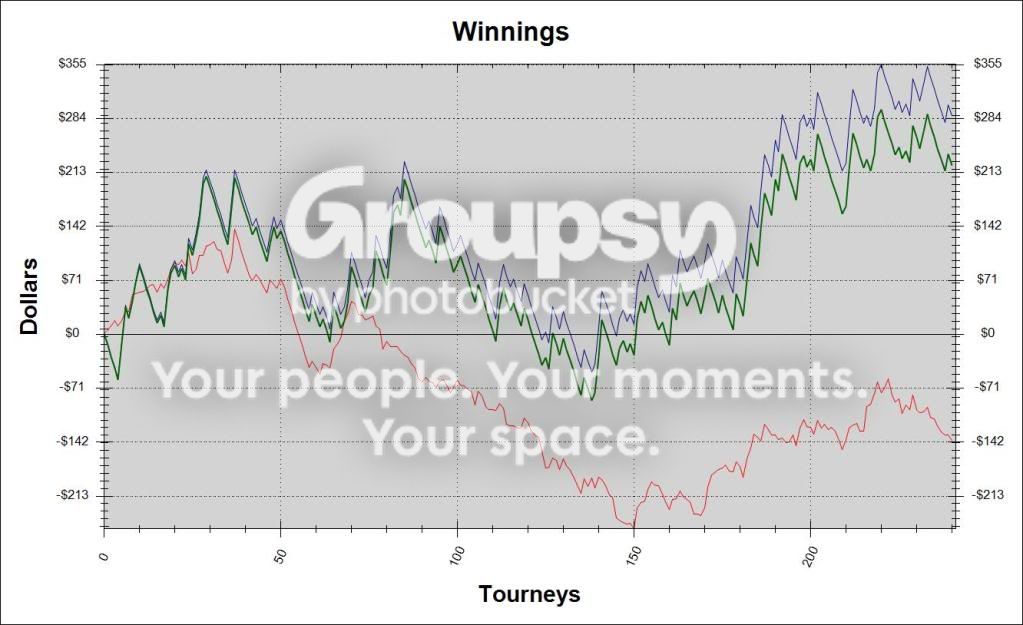
im interested to see where that line goes after 2k games. your sample is too small to take any notice of ROI at the moment. good luck.
Originally posted by lessthanthreee
im interested to see where that line goes after 2k games. your sample is too small to take any notice of ROI at the moment. good luck.
and of course u are ! ♦
btw one more thing i was having in my mind for the red line. does it count the actions of your opponents only ?example, u re on bubble and u re one of the two shortstacks, the other shortstack pushes u fold and chipleader calls, shortstack shows 72, bb shows AA shortstack wins ,isnt that considered bad luck for u since u had great chances of ending itm ?
keep like that on sts ! just dont get overexcited cause there are veeeeeeeeery swingy and i think if u can maintain a 6% roi in a big sample it would be great.btw u play the 9handed or 6handed ,if u have tried both tell us your opinion ♦
Originally posted by Schris7
Originally posted by lessthanthreee
im interested to see where that line goes after 2k games. your sample is too small to take any notice of ROI at the moment. good luck.and of course u are ! ♦
btw one more thing i was having in my mind for the red line. does it count the actions of your opponents only ?example, u re on bubble and u re one of the two shortstacks, the other shortstack pushes u fold and chipleader calls, shortstack shows 72, bb shows AA shortstack wins ,isnt that considered bad luck for u since u had great chances of ending itm ?
keep like that on sts ! just dont get overexcited cause there are veeeeeeeeery swingy and i think if u can maintain a 6% roi in a big sample it would be great.btw u play the 9handed or 6handed ,if u have tried both tell us your opinion ♦
That is yet another flaw in the EV line, since it only measures certain aspects of luck.
As for the 6 or 9 handed, I'm currently playing 9 handed which I prefer over the 6 handed. The graph I posted above includes a set of 12 6 handed 14+1 STs which I finished about 10BI down. I think one of the flaws in my ST game is I call slightly too tight sometimes but this is a bigger problem in shorthanded games since the players are more aggressive and you will be blinded away quicker. I'm sure I could still beat them but I'm more comfortabe in the 9 handed games.


Hi, just on the red line thing, I found this on a HEM thread from HEM forum, written by one of the administrators:
"
Hi, it is math and we have explained it in many, many other posts and when you say it isn't accurate as if it is a fact you are just showing that you don't understand what EV is but that's fine because it can seem complex until you get it.
Here is a good example First hand of tourney where buyin is $10. Your seat equity is worth $10 at that point. You get it all-in exactly at 50/50. So what does this mean - it means that you have a 50% chance of having a "seat value" of $0 and a 50% chance to have a seat value of probably somewhere around $19 (according to ICM) . So, this means that after going all-in your expected seat value is $9.50. if you lose the all-in you have an equity of $0 so that means you were unlucky by $9.50. If you win your equity is $19 which means you were lucky by $9.50.
If there were no other all-ins for the entire SNG and you win it then you win $50 but your EV is $40.50 since you were lucky by $9.50 I am going to use Caps to emphasize a point: WHENEVER YOU WIN AN ALL-IN (unless you were 100% to win) YOUR WINNINGS IS HIGHER THAN EXPECTATION AND WHENEVER YOU LOSE AN ALL-IN YOUR WINNINGS IS LOWER THAN EXPECTATION.
Step 1: Calculate expected "Seat Value" after the all-in based on odds and ICM Step 2: Compare to actual "Seat Value" after hand Step 3: That difference is added for every hand in the tourney where there was an all-in and compared to your actual winnings in the tourney to determine the $EV
It is completely accurate. It's just math.
If you're stealing sucessfully your ROI will be higher than if not (all other things being equal). The all ins are measured on their own merits and if your ROI is -1% and your luck adjusted ROI is 5% then quite simply you've been unlucky with your all in equity. But such a conclusion is not enough to say whether we're actually playing well or not.
btw one more thing i was having in my mind for the red line. does it count the actions of your opponents only ?example, u re on bubble and u re one of the two shortstacks, the other shortstack pushes u fold and chipleader calls, shortstack shows 72, bb shows AA shortstack wins ,isnt that considered bad luck for u since u had great chances of ending itm ?
Schris, HEM does calculate the difference between your ICM equity before and after every all in - whether involving you or not. Pick a tourney in data view where there was a difference btw you winnings and ev$. Now sort the hands by $EV won - you will see that all hands are included where there were allins - not just involving you. If you add all the ev differences in that column (-ve will be at bottom so scroll down) and add this to your actual winnings you get your $EV. Shimples! ♦
Thanks Tim, we now have it finally clear and in caps for everyone to understand!!
Stop clinging to your red line thinking you have been playing a great game.
You can have your red line 50 buy ins above EV by going all in a 50/50 early in the tourney
over and over again. We all know a chip won is worth mnore than a chip lost. So all you
know is your money if your cards held up, and nothing about weather your timing to
be all in is right or not.
Gun, I would be interested in seeing your graph after playing over 1k super turbos if you do not mind.
EV red line included, It was a mental trip for me when I tried a pile of the dollar ones.
Originally posted by 8979687
Thanks Tim, we now have it finally clear and in caps for everyone to understand!!Stop clinging to your red line thinking you have been playing a great game.
You can have your red line 50 buy ins above EV by going all in a 50/50 early in the tourney
over and over again. We all know a chip won is worth mnore than a chip lost. So all you
know is your money if your cards held up, and nothing about weather your timing to
be all in is right or not.Gun, I would be interested in seeing your graph after playing over 1k super turbos if you do not mind.
EV red line included, It was a mental trip for me when I tried a pile of the dollar ones.
Wrong way around, chips won are worth less than chips lost. Also, if you get your money in 1st hand 50/50 you will have a -ve EV line due to ICM tax and rake. For example, $14+1 BI, first hand you will have 50% chance of $0 and 50% chance of say $27 (not sure if that is exactly right) so you will win $13.50 according to the red line which is $1.50 less than the $15 BI so the red line will go down.
Also, thanks for that post Tim I didn't notice that the EV results included hands I'm not involved with. Having said that I still am not convinced that it is accurate although it may not be the method that HEM uses it might actually be the ICM model itself. We'll see what happens after at least 1K games.
Can I just add, the redline in super turbos will always be very low as it is a stealing game, getting your chips in ahead wont happen as often.
I can't beleive I actually wrote that backwards
I must be getting senile.
I meant to write that a chip lost is worth more than a chip won.
Call me insane here, but what I see written in caps is that if you lose that flip, you lost the all in, EV is higher
than money won which means the red line would go up no?
Another quick update, everything seems to be going nicely which is what I hoped by moving back down. The graph I have posted only includes 9 handed $15 STs which is what I'm focusing on at the moment. I'm glad that I've moved back down, I'm now enjoying my poker a lot more which is why I started playing in the first place (or was it the free money?). Anyway, since I play when FTs traffic is at its lowest I'm able to get a lot more volume in than I would normally (There were usually only 5-6 $36 tourneys running when I played the). This means I should be back to platinum status here and extra rakeback!
Also, as for the HEM red line experiment, I'm still kicking its ass. Hopefully if it is correct it catches up to me because I don't feel like a massive right now. Another thought... Does anyone else find that some limits have players that reduce or increase variance? For example I found the $22+2 really easy but the $33+3 horrible even though I'm still convinced there were more horrible players on the $33s. This is one reason why I like the STs at this limit, they refuse to call on the bubble which means I can steal steal steal and then set me up nicely for the win, HU is even easier... Anyway, hopefully my cockyness will not come back to bite me.
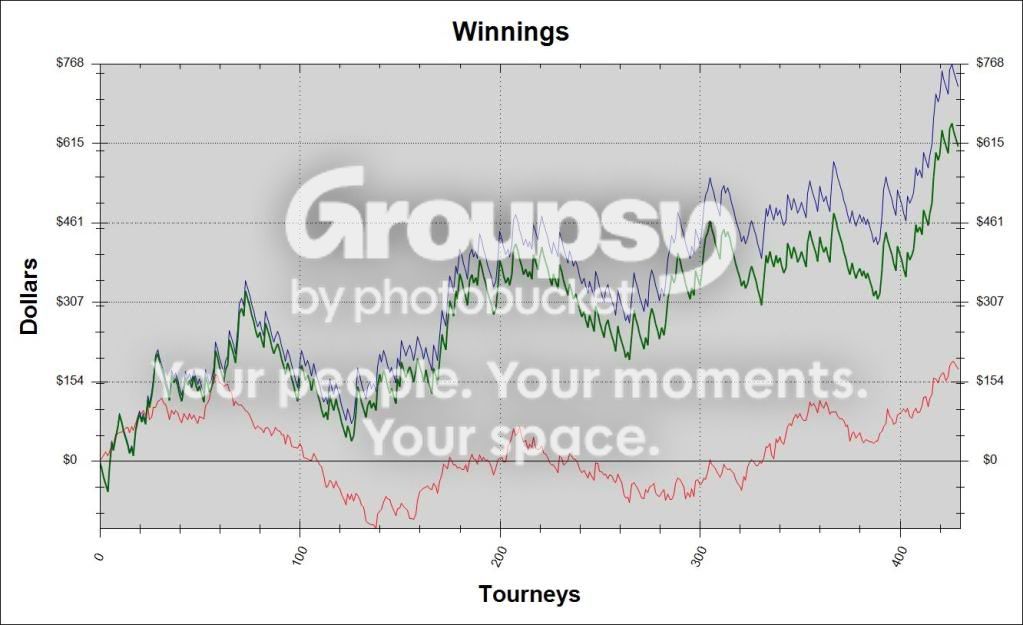
I've also decided to copy <3 and set some goals for march.
[ ] 1K games
[ ] Maintain ROI above 5%
[ ] Break the $5K BR barrier again and not instantly lose $2K
[ ] Get on Skype like I said I would
Call me insane here, but what I see written in caps is that if you lose that flip, you lost the all in, EV is higher than money won which means the red line would go up no?
Apologies, Gun, for hijacking once again. Feel free to tell us to get lost and have this discussion elsewhere.
I don't think it follows from the the wording in caps that in the situation you describe your EV (red) line goes up. If this were a genuine 50% flip then I believe the red line will be flat. It is your green line that drops. What does happen, though, is that a gap opens up between the two.
Also, if you get your money in 1st hand 50/50 you will have a -ve EV line due to ICM tax and rake. For example, $14+1 BI, first hand you will have 50% chance of $0 and 50% chance of say $27 (not sure if that is exactly right) so you will win $13.50 according to the red line which is $1.50 less than the $15 BI so the red line will go down.
To give a practical example:
Hand converted with online PokerStrategy.com hand converter:
$15/$30 No-Limit Hold'em (9 handed)
Known players:
[tg]CO$1380.00:///////;BU (Hero)$1575.00:///////;SB$1523.00:///////;BB$1500.00:///////;UTG1$1500.00:///////;UTG2$1500.00:///////;MP1$1500.00:///////;MP2$1522.00:///////;MP3$1500.00:///////;[/tg]
Preflop: Hero is BU with Q:s, Q:h.
UTG1 folds, UTG2 raises to $1,500.00(All-In), 4 folds, Hero raises to $1,575.00(All-In), 2 folds.
Flop: ($3120) J:c, 6:d, 6:h (2 players)
Turn: ($3120) 4:s (2 players)
River: ($3120) 4:h (2 players)
Final Pot: $3120.
Villain had AKo
Ok, so we have a classic 'flip' here (QQ v AK) at the start of the tourney. HEM gives the following (shortened) analysis (you find this by opening replayer and clicking 'ICM':
Start EV End EV Diff Player
$34.48 $62.13 $27.65 HERO
$33.00 $0.00 ($33.00) maska59
EV Result Luck Hand Player
$35.83 $62.13 $26.30 QsQh HERO
$26.59 $0.00 ($26.59) AhKs maska59
So we see from the second set of figures that my expected EV from this situation compared to my start EV is an increase of $1.35 ($35.83 minus $34.48). Villain's EV drops from his start point because he enters this 'flip' as an underdog. However, since the flip has to go one way or the other, in this case Hero wins and so he is 'lucky' by the difference between the $ he wins if you run the simulation infinite times and the $ actually won in this case, i.e. $62.13 minus $35.83 ($26.30). In terms of red line green line, this would show itself as my red line going up very slightly (because I still win $1.35 on average in this situation) where as my green line will go up steeply because I got lucky to the tune of $26.30. And all you do is repeat this over and over for all the all-ins in the tourneys you play in and look at the result. If the green line is above the red, you're running well and if it's below, you're running bad.
Stealing is a different matter altogether. If you push and no one calls there is no allin and nothing for HEM to analyse. There is no 'luck factor' at all when this happens.
You can think of the red line in Tournament view as performing a similar funcition to the All-in EV for cash games. The difference is that the program is not comparing chips won and lost, it's comparing the ICM $ value of those chips.
I don't really mind if those people who think the red line doesn't have any significance (and I'm not saying this applies to anyone reading) continue to think that. But in my own personal experience, when you run good the temptation is to think you are playing better than you actually are and when you run bad you feel that the whole world is against you.
On the $22s I ran at 8%. My EV ROI was, however, only 3.9%. At the time I was just happy to be making money and paid little or no attention to the gap. I moved up a limit too early with lots of bad habits created by winning more than my fair share. And it took me 200-300 games to tighten up early on and improve my game. Now, on the $36s, the reverse is true. After 1k games my EV ROI is a decent 4.6%, but my actual ROI is 0%. And that's fine (though obviously I'm not happy about it) because I know that this is variance and my red line is doing very nicely.
I think this might be my last word on the subject now. 
understood.
*** EDIT:
Bah ok thanks to the post after this one I edit, I understand what you are conveying and it is the same thingI was trying to point out all along. I appreciate you clearing up the actual workings of the program to such an extent.
It was very informing and I learned alot from it.
My last word on it will be that the red line can also mislead you to think you are playing better than you really are.
I do not doubt its accuracy, ICM does not take into account several factors of play.
again it was a good read and thanks.
Sorry for the hijack Gun.
Originally posted by Tim64
I don't think it follows from the the wording in caps that in the situation you describe your EV (red) line goes up. If this were a genuine 50% flip then I believe the red line will be flat. It is your green line that drops. What does happen, though, is that a gap opens up between the two.
If you have a 50:50 flip in the first hand of the tournament your EV line will go down, the AK vs QQ is a much more common situation but QQ is roughly a 57% favourite so you WILL gain equity in that particular case. Here is a more theoretical example.
1st hand of the tournament, 10 players, each player has 10% equity before the first cards are dealt. If 2 players decide to go all in preflop with exactly 50% chance of winning they will both have -$EV with the remaining $EV distributed evenly to the players not involved in the hand.
Using a simple ICM calculator on the net using a 50/30/20 payout structure each player starts out with 10% equity, after the first the player that won the flip will have 18.4% equity while the remaining players will have 10.2% each. Therefore the player invested 10% (the BI) for 18.4/2 =9.2% equity 10-9.2 = -0.8% (-$EV). This is obviously not taking into acount any rake that was paid so that will push the EV line down as well.
Originally posted by Tim64
^^ I'm happy to concede this, Gun.I agree. Well written.
What I am trying to figure out is and sorry if I seem dense, I just want this sorted out and since the topic has
sprung up here, and the author has not complained and even added to it, Help me understand something...What I wan't to know is does your red line go up if you shove say A9os first hand in the SNG, and you are
called by say A8os. What I am trying to figure out specifically is can you make a -Ev move like say shoving A8os
UTG first hand in a SNG which is obviously not going to make you money in the long run, so can you do this be
called by a worse hand, be a 70/30 (closer to 69/31) and have your red line go up?If this is the case, this is what I am stressing is that your red line may be 100 buy ins above where your
actual winnings line is, but it does not mean you are playing well if say you are pushing too wide, being called
by worse and having said worse hand suck out on you hence your red line goes up due to your bad play.I hope this makes sense, because I would really like to have this cleared up and you guys seem to understand
this heavily.Thanks.
Originally posted by 8979687
Originally posted by Tim64
^^ I'm happy to concede this, Gun.I agree. Well written.
What I am trying to figure out is and sorry if I seem dense, I just want this sorted out and since the topic has
sprung up here, and the author has not complained and even added to it, Help me understand something...What I wan't to know is does your red line go up if you shove say A9os first hand in the SNG, and you are
called by say A8os. What I am trying to figure out specifically is can you make a -Ev move like say shoving A8os
UTG first hand in a SNG which is obviously not going to make you money in the long run, so can you do this be
called by a worse hand, be a 70/30 (closer to 69/31) and have your red line go up?If this is the case, this is what I am stressing is that your red line may be 100 buy ins above where your
actual winnings line is, but it does not mean you are playing well if say you are pushing too wide, being called
by worse and having said worse hand suck out on you hence your red line goes up due to your bad play.I hope this makes sense, because I would really like to have this cleared up and you guys seem to understand
this heavily.Thanks.
In that particular hard A9 vs A8 your red line will go up but if you repeated that several times you would usually be called by worse hands so overall your EV line will go down. HEM doesn't take into account the calling range of your opponents it only analyses the actual results of individual hands. Going back to your example A9 vs A8, assuming that villian calls with 88+, A8+ your hand is only 35% vs this range but 69% vs that particular hand. Now if you repeat that many times you will be called by all of his range and have many sitations where you are crushed by his actual holding. If you make enough -EV moves this will eventually show on the red line.
On another note I'm starting to be more convinced that the red line is accurate, after a nice 30BI downswing (pretty standard for STs I think) I'm pretty close to it. Still keen to see the results after a large sample size though.
Thanks for the explanation, it makes sense. I am just afraid of relying on that red line too heavily incase
I am compounding bad play with bad luck and hence thinking everything is A ok. I guess reviewing your
game and getting in volume evens out this factor as you say against the ranges of opponents you will
eventually be ahead and behind with the same hand.
As far as them catching up to eachother it happens to me often over the course of a few hundred games.
The red and green line that is. I think it is page 5 on my blog I have 500 super turbos graph and the lines meet
head on.
It was frustrating having that red line below 0 for the whole stretch never happened to me before that or since.
I can't add anything to what Gun said - looks dead right to me. And it's a good point you made: a single instance or a small sample of red line vs green line can't tell you whether you are playing well or not since you could make a push with a bad hand, get called by a worse hand and still get unlucky (red line goes up vs green line but your play was still a losing one overall).
So it makes sense to review yr game once you have a decent sample. I think 500-1000 games will give a decent idea of your potential ev roi (even if the actual differs greatly due to variance).
Cheers