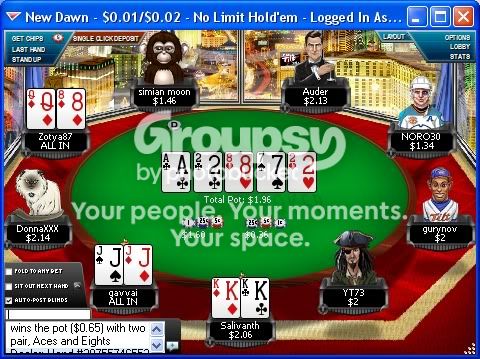
Well, I think I would reraise you here with a big overpair or a set. So I'd assume his range was 88, and either JJ+, or QQ+. Going with the more conservative estimate, we'll say QQ+. (I wouldn't call an UTG raise with 22 or 44)
That gives you a 39.83% equity to win the hand, according to the Equilator. Assuming you each had a stack of 1500, you already invested 500 into the hand. Raising to 200, plus a c-bet of 300. He reraised to 700, and you shoved. So you had 1,000 chips left to shove with. Let's assume that he's never folding here. Would I go all-in with QQ here? At the microstakes, probably. So you have 0% fold equity.
Risking 1,000 chips to gain 3,000 is 33.3%. That means that it's still a plus cEV play, even if you lose your stack most of the time. So now the question is, how much is a stack of 3,000 worth, compared to a stack of 1,500? Now here's the kicker.
According to this thread on 2+2, until you get near the final table, cEV and $EV are practically identical.
http://forumserver.twoplustwo.com/23/small-stakes-mtt/mtt-icm-chipev-vs-ev-186976/
Now as for my own hand, I couldn't calculate it precisely. So I decided to give it a dry board, because I remember it was try, and give both my opponents sets, just to really hammer the point home. I also gave one of my opponents a spade.
So, here's the scenario I set up:
Hero: A :spade:5 
Villain 1: 9 :diamond:9 
Villain 2: 4 :spade:4
Flop: 9 :spade:4 :heart:2
My equity in this hand was 35.99%. As we've established, risking 1270 chips to win 4100 is a 31% chance. So, even assuming I have a couple of percentage points of margin for error, you made the right play, and so did I.
Of course, this is discounting any skill advantages we may have had, but that's so subjective I chose to ignore that.
Now, naturally, if my ranges are inaccurate, so are my calculations. But I think they're correct: If only a big overpair or set pushes in, you still win out in cEV. Add that to the fact that if you play the micros as well, people might push with hands like A8, I think we have a healthy margin for error in the calculations.
What do you think? (Naturally I wish I could have frozen time and calculated all this when I made the play, but don't we all?)
 I'm heading off for the night now: Grindin' time tomorrow, I hope.
 Play 225 45-mans.