Skip to forum
Notifications
Clear all

Donking draws?

8 Posts
5 Users
3 Reactions
1,313 Views
Khiiniau
Joined: 21.08.2008

What you think about donking draws?

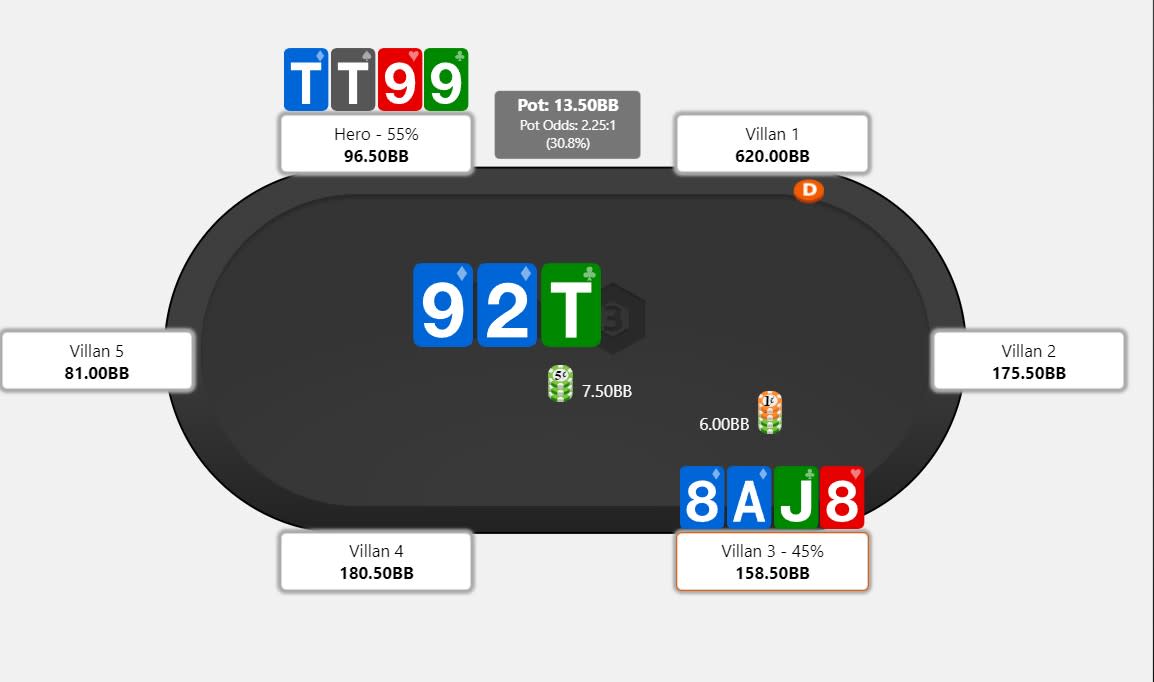
This happens very often in micros, villain OOP donks. Very often they are fishy small stack FD players with some non-nut FD, top pair or 2 pairs. I didn't have any markings for this player but his VPIP 25 in GG generic HUD and over 150bb stack are not fishy. I had top set and unfortunately I hitted also medium set that takes 2 fullhand outs from me.


Reply
Quote
7 replies
Super Moderator
VorpalF2F
Joined: 02.09.2010

Originally posted by Khiiniau
What you think about donking draws?

This happens very often in micros, villain OOP donks. Very often they are fishy small stack FD players with some non-nut FD, top pair or 2 pairs. I didn't have any markings for this player but his VPIP 25 in GG generic HUD and over 150bb stack are not fishy. I had top set and unfortunately I hitted also medium set that takes 2 fullhand outs from me.

I'm not an Omaha hi-only player. I play PLO8 only.
Let's assume that you accurately assumed that opponent has a nut flush draw and a open-ender.
At best you're a flip

Board: 9♦2♦T♣
      Equity  Scoops  Wins Hi  Ties Hi  Wins Lo  Ties Lo
CO    51.48%  48.19%   54.77%    0.00%    0.00%    0.00% { TdTs9h9c }
BB    48.52%  45.23%   45.23%    0.00%   19.49%    0.00% { 8dAdJc8h }

It gets even worse if opponent has an overpair as well.
I'm curious to see what the experts think


Reply
Quote
Coach
Kyyberi
Joined: 09.07.2010

If you want to keep it simple, you raise it when you have the nuts. At least at PLO5 and PLO2 I wouldn't worry about complicated strategies, you make profit with very straight forward style unless opponent is well known.

Once we start to get more thinking players to the pool, we should think more balanced approach. No matter how we play this (raise or call), we need to dodge the turn. There are few questions we need to ask ourselves:
- Does the opponent exploit you in future, if you never call with a set (=do we NEED to have sets in our call range)
- Is opponent's donking range heavily weighted to draws or made hands?
- What is the best way to get value, if he has a draw?
- What is the best way to get value, if he has a middle/bottom set (now he can't have middle, ofc)

To the first one, I would say even if you have 0 sets in your call range versus unknowns, it won't hurt you at lower stakes. Versus most known players, it still doesn't hurt us even if we always raise top sets (or any set).
Second is often not known, but in my experience from somewhat solid/passive players it's often weighted to either. Once you figure that out, you will print money.
Third and fourth are the reasons why at lower stakes I favor a raise with top set a lot. If we compare two lines, call flop and raise turn or raise flop, the thing is that on blank turns we get the same amount of money in. But if he has a draw and he checks blank turn, we get less money in. Also, if he has a lower set and turn completes a draw, it goes check-check and we miss value. The upside is that if we call flop, turn completes a draw and he pots (or bets big), we can fold and save money. Also at lowest stakes people make constantly mistakes (also at a bit higher too) by calling with draws that doesn't have the equity to call. I see in every session this same spot, and opponent has naded oesd or fd, or even gut shot and they call a pot sized raise. That is a big mistake, and to make money you have to give them chances to make that mistake. Therefore I have found out that versus pool that calls way too much and usually bluffs way too little, playing strong hands hard is the way to go.

From our perspective, having a default donk range makes flop strategy VERY complicated. If we have donk as a default strategy, it should have some balance in it. Of course, if pool is calling too much, our donk range should be weighted to value range. And all of those hands we donk are away from our calling or raising range. So having a donk ranges screwes our call and raise ranges. And to have enough balance in 2 more or less polarized ranges (donk and raise, which should be polarized to values and bluffs) is quite hard in reality. Quite often we don't have a clear idea of the ranges and we make the decision based on how we feel. That is not good default strategy. My advice is always to start with 0 donk strategy, and make sure our raise range is good and working. Once we have info on opponent, we can start to donk once we have a good reason (opponent cbets very litte or folds too much to donks). This is for HU pots. In MW pots we should donk more to build up the pot, and that would be pretty much always for value as default.

On solver, removing donk range doesn't really affect EV.

At lower stakes, in my opinion there are two things that favor 0 donk range in HU pots:
- Opponents are a bit sticky at flop, so donking as semibluff rarely has enough FE
- Opponents are cbetting way too much, meaning that check-raise gains more value.

In the posted hand, if we could as the opponent is that bet a bluff or raise (does he want you to call or fold), I am quite sure that he couldn't answer. There is no strategy thinking behind it. He has connected with the board, he bets. So simple. :)


Reply
Quote
Mascherano95
Joined: 09.10.2010

Donks in PLO are not necessarily a fishy play. You have to have a donking range in many situations which is hard to evaluate and to define though.

Depending on how loose villain is calling preflop, he should donk around 10-40% it highly depends on preflop ranges in play, with a loose BBvsBU range he should donk less (10-15%) with a stronger calling range from SB he can increase the donking frequency. No matter what is true here, we should always raise it up with our specific hand to protect against draws and to generate more value. We will have position on coming streets and we are at the top of our range which outweigh the factor of blocking villains stack-off range ( :Tx: :9x:, :9x: :9x: ).


Reply
Quote
ghaleon
Joined: 17.10.2007

I don't lead much at all in HU pots unless flop is good for my range or/and I know villain is not over cbetting. In multiway pots it's much more interesting option as other won't do betting for you as often (depending also how many are behind) and even if they do bet their range tens to be very value heavy. Which mean threshold for x-r increase.

Multiway though we can also bet more with bigger emphasis on equity denial when using smaller sizing.

With our hand in this example I would not mind either call or raise versus lead. It's basically worst possible top set combo to have and villain continue range will be pushed toward draws that do pretty strong. That if villain doesn't do big mistakes. But Kyyberi mentioned lot of points on this.

But in general when talking of leading/donking hand you should think it from few views:
- If checking can I continue versus bet?
- if leading what is plan versus raise?
- what turns can I continue after leading and getting called?

Basic idea being if hand is not strong enough to x-c versus bet but it has properties beneficial with the board (blockers, nutty equity) it's sort of shame to be just x-f always. So to prevent this we can take aggression on our side and create some fe. Aggression can come in form of leading or x-r. Latter being more costly option.

But as mentioned earlier when we take lead or x-r line our range should be fairly polarized. Basically meaning we have clear decision versus raise. That in HU pot. In multiway it's bit different as there is often different type of opponents and stack depths in play. So versus some we might be happy to get it in and fold versus someone else.


Reply
Quote
Khiiniau
Joined: 21.08.2008

Very good points to think. In micros (at least in Fast versions what I play mostly) practically nobody call or fold top set on any non-flush flop where may only call flop. So I raised and villain shove. Turn 7♣: and I had only 20%.

Let's assume that I only call and turn is blank like 4♠: . Does villains multidraw have enough equity (40%) to continue betting or call my raise? I don't have any calculators for that. Is any free and simple available?


Reply
Quote
Coach
Kyyberi
Joined: 09.07.2010

Chance to hit your outs on next street is outs x2 and then +2 if over 10 outs, use +3). I call it 2+2 formula.

On a blank turn he has 6 for straight and 8 for flush, which is 14 outs. Chance to hit them with formula is 31%. Real odds are 33-35% depending on known cards. So he has odds to call. The thing is in reality that he doesn't know your hand and you don't know his. You play ranges. But 14 nut outs is a hand that you never fold.


Reply
Quote
Mascherano95
Joined: 09.10.2010

But 14 nut outs is a hand that you never fold.

+1

So I raised and villain shove. Turn 7♣: and I had only 20%.

If you got it in on the flop, turn equity does not matter anymore. If you call the flop with nuts which can occasionally make sense (not here in this spot though) with the requirement of having a defending range and more or less sufficient odds you basically always call the turn to redraw for a fullhouse and you always bet/shove the turn on blank turn cards for the same reasons we do otf.

In PLO you are choosing side-card components very selectively but you do not play your ranges disjunctive at all in terms of overall continuation frequencies. You cannot be picky chasing your favourable runout because equities often run close. It is like in the big banks' businesses, where you close a huge amount of deals that are in a gray area legally spoken but alltogether generate profits that easily cover the incidents jumping over the cliffs, meaning those which end up in a statutory penalty payment.

For a check-back ott we chose more mediocre strength hands suitable for the various potential river runouts in order to protect our check-back range. Those are hand that prefer to play 2 streets game but with the nuts we usually constantly press the accelerator pedal ip. Because our strategy IP is to polarize our betting-range by sizing it up big and mixing in an appropriate amount of pure bluffs (favourably with nutblockers and reverse draw blockers). This makes it hard for villain to call down or pursue a solid defensive strategy: Villain will face multiple barrels or getting his whole stack threatened holding a capped medium strength hand range.

Villains donk-bet is actually pretty good play with the particular hand. From a GTO-pov his overall leading range is just slightly over 10% but the specific Nutflushdraw+oesd+straighdraw-blocker prefers to lead-bet (Nutflushdraw+oesd or nutflush-draw blocker with specific side-values donk-bet with an over 50% frequency) hoping to fold out SDV along the way or gii otf against a raise where he basically has a flip against our top-range due to dominating non-nutted or non-existent flushdraw-components in our range and this way also generates FE. Another option for him is to check-raise leveraging a value-shove on almost any turn-card. Villains bluff-leading range should have primarily the nutflush-blocker (implied FE which allows him to keep bluffing on flush runouts), especially those which block the straightdraws (block our continuing range), have minor additional SV (like the bdfd for improved playability oop) or have vulnerable SDV (protection and blocker-effects) like:

A♦:K♣:J♥:3♣:, A♦:K♣:Q♣:7♥:, A♦:T♥:8♥:8♠: or A♦:Q♠:Q♣:3♠:.

Most players won´t have enough of those bluffs when donk-betting so our raise has improved chances to extract value which increases the EV of that action with our particular top-set hand. Calling the flop would be really bad missing too much value.


Reply
Quote