Skip to forum
MTT Beginner Coachi...
 
Notifications
Clear all

MTT Beginner Coaching: Discussion and feedback thread

334 Posts
83 Users
23 Reactions
161.4 K Views
Asaban
Joined: 22.09.2006

Poker-Course: MTT Beginner Coaching

Time: Each Tuesday from 19.30 to 21.00 CET.
Dates: 13.05.2014 - 10.06.2014
Status: Available for all registered users
Target Group: Tournament novices with basic poker knowledge

Tournament Poker certainly is the most well known variant of texas hold'em poker. Thrilling action and big winnings result in its great popularity. But how can you succeed in tournaments?
In this course you will learn the fundamentals of tournament poker. Soon, you will be able to impress others with your own results.

What can I expect to learn in this course?
• Learn why you should play tournaments at all
• Get valuable tips to start your own career in tournament poker
• Get a fundamental game plan for tournaments
• Learn how to deal with the different phases of a tournament
• Get to know all fundamental concepts for the most important spots you will encounter

Dates and topics

Week 1: 13.05.2014 MTT beginner strategy: First tips to get you started
Link to the article
Lesson Recording
What should you know about tournaments and how can you beat them?
In your very first lesson you will learn the basics about tournament poker and get first hints to get you started.

Week 2: 20.05.2014 The early stage
Link to the article
Lesson Recording
In your second lesson Asaban will show you how to play in the early stages of a tournament. You will learn fundamental strategies for pre- and post flop play with big stacks.

Week 3: 27.05.2014 The mid stage
Link to the article
Lesson Recording
The third lesson takes you into the mid stages of a tournament. You will learn the push or fold play and get to know the concept of steals and re-steals.

Week 4: 03.06.2014 The late stage
Link to the article
Lesson Recording
The late stage of a tournament required a unique play style, different to early or mid game stages. Learn how to adjust to late game and final table play.

Week 5: 10.06.2014 The final quiz
Lesson Recording
Test your knowledge and master the mtt beginner course.


Reply
Quote
333 replies
Asaban
Joined: 22.09.2006

MTT beginner course: First tips to get you started

In this lesson you will learn what to expect from poker tournaments and what you could possibly win playing them. In addition we will show you your first tournament strategy and how to test it out without taking risks.

In tournaments you use your buyin to play against a lot of opponents for a big prize pool.
In tournaments you will get a fixed amount of chips for your buyin.
Contrary to cash games it is not possible to rebuy lost chips in most tournaments. A tournament ends when one player holds all the chips. He is the winner of the tournament. All other places are determined by the time of elimination. Since a lot of people are participating in most tournaments, the winner gets quite a lot of money. Prices are most of the times awarded to the best 10 to 15% of the participating players.

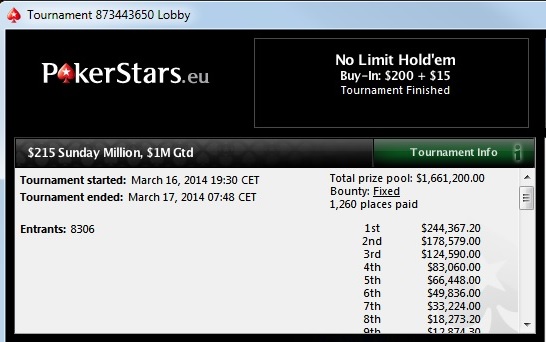
In this example the buyin is $200 (plus a 15$ fee) and 8306 players registered. That sums up to a total prize pool of $1.661.200,00. This prize pool was divided between the best 1260 players with the winner getting $244.367,20, which is 1200 times as much as he payed to participate. In smaller tournaments the winner gets between 50 and 200 times the buyin.

Tournaments are fun and you can count on a weak competition
Tournaments are very popular amongst casual players as well as professionals. You get a great risk-reward ratio, because you can earn price moneys worth multiple buyins. In addition they trigger the sporty ambitions of all participants. How many players can you outrun?! You should also note, that poker's biggest competition, the world series of poker, is played out in this format.
Everybody that has ever played a tournament also knows about the thrill of rising blinds, when each of your decisions suddenly matters.

Start your tournament carrier playing freerolls
Freerolls are free of charge tournaments where you can win real money. For new players they are the perfect opportunity to build up their own bankroll without investing any money. Because they are free of charge, freerolls attract a lot of players that, more often then not, are not very familiar even with the basic rules of poker. Even with a very basic knowledge you can therefore score some decent results quickly.

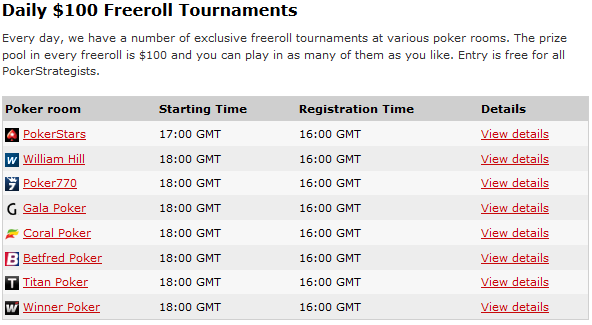
An overview of all freerolls and promotions offered by pokerstrategy.com is to be found here: http://en.pokerstrategy.com/freerolls/

As always, the right strategy is crucial. Even in tournaments.

5 tips for your profitable start into the world of tournaments

1. Play tight-aggressive
Tight means that we won't play everything we get our hands on. There are a lot of hands that look bad and certainly are. At the same time there are various hands that look quite good, but aren't anyways. King Jack for example.
Following the flop you don't have to engage with every pair that you hit. It's always important to know when you are behind or if the price is way to high to pay it with your hand. If you do it will save you a lot of money.

The right selection of starting hands is the most important factor and many of your opponents on lower limits will burn many buyins because they are doing it wrong. Most of them play too many hands or they don't know when to get out of trouble with there mediocre holdings that look rather nice to them.

Aggressive means, that you will always try to get the maximum out of your monster hands. Bet big if you are holding a strong hand and don't try slowplaying.

The open raise size you are starting with depends on the tournament stage you are in. At the beginning, while no antes are in play, you should size your open raise anywhere between 3 and 4BB. As soon as antes kick in you can reduce this amount to 2,5BB at first and only 2BB later on.

2. Call-20-Rule
Pocket Pairs are a possible way to get your hands on big pots without investing much. If there is at least 1 player involved in the hand, a call can prove very profitable.

As a rough guide the amount you have to pay should be 5% of your total stack size at maximum (you should have 20 times as many chips left behind) and your opponent should have the same or an even bigger stack as you.

If you hit your set (three of a kind) on the flop, proceed with an aggressive play. If you don't hit the board on the other hand, you can easily give up on your hand without investing to much into it.

3. Limping is not an option
A common beginners error. You hold a speculative hand like Q :spade:T :club: or 9 :heart:8 :heart: and you would like to take a look at the flop. The cheapest way to get there seems to be the limp (calling the big blind). That's wrong!
Limping might be tempting, but it doesn't make sense in most circumstances. Getting the hand started with an open raise is the way better play. That way you enable yourself to get a hold of the pot preflop without having to play further streets.

4. Set Continuation-Bets
If you open raised preflop and one or two players called you, you should think about setting a continuation bet. The following requirements must be met:
• You face a maximum of two opponents
• You represented a strong hand preflop by raising your hand and you were the last person to do so
• There was no raise by any other player postflop when the action gets to you

If you meet these conditions you should place a continuation bet that amounts to 50% of the current pot size.

5. Push-or-Fold
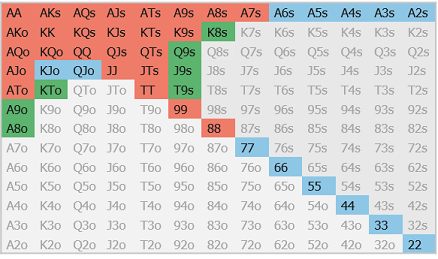
As soon as you have less then 15BB, you enter the push-or-fold phase. In this phase you should do without open raises and decide between pushing your hand all-in and folding it instead. Stick to the following strategy.

Requirement: Your stack is less then 15BB and no other player has entered the hand with a raise in front of you.
Note that limping players won't influence our decision.

The positions:

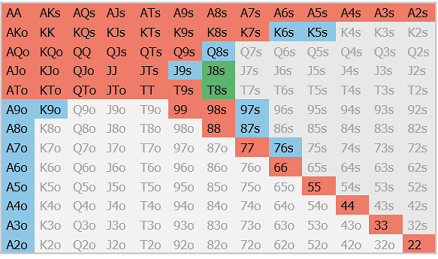
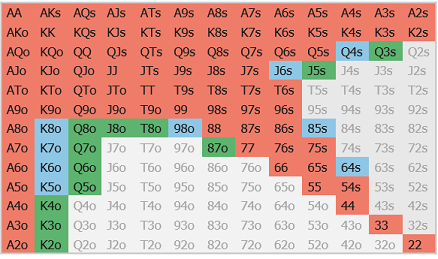
UTG to MP1:

MP2 to CO:

BU to SB:

And that's what the colors mean:
red hands should be pushed as soon as our stack is at 15BB or less
blue hands should be pushed in addition if our stack is 5 to 10BB
green hands should be pushed when our stack is 5BB or smaller

Bankroll-Management.
If you consider playing poker long-term, you should use proper bankroll management. Look at the money you are taking to the tables, as if it were an investment. You only invest if something is promising a good yield and the risk of losses is reasonably low. In the case of poker you achieve this goal by using bankroll management.

It tells you how many buyins to invest in order to find a balance between the desire to...
• ... win as much money as possible if you succeed in a tournament.
• ... overcome losses in times when you are running bad.

You achieve these goals if your bankroll is at least 150 times bigger then your average buyin. Bankroll management gets important as soon as you decide to play tournaments on a regular basis. If you are just looking to try it out there is no need to start with 150 buyins right away. The bigger the limits that you are playing get, the more conservative your bankroll management should be.


Reply
Quote
wlcKeD
Joined: 24.02.2009

Cool ! Def following ! :f_cool:


Reply
Quote
Asaban
Joined: 22.09.2006

Thanks all for attending todays coaching. Posting feedback in this thread is appreciated =)

If you have any questions regarding the coaching feel free to post them in this thread as well.

Regards,
Asaban


Reply
Quote
Shamelesssc
Joined: 07.05.2011

Can recommend to watch this series to any starting player, u will learn something for sure, going to watch all of them :)


Reply
Quote
AdamLaw33
Joined: 05.03.2010

Really looking forward to the 27th. Thanks Asaban, take care,


Reply
Quote
ixpiyacol
Joined: 06.07.2013

Unfortunately, I didn't know about the training until now. Besides, the coaching time is not very convenient, are those coachings going to be recorded for those who are not able to watch them live?


Reply
Quote
TJtheTJ
Joined: 12.10.2011

Originally posted by ixpiyacol
Unfortunately, I didn't know about the training until now. Besides, the coaching time is not very convenient, are those coachings going to be recorded for those who are not able to watch them live?

They should be, yes. Keep an eye out on the video section :)


Reply
Quote
onepark
Joined: 09.07.2009

Originally posted by ixpiyacol
Unfortunately, I didn't know about the training until now. Besides, the coaching time is not very convenient, are those coachings going to be recorded for those who are not able to watch them live?

yeah me too.. it will be awesome if available in Video...


Reply
Quote
TJtheTJ
Joined: 12.10.2011

Videos of practically all our coachings will be available in the video section. It will usually take up to a week for the videos to become visible though so like I said, keep an eye out on the video section because it should be there soon :)


Reply
Quote
Asaban
Joined: 22.09.2006

The video of lesson 1 will be released tomorrow.
I hope to see all of you for our second lesson on tuesday =)

Regards,
Asaban


Reply
Quote
ZeroDegrees
Joined: 03.06.2008

Are the push/fold charts really working? For example, go all-in with K7s from mp2 with 14 BB's.


Reply
Quote
Asaban
Joined: 22.09.2006

The ranges are based on nash ranges. Nash ranges being the mathematical optimum in theory. Due to the ranges in low and micro stakes mtt's we adjusted the nash ranges slightly and therefore we push a bit tighter on average.

The ranges do work unless your opponents are calling REALLY loose. If they do you have to push a bit tighter in order to exploit them. However, big changes to our ranges shouldn't be necessary for the most part. We will have a look at the changes that are required in the late game in our 4th lesson. In addition we will refine the ranges a tiny bit in lesson 3.

Regards,
Asaban


Reply
Quote
Asaban
Joined: 22.09.2006

The recording from last weeks coaching is released. I added the links to the first post in this thread. If you have any questions regarding our first lesson please ask them in this thread. Same goes for feedback.

I hope to see most of you again at tomorrow's coaching =)

Regards,
Asaban


Reply
Quote
marcofurtado
Joined: 25.10.2011

Originally posted by ZeroDegrees
Are the push/fold charts really working? For example, go all-in with K7s from mp2 with 14 BB's.

Wow 14bb push K7s where is that correct ?


Reply
Quote
Asaban
Joined: 22.09.2006

If you want to get the push or fold game into 3 charts you will have to make some decisions. Whenever you look at the edges you will see one of these decisions. K7s is a good push with 13BB from MP1 and for 10 or 11BB from MP2.

It is boarderline for 14BB from MP2 and wouldn't normally be part of that range. However, because you benefit from pushing the hand from most positions included in that chart it is included anyways.

Sure, it's not perfect, but it's working.

Regards,
Asaban


Reply
Quote
SignOff1970
Joined: 24.04.2011

Originally posted by marcofurtado

Originally posted by ZeroDegrees
Are the push/fold charts really working? For example, go all-in with K7s from mp2 with 14 BB's.

Wow 14bb push K7s where is that correct ?

It doesn't mean that it is a "must", like in you see K7s and have 14BB in MP2 you push. It doesn't suit my comfort zone as well, I do it, when I see what the players behind tend to do.

However, just wanted to brag as former graduate of the German version of this course, played yesterday the 1700h 1$ daily GTD donkament, came in 2nd.

Call it upswing, luck, whatever, still leaves the fact that I managed to outrun 2k+ others -after- finishing the course :)


Reply
Quote
Asaban
Joined: 22.09.2006

MTT beginner course: The early stage

Following this, as well as the next two lessons, you will get a complete training that will enable you to beat your first tournaments.

Tournaments can be divided into three parts: early, mid and late stage. The stages are defined by the progression of the tournament. In this lesson you will learn more about the early stage.

In the early stage you are playing big stacks against weak opponents
The early stage includes all hands from the beginning of a tournament until the point when antes kick in. Antes are additional forced bets, which have to be paid by each player before the cards are dealt. That distinguishes them from the blinds, which are paid by different players in turn.

In tournaments you will generally start with 100 Big Blinds or more:
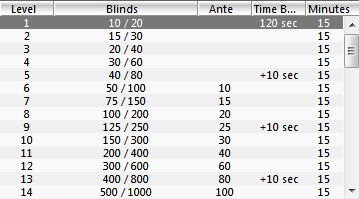
In this tournament you will get 3000 chips to start with, while the blinds start at 10/20. Therefore your starting stack is 150 Big Blinds deep. The early stage ends when level 6 is reached and the blinds hit 50/100. At this point the antes kick in. The average stack at that point is around 35 BB.

Only play selected strong hands before the flop
During the early stages there are a lot of weak players still left in the tournament. These players are usually very curious to have a look at the flop, even with their bad hands. If they hit anything it's rather difficult to get them to fold their hand. You can exploit that behaviour by waiting for strong hands and playing these hands very aggressively. Therefore you will get into a hand by raising it preflop. That way you will end up with the better hand on average in a bigger pot, postflop against a bad player.

The second strategic trick is the so called blind-steal. If you are able to attack the blinds directly, meaning that you are seated on the button or small blind and all other players fold to you, you can open raise very wide. Your goal is to get a hold of the blinds.

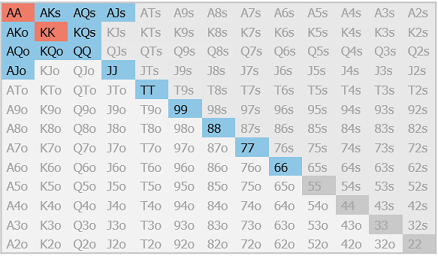
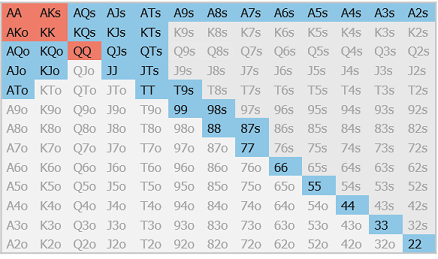
The following charts will show you which hands you can profitably play from which positions:

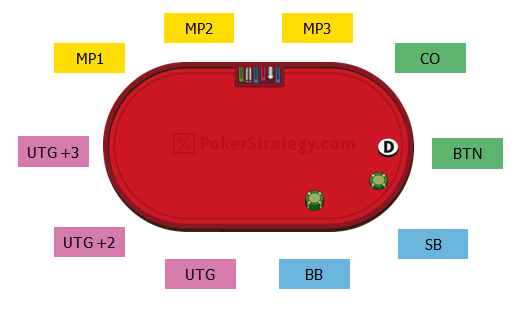
Positions at a poker table:
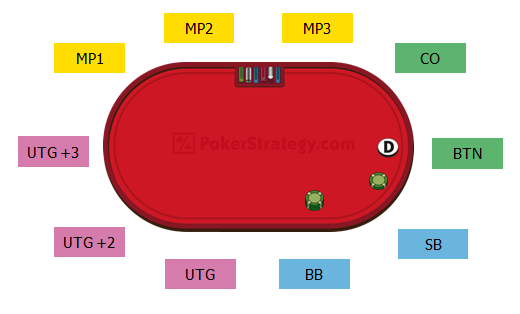
With these hands you can engage from early positions (UTG, UTG+2, UTG+3, MP1):
These hands can be profitably played from MP2, MP3 and CO:
These hands are a good option for attacking the blinds from BU and SB:

You can defend your big blind with the following hands:

During the early stages of a tournament you will open raise for 3 Big Blinds.

If another player already limped (open call) into the hand you will raise to 3BB + 0.5BB for each player that limped.

Blue hands are already better then the hands that your opponents will call preflop on average. You play them,
... if no-one else already entered the hand
Exception: If another player entered the hand with a call, you will only raise hands that are marked for the position UTG (this does not apply for the big blind range).

Red hands are your strongest holdings and you play them,
... if no-one else already entered the hand.
... if other players already entered the hand with a call.
... if there was an open raise already or another player 3-bets against your own open raise. In these situations you re-raise to 2.5 times the amount of the last raise and you go all in to each further action.

Yellow hands are only available if you are the big blind. These hands are strong enough to call them against steal attempts. You play these hands if there was an open raise from BU or SB.

Postflop: Determine your hand strength

Made Hands: Top Pairs,

For example: You are holding A :heart:J :club: on J :diamond:9 :diamond:3 :spade:

Monster: Overpairs and all stronger hands, i.e. two pair, three of a kind or a flush.

Example: You are holding A :heart:K :heart: on 4 :heart:3 :heart:Q :heart:

Strong draws: Flush draws as well as open ended straight draws.

Example: You are holding J :club:9 :club: on 4 :spade:8 :heart:T :diamond:

Worthless hands: All hands that do not fit into one of these categories are worthless for us.

Determine how to play your hand postflop

Case 1: You were the last person to raise preflop.

Made Hands: You are betting on Flop, Turn and River for 50% pot size. If your opponent raises, you fold.

Monster: You are betting on Flop, Turn and River for 50% pot-size. If your opponent raises, you re-raise to 2.5 times the amount he raised. Your goal is to get all in.

Strong draws: You are betting flop and turn as a bluff for 50% pot-size and fold if your opponent raises.

worthless hands: Against a maximum of one opponent you bluff for 50% pot-size. If your opponent does not fold, or you face more then one opponent, you give up on your hand.

Special rule:

Your opponent bets first (donk bet):

If your opponent bets ≤ 2BB you ignore the bet and pretend it didn't happen. If he bets >2BB you only continue playing the hand if you have a monster. If so raise for 2.5 times the size of his raise. If not simply fold.

Case 2: You only called preflop

Made Hands: You check/call the flop for a maximum of 2/3 pot-size. If your opponent checks, you bet the flop for 50% pot-size. The same applies for turn and river play.

Monster: You immediately bet yourself on all streets for 50% pot size. If there is another raise behind you, you re-raise to 2.5 times the amount. Go all in if there is another raise afterwards.

Strong draws: You check/call on flop and turn for a maximum of 50% pot size. If you haven't improved on the river you give up on your hand. Check/fold your hand in that case.

Worthless hands: You check on the flop if possible and fold against any bet.


Reply
Quote
fredovelox
Joined: 05.12.2010

Hello

Once , Again thanks for the quality of the coaching. _biggrin:

I am only surprised of the sizing adjustment vs blind size. In my previous training i learned that we adjust the open sizing to the effective stack so:

3-4 BB when effective stack is >100BB
3 BB For 100 to 70BB
2.5 70 to 50BB
And 2bb for less than 50BB

Because if we are in a deep run with other big stacks , will we have so much fold equity with an open at 2BB?


Reply
Quote
Asaban
Joined: 22.09.2006

Hey fredovelox,

thanks for your feedback =)

You won't see any regular that sizes his open raises according to the effective stacksize. Problem would be that there is always a shortstack at the table. Therefore you would have to use that sizing anyways.

Most regulars will play the very same sizing that I suggested. Even in high buyin tournaments.

Regards,
Asaban


Reply
Quote