


Making game theory easy to understand with Andrew Brokos
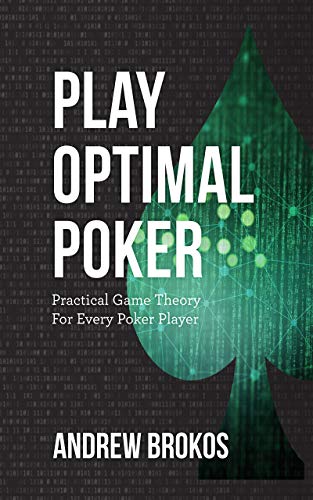
We chat to the podcast host and poker coach about his new book Play Optimal Poker, which is helping players understand game theory.

In your new book you make reference to the Clairvoyance Game (or the AKQ Game). It's a useful game because it helps understand the 'why' behind a bet.
Andrew Brokos: It’s what in poker we would call building a polarised range. In a game where you are allowed to bet you’d rather have very strong or very weak hands because those are the hands that benefit from betting. The very strong hands benefit from calls and the very weak hands benefit from folds. The hands in the middle don’t benefit from betting, they can’t make better hands fold because they are very strong, and they can’t make worse hands calls because they are very weak.
You start your examples of Condensed vs Polarised Ranges with hand examples on the river, which I think is the best street to learn about betting because you usually have a sense of whether you are betting for value or as a bluff.
Andrew Brokos: In the book I use a lot of hand examples on the river because they remove complicating factors like equity and draws. Before the river, hands that start strong can become weak and vice versa, and that complicates betting decisions. Once you get to the river your hands are typically either strong, weak or medium strength, so it’s useful to learn concepts in those river situations and extrapolate backwards to more complicated streets afterwards.
"Use game theory as a default"
Is one of the biggest problems for struggling amateurs simply not knowing why they are betting?
Andrew Brokos: It’s something that comes up a lot in my coaching. I’ve been coaching for over ten years, so I have a good sense for what the common road bumps are that people run into and one of them big one is not thinking about why they are betting. You’ll hear things that don’t make sense like “I’m betting to take it down” and I don’t think that really means anything, mathematically it’s not a good reason to bet. You should have in mind, especially on the river, “this is a value bet/this is a bluff” and furthermore if it’s a value bet you should be able to articulate the hands that your opponent could have that would call you. If you are bluffing you shouldn’t have in mind “my hand is bad so I want them to fold” you should have in mind the hands in their range you believe will fold. Once you have those targets in mind it’s easier to know when to bluff. If you can’t articulate whether your hand is a bluff or a value bet you probably shouldn’t bet. There are exceptions, but thinking in these terms will help prevent common errors.
I think a lot of people find game theory intimidating, especially solvers like PIOSolver. I think the book does a great job of demystifying game theory, in particular your use of real life examples, such as using game theory to decide on which movie to watch.
Andrew Brokos: I’m glad you said that because it’s the reason I wrote the book. I ran it past a number of players of different ability levels to make sure it was digestible and not too complicated.
PIO is intimidating, this book is not a ‘how to use PIOSolver’ guide. It will help readers better understand solvers but PIO is not the be all and end all of game theory. My focus is on the lower hanging fruit, like what the reasons are for betting, which hands are best for bluffing, etc. There’s a lot you can learn about game theory, and a lot you can do with game theory, without ever touching Pio.
I’ve found a lot of people use solvers to end arguments, basically suggesting that if PIO says it’s right, it’s right. Again this is the sort of thing that probably makes it intimidating to new players.
Andrew Brokos: This is a common misunderstanding about game theory, it’s not a case of looking in the back of a math textbook to get the right answer. A solver will tell you what is optimal if you are not comfortable making assumptions about what your opponent is doing. The way I encourage people to think about game theory is it’s like a default, a starting point without any assumptions. Then there’s the exploitative piece, where you think about your opponent is likely to deviate from the equilibrium and how best to take advantage of that. Game theory can help you do that better as well, and that’s a big part of what the book is about.
"You will never figure out poker by solving one-off situations"

There are a lot of ‘real life’ examples of game theory in the book, do you ever apply game theory to your own everyday decisions?
Andrew Brokos: One big thing I have taken away from poker is often when decisions are really difficult to make, the reason they are difficult to make is because the expected value between them is very similar. People agonise over these close spots, but from a poker study perspective they are not worth your time precisely because they are so close. With a close decision, it doesn’t matter terribly much what you do. It’s much more important to make sure that you’re getting decisions right when there is a clear best choice.
I do find that useful when you have a big decision you are agonising in real life. Poker really helps you accept and embrace uncertainty, that you won’t always know what the right decision is. If you are struggling between two options, there might not be a clear answer, and it can be frustrating, but picking one is better than agonising over a choice where you’re simply never going to have all the information you wish you had.
Is the hardest thing about a book about game theory convincing the people who don’t really know it exists that they need to learn it?
Andrew Brokos: This is something I changed my mind on in the revision process. Some of my early draft readers had the same feedback, which was the original introduction to my book assumed a hostile audience where I had to convince people they needed game theory. I have a background in competitive debate so I have this ‘refuting’ mindset. I even considered making the subtitle of the book ‘Game Theory for people who don’t think they need Game Theory’. I realised if people are reading the introduction, they must be at least receptive to the idea, so I opted to make a more positive argument for it. I think there’s a big chunk of people out there who are aware game theory exists, and who suspect that it’s the “secret sauce” that separates that gives the best players their advantage. There is so much poker content out there now, everyone has information overload. You will never figure out poker by solving one-off situations. Learning through experience will help you in so-called “standard” spots, but you’re going to struggle when opponents put you in uncomfortable situations, maybe by over betting or betting a quarter of the pot. You have to be able to figure out a viable strategy, on the fly, for any situation you end up in, and for that it’s just essential that you understand the mathematics and theory that are the foundations of the game.
You can follow Andrew Brokos on Twitter and check out his new book.
