


How much sleep do you need?
How many hours do you need to sleep for optimal recovery? Let's find out!
Judging by the comments for my previous column about proper breaks during poker sessions, the topic of sleep presents a great deal of interest for many of our readers. When to go to sleep? How long to sleep? Such questions are very important to poker players because we have a unique opportunity to choose our sleep schedule.
As you understand, this topic is very complex and also not fully explored. The phenomenon of sleep still has many cloudy areas. That's why, considering poker specifics, in this article I'll try to answer three questions which are of the most importance to poker players:
- What is sleep and how many hours per day should we be sleeping?
- Is nightlife harmful? If yes, what's the damage?
- Why is sleep stability so important? In other words, how harmful is it to constantly be shifting our sleeping hours?

Sleep is one of many aspects of a productive life. We should sleep long enough but not too much, in order to recover our bodies physically and psychologically. By its very nature, sleep is like fitness. If you've slept too little, then you'll feel tired for the rest of the day. If you keep overloading yourself with physical activities and won't let your body recover, your stats will get worse. If you've slept too much, you'll be lazy for the whole day. If you've rested too long after exercise, your muscles will stop working optimally.
I'd like to point out that I won't be discussing concepts like polyphase sleep here. Firstly, that deserves a dedicated article of its own, and secondly, adapting to this kind of sleep takes some very serious rebuilding of your whole system. It's not like you can just throw away the old schedule you've got used to since childhood. Besides, such concepts don't fit everybody. For instance, if you study at a university or have a full-time job, getting used to a polyphase schedule isn't possible. However, for some people it can be a nice strategy. If you want to sleep less and keep showing great results, try and learn these techniques instead!
Phases and sleep architecture
If only we could fall asleep instantly and wake up at a convenient moment thus gaining the necessary amount of hours needed during the day.
Unfortunately this is not possible and, furthermore, there are different kinds of sleep. The process of sleep consists of a series of repeated stages, each of which is unique and has its own importance. The two main types of sleep are:
- Non-rapid eye movement (NREM) sleep which consists of 3 phases, the along you advance, the deeper you sleep.
- Rapid eye movement (REM) sleep where we mostly see dreams, causing our eyes to move rapidly, hence the stage's name.
| NREM sleep |
|---|
| Phase #1 (falling asleep). The phase lasts about 5 minutes. Our eyes slowly close, muscle activity subsides and it's easy to wake us up. |
| Phase #2 (shallow sleep). The first phase of real sleep which lasts from 10 to 25 minutes. Our eyes stop moving, our heart rate drops as does body temperature. |
| Phase #3 (deep sleep). It's hard to wake us up and, after that, for a few minutes, we act slow and can't understand where we are. In this deepest phase of sleep our brains are at their least active. Muscular blood flow increases thus restoring physical energy. |
| REM sleep |
|---|
| REM sleep (dreaming). After 70-90 minutes since we fall asleep, we enter the fast phase of sleep during which we see dreams. Our eyes move rapidly, breathing gets faster, heart rate and blood pressure rise. During this phase, arm and leg muscles are paralysed. |
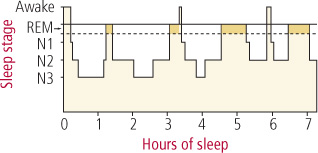
Most likely, you think that immediately after falling asleep, you fall into the deep stage and stay there most of the time, while the lighter sleep comes when you are closer to awakening. In reality, the sleep cycle is much more complex.
Our sleep follows a predictable pattern in which deep recovering sleep and shallow and REM stages interchange constantly. Together they create a full cycle of sleep, each of which lasts around 90 minutes. In order to completely recover, a human body must go through 4-6 such cycles per day.
Soon after falling asleep we are mostly in the deep stage. Then REM stages get longer, then they get swapped by shallow sleep. That's why it is easier to wake us up in the middle of the night and closer to the morning, compared to right after falling asleep.
How many hours should we sleep?

Are you sure 6 hours of sleep is enough for you? Think again. Scientists from the University of California discovered a gene that allows people to function normally while having 6 hours of sleep per day. This gene, however, is very rare, and only 3% of all people have it. The rest (97%) have to sleep longer.
A standard recommendation from most scientists is 7.5 to 9 hours of sleep per day. This schedule may not be for everyone but most of us can adapt to it pretty easily. As a rule it allows us to recover more effectively than 6 or 10 hour sleep.
Try to sleep for 7.5 hours every night for two weeks and see if your productivity in one day improves. This is very easy to track using a diary or just writing down your feelings and listing the things you've been doing throughout the day.
Many people think that they can function normally while having 6 hours of sleep per day because they've been living like that for a few years and got used to that schedule. However, research shows that if these people start sleeping 7.5 per day, then they can achieve more in the remaining 16.5 hours compared to 18 hours they had before. Besides, many people waste these 1.5 hours watching TV or surfing the internet which doesn't really suggest an increase in productivity. Once again, it's not for everyone, but give it a try because there's a chance you've been losing an additional source of energy.
What is most important?

The less you sleep, the more hungry you get. Our hunger and sense of fulness are regulated by the hormones, grehlin and leptin respectively. When we experience lack of sleep, our grehlin level rises, while leptin's lowers. That's why we often overeat, confusing it with "healthy appetite".
The problem is you may not even suspect that you sleep too little. Many symptoms of sleep deprivation are hidden from our consciousness. Moreover, if you got used to lack of sleep, you may not even remember what it's like to be well rested and energetic. Here are the main symptoms telling that you need to sleep more:
- you need an alarm clock to wake up on time
- you can't get up with the first ring of your alarm clock
- you feel tired in the middle of the day
- you get sleepy while in boring meetings and lectures or in warm rooms
- you want to lie down after you've eaten and you start to fall asleep while driving
- you can't live without a short midday shut-eye
- you fall asleep in the evening in front of TV
- you feel that you need to cover the sleep debt at the weekend
- you fall asleep within 5 minutes after going to bed
But how can we get enough hours of sleep if there are too many things to do? It's easy. Make your sleep a priority. Try and sleep for 7.5 per day for a week and see the results. You'll be surprised with how much more you'll be able to do if you invest these 1.5 hours into additional recovery.
But why precisely 7.5 hours and not 8? If you want to make the moment the alarm clock goes offf less painful, try not to be in a deep sleep at the time. For this, the total amount of sleep should be divided by 90 minutes which is the duration of a whole cycle. After sleeping for 7.5 hours you're likely to rest better than after an 8 hour sleep. That's because you'll be waking up in the end of a cycle, when both your body and your brain are ready to wake up.
If you want to fully optimise your sleep, try other possible modes, keep a diary for each of them and find your strategy. Some modes require prolonged adaptation periods, so be aware of this.
In the next article, we'll compare day and night sleep and will find out why occasional sleep without a schedule is harmful.
Other articles by Grigoriy "ahlinpoker" Skrypnik
- Take the best breaks you can
- Rest better to win big!
- When you knew there were nuts...
- Why our feelings don't agree with the maths?
- How overconfidence could be your downfall
- How your brain betrays you at the poker table
