


Was this a great fold by Daniel Colman?
Italian coach 92Niko reviews one of the biggest pots from a Super High Roller cash game. Was it really a great fold by Colman?
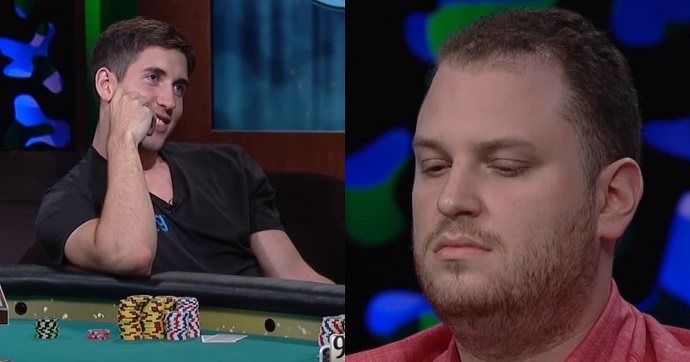
Let’s jump back to 2015 at the Aria Resort & Casino in Las Vegas where one of the most exclusive No Limit Texas Hold’em games is taking place. We are talking about the Super High Roller Cash Game, where the minimum buy in is $250,000 and blinds are $400/$800.
Robl, with massive $1,693,600 stack behind, is dealt 88 and enters the pot with a $2,400 raise in MP. Colman has AA on the cutoff and immediately 3-bets to $8,500. Seiver takes a few seconds to decide what to do with his hand. He holds 99 on the button, calling is a viable option here, but finally he opts for a $24,000 4-bet.
Both Trickett and Newey fold their trash hands from the blinds. The original raiser quickly peeks again at his hole cards and folds his pocket eights. He is not the only one to have an easy decision as Colman 5-bets and makes it $46,000 for the button to see the flop. Seiver calls.
The hand in detail by 92Niko
Let’s try to make sense of this preflop action. First of all, some of it wouldn’t be clear without considering how deep the stacks are at the moment. Colman dictates the effective stacks in play with his $583,200 which is more than 700 bb deep. Now that we know how much money each player is able to put into the pot, a crucial question arises: why is Seiver cold 4-betting with 99? Calling seems to be the easiest option. When he just calls, Robl is probably going to 4-bet with the strongest portion of his range and just call with most of his hands as at the moment he would need to put only $6,100 more into the pot to see a $27,900 flop out of position with two opponents and huge implied odds.
4-betting is much trickier as he needs Colman to be calling out of position often enough to exploit positional advantage. If he’s not willing to play his 99 for showdown value, then many other combinations would work as better bluffs.
Anyway, once Colman 5-bets a call is close, maybe a bit on the loose side, but reasonable. Despite Colman 5-betting 3x the size of the 3-bet he needs to add $46,000 to see a $144,800 flop. This doesn’t give him the correct pot odds for set-mining of course, but he can call if he’s confident that he’s getting extra value when he hits a set or if he thinks he can win the hand otherwise by exploiting what he knows about Colman.
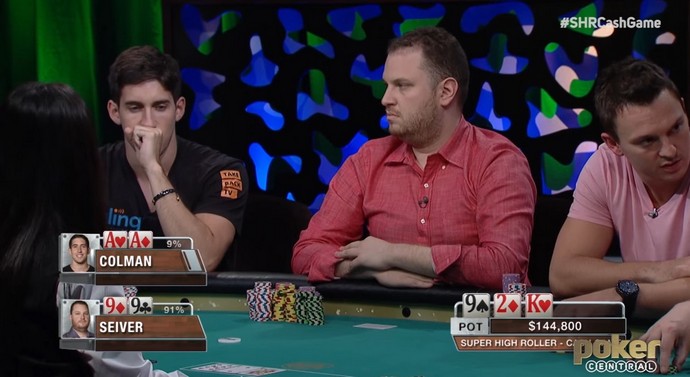
The flop comes K92, Seiver gets his set and Colman fires a small continuation bet, "only" $50,000. The flop is extremely dry and despite being originally 700 bb deep, there’s really no need for big sizes in a 5-bet pot as betting 1/3 on both flop and turn would leave the players with less than a pot-sized bet on the river.
Even without considering Seiver's range, the continuation bet is probably the best and the easiest way for Colman to play his hand. With Aces he thinks he still has the best hand on that kind of flop, and check/calling is possible, but being out of position for the rest of the hand will be really complicated.
Seiver decides to just call the continuation bet. This is reasonable as the flop is really dry and he can expect to get more money on later streets.
The turn is 3, and the pot is now $244,800. Colman goes for a check. Getting more value from his Aces is now a bit more complicated. The board is not that scary so he can afford to let his opponent see a free river. Seiver decides to bet half the pot. Colman calls.
River is 8, the pot is $484,000, and Seiver has only $343,200 left which he shoves all-in as soon as Colman checks again.
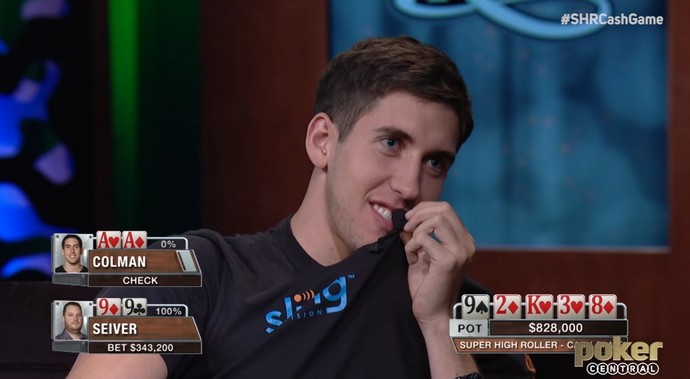
Colman leans back in his chair, biting his T-shirt nervously. He smiles to Seiver and asks whether he holds kings. He takes a look at what is left of his stack then starts staring at Seiver. He might be looking for some tells saying he holds Aces and explaining to Seiver his thinking process. Seiver avoids eye contact.
After a few moments, Colman mucks his Aces and Seiver takes down the pot.
What a fold! Many people would probably think this is a huge laydown, and that they would probably never fold AA in a 5-bet pot, on a dry board, when the opponent (whom they give the option to bluff) goes all-in on the river giving 2.5:1 pot odds.
Is folding the correct option for Colman?
This looks like a tough question, but luckily (something that rarely happens at high stakes tables) Colman gave us some insights about his thinking process with the few words he said after facing the opponent’s push: "Scott, Scott, Scott… Kings right? That’s all you can have. I have Aces… You wouldn’t play AK like that".
Is Colman right? The key to understanding his decision is Seiver's action pattern. He called the flop, then double barreled turn and river. Can he ever hold a bluff when he plays like this? This depends on what his 4-bet/calling range looks like:
- KK (3 combos): it probably wouldn’t make much sense to 6bet KK IP since he can only expect to get action from AA-KK. This is the hand that Colman assigned to Seiver on the river shove;
- AK (max 6 combos): not the kind of hand that many players would like to play in a 5bet pot. 6betting transforms the hand into a bluff. Flatting is reasonable especially if Seiver knows that Colman uses Ax or Kx for 5bet bluffs. Also note that this hand can be in Seiver's range for just calling the original 3-bet.
- QQ-TT (6 combos each): hard to tell. These are the hands that can be 4-betted to isolate HU vs Colman. But again, these are not the hands that play well when 4-betting as effective stacks are really deep and facing a 5bet gets them in trouble.
- AA (1 combo): pretty unlikely, but would be an interesting way to play it in position.
How are all these hands playing on the flop? All of them are probably calling as Seiver actually did, so nothing weird up to this point.
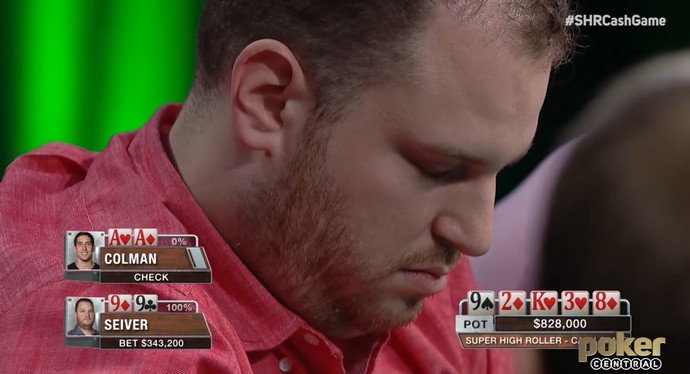
What about the turn? Well, here, once Colman checks, the strongest combos can value bet (KK of course and AA), AK has the option to bet but there's no worse hand calling. Colman's range should be polarized so either he has AA-KK that he c-bets and check-calls or he is probably folding everything else. The best case scenario for a hypothetical Seiver holding AK would be Colman 5bet bluffing with something like KQo or KJo that hold blockers and then c-betting the flop and check/calling the turn. But it is hard to see such hands check/calling the blank once again on the river. QQ-TT are the only hands that can be transformed into bluffs at this point but this wouldn’t make too much sense, and of course considering the board is really dry it is harder to bluff effectively versus a made hand.
Another important point is that Seiver cannot be holding any realistic semi-bluffing hand on the turn as he would need to have called preflop with something like QJs (which given the action is hardly possible).
So the key point here is relatively simple: Seiver can be holding a hand that is worse than AA when he is betting the turn, but he is never betting the next steet too with the same kind of value hand. It is hard to believe that, with AA being a very likely hand in Colman’s range, Seiver would value bet AK on the river after betting the turn.
The hands in Seiver’s flop calling range that lose to Aces won't bet both turn and river as they aren't gonna be payed by a weaker hand. Bluffs are unlikely given both the texture of the board and Seiver’s call on the flop. Colman needs to fold.
What do you think about this hand? Was it a good fold by Colman? Could Seiver have made more money in this hand? Let us know in the comments!
Enjoy 92Niko's streams at his Twitch channel!
