


The most important concept in PKOs
PKOs are far from solved but today Dara O'Kearney shares the most important strategic adjustment you need to make in them.

PKOs have taken online poker by storm since they appeared a few years ago. Probably the main reason people play PKOs is because they are enjoyable. The action is fast, there is more gambling involved, you can win money right away and winning a big bounty is a very satisfying feeling, as is winning several bounties in a single hand.
Recreational players enjoy them, which means they are soft. It gives them a chance to blow off steam and gamble. PKOs give recreational players more winning moments, which creates a paradox for serious players in that their edge is lower but they are ultimately more profitable than normal MTTs because so many casual players are in the field.
Another reason to play PKOs is that a lot of good MTT regulars avoid them because their edge is lower and there is too much gambling. A common mental game leak of otherwise good professional poker players is that they don’t recognise when occasionally losing to a recreational player is good for their profitability in the long term. The amateur player who wins now and then is going to come back for more, the player who gets crushed every time is going to find their entertainment elsewhere on Netflix or Fortnite. So PKOs are not only full of amateurs, the solid regulars are also much smaller in numbers too.
Maybe the biggest long term reason to play PKOs is because online poker operators like them, so they are going to figure more and more in their MTT schedules. The reason operators like them is because the prize pool gets spread around much more widely, so more players can play on their site for longer. In a PKO a much bigger percentage of the field get a prize which they can continue to play on the site with, which means more potential rake to be generated for the operator. PKOs really help an operator’s ecosystem, they are not going anywhere.
So what is the key fundamental concept in PKO? It's one of those things that is blindingly obvious after you're told it, but many players don't realise just how important it is. Without further ado, that concept is simply....
Play looser when you can win a bounty
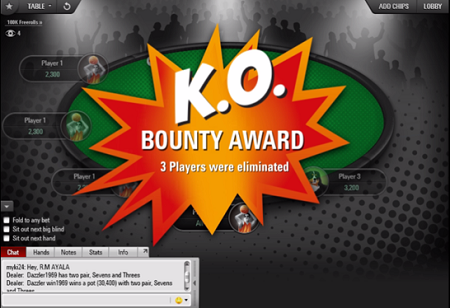
What makes PKOs radically different to normal MTTs is the presence of bounties. Winning a bounty not only is an immediate cash prize it does the double whammy and gives you a bigger stack to serve you well as you try to win a payout (and more bounties). The upside of getting all your money in the middle of the table when you can win a bounty is far greater than it is in a normal tournament where you just win chips.
For this reason the equity you need to call a shove when you can win a bounty is lower than it would be in a regular ChipEV spot and much lower than it would be in an ICM influenced spot. In a scenario where you would need 50% equity to call in a cash game you might need 60% equity to call in a tournament near the payouts, but in PKOs you might only need 35% equity. PKOs are a unique beast in that you often have to make a call that you know will lose you chips in the long term because the times you win the bounty more than make up for it.
Play more pots against people you cover. Focus on keeping them in the pot. If they fold at any point in the hand, you can’t win their bounty, so adjust your betting lines so they will continue more often than in a normal tournament. But what about when you are covered by your opponent(s) in a hand?
Play (close to) normal when you are covered

When you are the player who risks elimination in a hand and thus cannot win a bounty, that changes things considerably. There is no additional prize to win, you can only win chips, so as such you should not be taking big risks all-in. This does not mean you should be playing overly tight either because those chips are still worth winning as they are in a regular tournament.
If in doubt, just play the hand like it is a regular tournament without bounties. Ideally what you should actually be doing is playing as if it were a regular tournament, adjusting for your opponents being quite loose aggressive. Although you cannot win a bounty, there is one on your head to be won, so while you may be playing a regular MTT strategy, your opponents will be trying to get all your chips in the middle of the table. Treat it like you are playing a regular MTT against a table of maniacs where you expect to be called and reraised much more often. This does mean you can widen the range of hands you are prepared to value bet and bluff catch with, just not to the extent you would when you have a chance of winning a bounty.
You can get advice like this every month in Dara's free strategy newsletter (with a current focus on PKOs) which you can join right here.
