


How to think in terms of your range
Dara O'Kearney shares how to stop thinking about your hand and start thinking about all the hands you could have.
A lot of players struggle to think in terms of ranges rather than their specific hand. It is difficult because we have all been brought up with the trope that professional poker players can put people on exact hands like they have a sixth sense.
As poker advanced, the literature and general zeitgeist went more towards thinking in ranges, but typically only our opponent’s range, not our own. We know that putting our opponent on a range of hands is much more useful and easier for us to produce a reliable strategy against them, but what about how we play our own range? It is a big ask to think of your range of hands and play them accordingly when your actual hand has just completely missed the flop.
My students struggle with this aspect of poker, so I try and explain my own thought process on the flop to steer them in this direction. It has three stages.
1. Evaluate the flop
I ask myself if this flop is good, bad or average for my range, not my hand? So for example if a tight player opens under-the-gun, I defend the Big Blind and the flop is AK9. Before we even think of my hand, this is a bad flop for my range. I would likely have raised with the really strong hands (AA, KK, AK) that like this flop so the only great hand I can have here is 99.
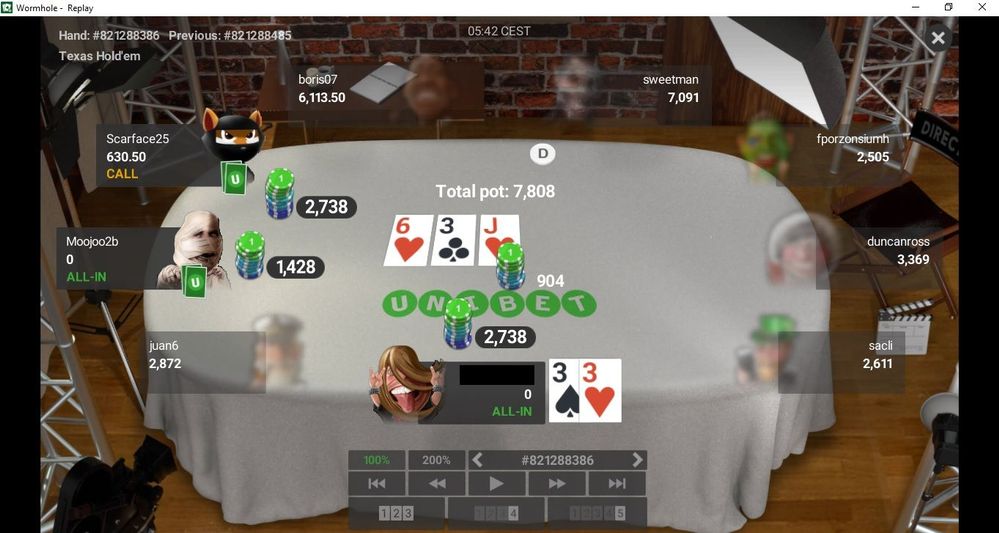
However, if the flop comes 876 then that is great for my range. I can have 88, 77, 66, 89, 87, 76, 65. Villain for the most part misses this flop or at best has an overpair.
Typically a good flop for our range will be a bad flop for our opponent’s range, and vice versa. Again, we still haven’t considered our actual hand yet.
2. Determine overall flop strategy
Whether the flop is good or bad for our range should inform our basic strategy. Would our range donk bet, check call, check raise, check fold, and so on. Which strategies would work, and which would not?
For example, if it is a bad flop for our range we should not donk bet. In that AK9 example, if we donk bet we will get called or raised a lot of the time and most of the time we won’t be able to continue. We shouldn’t even donk bet when with have the 99 because the flop is good for our opponent, so they would bet a lot of the time when we check and it would be obvious what we have if we donked.
When the flop is good for us, we can donk bet, because we can get calls when they would have otherwise checked as well as get bluffs through when we don’t have anything. Go through this thought process for every line you could take.
3. Construct ranges
This is where we look at our overall range and decide what to do with each of our specific hands based on the strategies that would work. Which hands would donk bet, which hands would check call, which ones would check raise and which hands would check fold.
So for example in the 876 flop example. If my range was 22-JJ, 34s, 45s, 56s, 67s, 78s, 9Ts, JQs, KQs, Axs and AJo+. I might donk bet with 34s, 45s, 56s, 67s, 22, 33 and 44. I might check raise the sets, 78s and 98s. I might check call the Axs where I have made a pair and my overpairs. Then I might fold everything else.
When deciding what to do with what hand, note that each range has a mix of strong and weak hands (with some equity) in there, other than the check folds which are just the really weak hands. If we only have strong or weak hands in each of the other ranges, we become easy to exploit.
It’s only in this final stage that we make a decision based on our actual hand. It’s very hard to think of all these things at once during a hand, but once you start to do it and in particular do it more in your self study, it becomes routine and gets easier to do in the moment.
Dara O'Kearney's new book Endgame Poker Strategy: The ICM Book is out now.
